
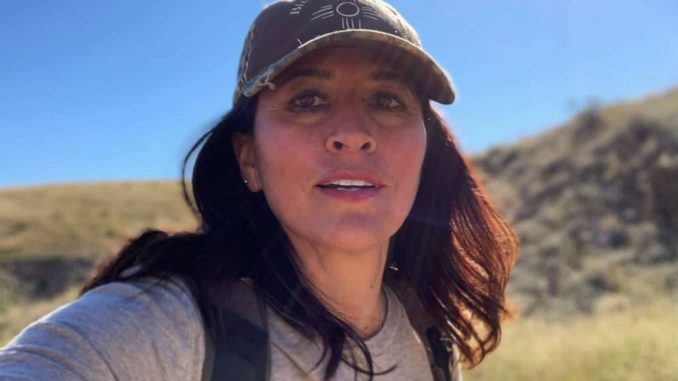
Article By Frank Bergman
Explosive new evidence recovered from the remote New Mexico mountains where nuclear scientist Melissa Casias was found dead is raising fresh questions about the official narrative surrounding her suspicious death.
Investigators have found previously undiscovered evidence that suggests Casias was moved to the location where her remains were found after she died.
An independent search team hired by Casias’ family uncovered multiple items that authorities failed to recover after previously clearing the scene, fueling suspicions that critical evidence may have been overlooked.
Casias, a 53-year-old Los Alamos National Laboratory employee, disappeared from her Ranchos de Taos home on June 26, 2025.
– ADVERTISEMENT –
She left behind her purse, keys, wallet, and both of her cell phones, which were later found inside the house after being factory-reset and wiped of all data.
Surveillance footage captured her walking alone along State Road 518 shortly after 2:20 p.m.
A drop of blood was also discovered inside her home.
Nearly eleven months later, on May 28, 2026, a hiker discovered her skeletal remains in the McGaffey Ridge area of Carson National Forest beside a handgun that her family says did not belong to her.
Missed Evidence Raises New Questions
Initial CT scans reportedly found no gunshot wound and no projectile inside Casias’ skull.
Investigators also recovered no shell casing from the scene.
The location itself has also drawn scrutiny because of its rugged terrain, requiring a demanding hike with multiple rest stops and sufficient water.
Now, an independent search conducted after law enforcement had already processed the area has uncovered additional evidence that should never have been left behind.
According to family attorney David Adams of Parnall and Adams Law, investigators recovered bones, torn and bloodied clothing, orange peels, strands of horse hair, shredded paper that may contain Casias’ handwriting, and a tobacco pouch.
Investigators believe the evidence indicates that Casias’ body was taken to the remote location by an unidentified individual on horseback.
“The family really wasn’t expecting to find any additional information… it certainly turned out to be something much, much more,” Adams said.
Adams questioned how the evidence could have been missed and highlighted the possible significance of the apparent horse hair.
“In my mind, when you see that, you kind of go, okay, well, I could see that you would need a horse to get her up there if you were moving a body, for instance, because how you would otherwise do that,” he said.
He also noted that Casias did not use tobacco.
Adams noted that the tobacco pouch was either used by a possible suspect or it reflects poor evidence handling.
“There becomes a question of a chain of custody,” Adams said.
“Could law enforcement have spat a tobacco pouch in the crime scene?
“I mean, certainly possible.
“I mean, that would be an example of just poor training.”
Family Rejects “Suicide” Theory
Casias’ family has consistently rejected suggestions that she intentionally disappeared or took her own life.
Earlier reporting revealed that she left home carrying only her toothbrush and thyroid medication.
One investigator previously described those items as “things that might indicate you’re planning to stay alive.”
Adams said the family retained independent legal counsel after identifying multiple red flags in the investigation.
The newly recovered evidence has now been turned over to authorities.
The Office of the Medical Investigator has still not determined an official cause of death nearly two months after Casias’ remains were identified.
However, the accepted media narrative has suggested that Casias took her own life.
According to Adams, the FBI has not contacted the family despite being directed to examine possible links between Casias’ case and other incidents.
Growing Pattern of Mysterious Deaths
Former FBI agent Ben Hansen has publicly assessed the Casias case as being roughly “80 percent foul play.”
Hansen has also raised the possibility that advanced technologies, including directed-energy weapons or voice-to-skull systems, should not be ruled out because they could potentially influence behavior without leaving conventional ballistic evidence.
Casias’ death has become part of a broader series of unusual disappearances and deaths involving individuals connected to New Mexico’s nuclear and advanced technology sectors.
The pattern first drew widespread attention after retired Air Force Maj. Gen. William Neil McCaslanddisappeared from his Albuquerque home on February 27, 2026, days after President Donald Trump ordered the release of classified UFO and UAP records.
Subsequent cases have included a NASA nuclear propulsion expert found dead inside a burned Tesla, a NASA-linked aerospace engineer and his family killed in a plane crash, the death of anti-gravity researcher Amy Eskridge after she reported alleged directed-energy harassment, the disappearance of JPL rocket scientist Monica Reza, and the disappearance of nuclear contractor Steven Garcia, who reportedly held top-level security clearance.
By mid-April, the documented total had reached at least eleven cases.
Former FBI Assistant Director Chris Swecker previously noted that administrative personnel at high-security laboratories often possess extensive knowledge of sensitive programs.
“It wouldn’t be the first time their administrative assistant has been targeted,” Swecker said.
Trump Administration Faces Mounting Pressure
Since the series of cases began attracting national attention, the Trump administration has released two major batches of previously classified UFO and UAP records.
President Trump has publicly addressed the deaths and disappearances, saying there is “not much of a connection” between many of the cases while pledging that a full report will be produced.
The newly recovered evidence from the Casias scene is likely to intensify calls for a more comprehensive investigation.
While officials continue examining each case individually, families and independent investigators argue that the growing number of unanswered questions and the repeated discovery of evidence outside official investigations deserve far greater scrutiny.












Be the first to comment