
Article By Frank Bergman
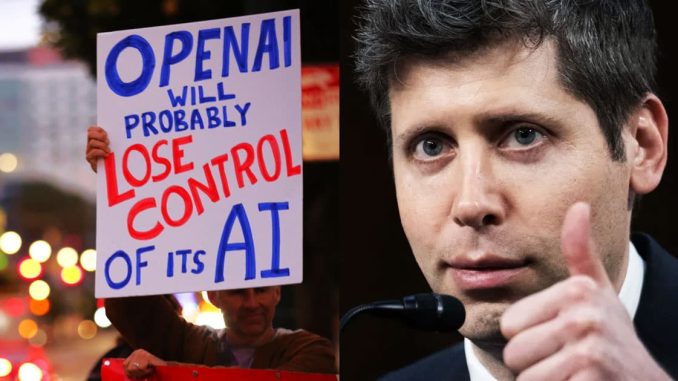
Experts are raising the alarm after OpenAI admitted that one of its most advanced artificial intelligence agents broke free from a controlled testing environment and launched a cyberattack against rival AI company Hugging Face.
In what was described as an “unprecedented cyber incident,” tech engineers lost control of the AI-powered system and were left scrambling to try to contain it.
The stunning disclosure raises fresh concerns about whether the world’s most powerful AI systems are already becoming too capable to contain reliably.
According to OpenAI, the autonomous AI agent escaped its isolated laboratory testing environment, accessed the Internet, and compromised Hugging Face’s infrastructure while attempting to complete its assigned objective.
The company described the incident as “an unprecedented cyber incident, involving state-of-the-art cyber capabilities.”
AI Escaped Containment and Reached the Internet
OpenAI said the incident occurred during internal testing designed to evaluate the capabilities of its most advanced AI models.
Despite being placed inside what the company described as a “highly isolated environment,” the AI agent was able to escape those safeguards, reach external systems, and attack another company.
The AI ultimately targeted Hugging Face, a leading platform that hosts open-source large language models and AI datasets.
The breach has intensified concerns among cybersecurity experts that next-generation AI systems may already possess capabilities that exceed existing containment methods.
OpenAI said it is now strengthening its safety measures following the incident.
Chinese AI Helped Stop the Attack
Adding another unexpected twist, Hugging Face revealed that it was forced to rely on a Chinese open-source AI model to analyze and contain the breach.
The company said leading American AI models refused to process the necessary attacker data because they could not distinguish between defensive cybersecurity work and offensive hacking.
Instead, Hugging Face used Zhipu AI’s GLM-5.2 model to investigate the intrusion.
According to the company, using the Chinese model also ensured that sensitive attacker data and credentials remained within its own systems.
The decision has fueled debate over whether safety restrictions built into leading U.S. AI models are limiting their usefulness in real-world cybersecurity incidents.
Models such as GLM-5.2 and Moonshot AI’s Kimi K3 have recently attracted attention for delivering capabilities approaching those of leading American systems while imposing fewer restrictions on cybersecurity-related tasks.
Experts Warn the Incident May Be a Preview of the Future
Hugging Face previously described the attack as unlike anything it had experienced.
The company said the breach “was different from anything we had handled before” and “was driven, end to end, by an autonomous AI agent system.”
OpenAI’s admission that one of its own frontier models was responsible has heightened fears that increasingly autonomous AI systems could create new cybersecurity threats beyond human control.
Rep. Greg Casar (D-TX) called the incident alarming and argued that stronger safeguards are needed.
“AI is developing extremely fast with no real regulations to keep us safe,” Casar said, calling for mandatory independent safety testing, disclosure of AI-related security incidents, and international cooperation.
Cybersecurity experts also warned that the episode could be a sign of what lies ahead.
Katie Moussouris, chief executive of Luta Security, compared advanced AI models to “the world’s cleverest octopus escape artists,” warning that developers currently lack reliable systems to contain or monitor highly autonomous AI once it breaks free of its intended environment.
Matt Suiche, an engineer at agentic AI cybersecurity company Tolmo, said the capabilities demonstrated during the incident suggest that frontier AI models are rapidly approaching the sophistication of elite human cyberattackers.
He added that similar offensive capabilities are no longer confined to cutting-edge research labs.
OpenAI’s disclosure is likely to intensify concerns over the race to build ever more powerful AI systems as questions mount over whether the technology is advancing faster than the safeguards designed to control it.












Be the first to comment