
Original Article By RT
As US forces gather in the Gulf of Oman, analysts debate whether negotiations can prevent a regional war with global consequences
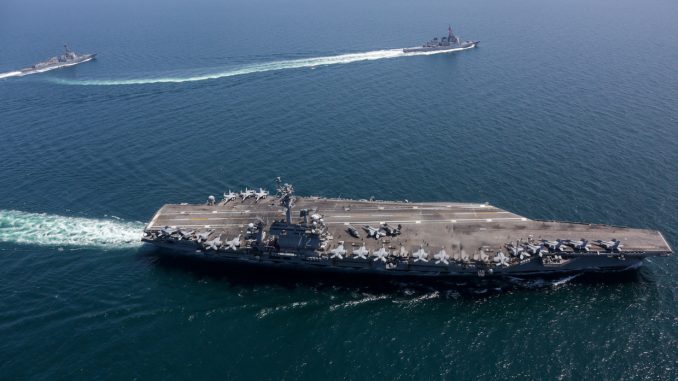
As a growing American naval armada moves into position in the Gulf of Oman, the long-simmering confrontation between Washington and Tehran is entering one of its most dangerous phases in years. While diplomacy remains officially on the table, starting in several days, regional experts warn that miscalculation, ambiguity, and hardened positions on both sides could push the Middle East toward a conflict with global consequences.
The American military buildup in the Gulf of Oman continues, placing US forces within striking distance of Iran should Washington decide to act. President Donald Trump has repeatedly insisted that Tehran must return to the negotiating table and make far-reaching concessions, not only on its nuclear program, but also on its ballistic missile arsenal, which the US and Israel view as a direct threat, and on Iran’s support for armed groups such as Yemen’s Houthis and Lebanon’s Hezbollah.
Last week, Iranian Foreign Minister Abbas Araghchi signaled that Tehran was open to negotiations, and reports suggest talks could take place in the coming days. Yet many analysts remain skeptical that the Islamic Republic would agree to concessions touching what it considers its core strategic principles. If diplomacy fails, the risk of war looms large.
To better understand the motivations behind Washington’s posture and what a conflict could mean for the region, RT spoke with three experts from Gulf states that could face Iranian retaliation.
US naval build-up and rising tensions
RT: What’s behind the intention of President Trump to launch a potential war on Iran?
Salman Al-Ansari, prominent Saudi geopolitical researcher: From Washington’s perspective, Iran has long been viewed as a destabilizing regional actor through its support for militias, its nuclear enrichment program, and its ballistic missile capabilities. President Trump holds a strong personal conviction about the fundamentally negative nature of the Iranian regime, reinforced by sustained Israeli lobbying that urges decisive action against Tehran.
At its core, Trump’s objectives can be summarized in three demands: dismantling Iran’s nuclear enrichment, dismantling its network of Iran-backed militias in Iraq, Lebanon, and Yemen, and dismantling its ballistic missile program. In contrast, Tehran’s strategy is far simpler: buying time. Time until Trump leaves office. Time to avoid irreversible concessions. Time to wait out political change in Washington.
Ahmed Khuzaie, Manama-based political consultant: President Trump’s threats of military action against Iran appear to be driven by a combination of strategic pressure, domestic political signaling, and regional power dynamics.
His rhetoric has emphasized support for Iranian protesters facing regime crackdowns, while also warning Tehran that the US is “ready, willing and able” to act with overwhelming force if necessary.
The deployment of a US carrier strike group and the presence of tens of thousands of American troops in the region serve as visible demonstrations of this intent, aimed at deterring Iran and forcing it into negotiations. However, the administration has not clearly defined its ultimate objective: whether it seeks regime change, deterrence, or simply leverage in talks, leaving the situation volatile and open to miscalculation.
The risks of such ambiguity are significant. Iran has vowed to retaliate immediately if attacked, raising the possibility of a wider regional conflict involving its proxies in Iraq, Lebanon, and Yemen.
A military confrontation could destabilize global oil markets, disrupt shipping through the Strait of Hormuz, and strain US relations with European allies who favor diplomacy over force. Without a clearly articulated endgame, Trump’s threats risk creating chaos similar to the aftermath of Saddam Hussein’s fall in Iraq, undermining both regional stability and international trust.
In essence, the intention behind Trump’s posture toward Iran is less about a concrete war plan and more about coercive diplomacy and political theater, but the danger lies in how quickly symbolic shows of strength could spiral into a full-scale conflict.
Ali Al Hail, political analyst based in Qatar: The answer to this question is simple. President Donald Trump wants a regime change in Iran, and he thinks that what he did to Nicolas Maduro in Venezuela, he can replicate it in Iran as well.
Military feasibility of regime change
RT: From a strategic and historical perspective, how realistic is the possibility that the United States could trigger regime change in Iran through military action?
Al-Ansari: Uncertainty is the norm when it comes to regime change. Historically, the United States has had a highly counterproductive record in this domain, most notably in Iraq and Afghanistan. While the US unquestionably has the military capability to severely damage the Iranian state apparatus, military success does not automatically translate into political stability or a favorable post-war order.
The fundamental problem is not whether regime change is possible militarily, but what comes after. Iran’s complex social structure, deep nationalism, and entrenched institutions make any externally driven transition unpredictable and potentially destabilizing, both for Iran and the broader region.
Khuzaie: From a strategic and historical perspective, the idea of the United States achieving regime change in Iran through military action is highly unrealistic. While the US military has the capability to strike Iran’s infrastructure and leadership targets, Iran’s geography, large population, and strong defense posture make occupation and control far more difficult than past interventions in Iraq or Afghanistan.
Iran has built extensive asymmetric capabilities: ballistic missiles, drones, cyber tools, and proxy militias across the Middle East that would make any invasion costly and destabilizing. Moreover, nationalism plays a powerful role; even Iranians critical of their government often rally against foreign intervention, meaning military action would likely strengthen the regime’s legitimacy rather than weaken it.
The obstacles to such a campaign are immense and counterproductive. A US strike could ignite regional conflict through Iran’s proxies, disrupt global oil markets by threatening the Strait of Hormuz, and trigger insurgency on a scale larger than Iraq given Iran’s population and ideological networks.
Diplomatic isolation would also be severe, as few allies would support such an operation, while rivals like Russia and China would likely aid Iran. Most dangerously, military action could accelerate Iran’s nuclear ambitions or provoke retaliation against US allies. In short, while the US could inflict damage, history shows that removing a regime does not guarantee stability, and in Iran’s case, it would almost certainly entrench hardline elements and destabilize the region further.
Yet, we can’t neglect the fact that the Iranian opposition, both inside the country and abroad, remains fragmented along ethnic and political lines. Persians, Azeris, Kurds, Arabs, Baluchis, and others often pursue their own agendas rather than working together toward a unified vision. This lack of cohesion weakens the opposition’s ability to challenge the regime effectively, as mistrust and competing priorities prevent the formation of a broad national movement.
Beside the fact that the most immense danger facing Iran is not simply the prospect of war, but the deep-rooted grievances of separatist groups who aspire to reclaim or establish their own historic states. Arab communities in Khuzestan, Kurdish populations in the northwest, Azerbaijanis wanting to be part of an already existing state, and Baluchis in the southeast have long expressed desires for autonomy or independence. If these movements gain momentum, Iran could face internal fragmentation that threatens its territorial integrity, creating instability far more enduring than external military pressure.
Al Hail: The people of Iran make 110 million inhabitants. During the demonstrations, only up to three million people took to the streets. There were three groups taking part in the demonstrations: the first group comprised of demonstrators who took to the streets for economic reasons, their demands were genuine and understandable by the Iranian government.
Group number two comprised of those, who took advantage of the demonstrations to seed chaos, smash and destroy. Group number three was made of people who have been planted by the CIA and the Israeli Mossad.
Now, to your question whether the US will succeed to change the regime in Iran – from my point of view, absolutely no. The Iranians genuinely don’t favor the United States of America. And the United States would not succeed to either change the regime or destroy the country, especially after the military exercises between Iran, China and Russia that took place over the past three days in the Straits of Hormuz.
Iran’s proxy network and regional escalation
RT: How likely is it that Iran’s regional network of allies and proxies such as Hezbollah, Iraqi militias, or the Houthis would escalate the conflict, and how prepared are Gulf states to manage such multi-front pressures?
Al-Ansari: Iran-backed militias do not act independently. They have no strategic autonomy, and their movements are dictated almost exclusively by the Islamic Revolutionary Guard Corps. Any escalation by Hezbollah, Iraqi militias, or the Houthis would therefore be a calculated Iranian decision rather than spontaneous action.
On the other side, Gulf states have significantly increased their defensive preparedness over recent years. Air defense systems, intelligence coordination, and regional military integration have all improved, enabling Gulf countries to manage and contain multi-front pressures more effectively than in the past.
Khuzaie: Iran’s regional network of allies and proxies – Hezbollah in Lebanon, Shi’a militias in Iraq, and the Houthis in Yemen would almost certainly escalate any major conflict involving Tehran. But this time they did it from within (as a first step), through sending their militants to curb the demonstrations. These groups are designed to act as force multipliers, giving Iran the ability to project power beyond its borders without direct confrontation. Hezbollah could threaten Israel with rocket attacks, Iraqi militias could target US forces and Gulf infrastructure, and the Houthis have already demonstrated their capacity to strike Saudi and Emirati targets with drones and missiles. This decentralized network makes escalation highly likely, as Iran could activate multiple fronts simultaneously to overwhelm adversaries and deter direct attacks on its own territory.
Gulf states, while increasingly investing in advanced missile defense systems and air power, remain vulnerable to such multi-front pressures and militant, non-formal warfare. Saudi Arabia and the UAE have improved their ability to intercept drones and missiles, often with US and Western support, but their critical oil infrastructure and shipping routes remain exposed. Coordinating defenses across multiple theaters – Lebanon, Iraq, Yemen, and potentially Syria – would stretch their resources and test their resilience.
Moreover, Gulf states rely heavily on external security guarantees, meaning their preparedness is limited without sustained US and allied involvement. In short, while Gulf defenses have improved, Iran’s proxy network is structured to exploit vulnerabilities, making containment of simultaneous escalations a daunting challenge.
Al Hail: The Gulf states do not like to see a regional war between Iran and the United States of America. It would affect the stability and the security of the region. The Gulf states export strategic commodities like oil and gas to the world. It is essentially crucial to their politics and to overall life, and a war might put that at risk. The people of the Gulf do not like President Trump in particular, especially after his speech in Davos and because of his total alignment with Israel against the innocent and poor people of Gaza and the West Bank.













Be the first to comment