
Article By Ken Macon
Google wants to sit between you and the growing list of websites that now demand proof of who you are.
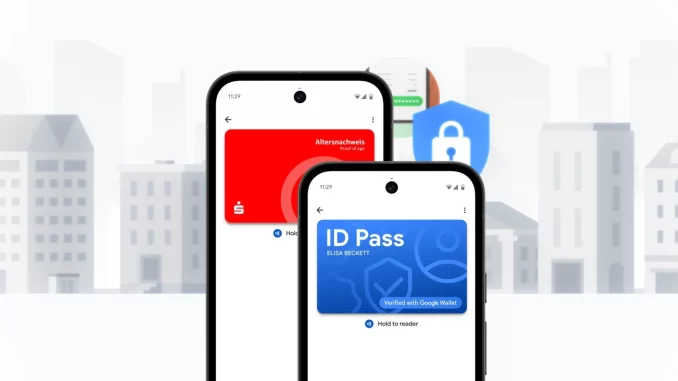
The company used its Money 20/20 Europe announcement to confirm that Google Wallet will start holding government digital IDs in select European Union countries this summer, with Ireland, Spain, France, Italy, and Estonia named as the first wave.
British Android users get the same capability “soon,” with no firmer date attached.
The selling point is age verification. To enroll, you record a short video of your face, scan a government-issued ID, and hand both to Google so the app can cross-reference them before the credential settles into Wallet. After that, your phone can vouch for your age whenever a site asks.
Google has also signed Sparkasse Bank as its first national credential partner for European age checks, which lets the bank’s customers prove they clear an age limit “without revealing personal information, such as their name, address or date of birth.”
On the merchant’s side, the claim mostly holds. A liquor retailer or an adult site learns that you passed the check, not your birthday. What the framing leaves out is where Google ends up standing in the transaction. The age check runs through a Google account could now be bound to a real, government-verified identity, which means Google can see that you ran one, when you ran it, and which gate you were trying to clear.
The personal data stops flowing to the website but it does not stop flowing toward the company that built the wallet.
Google leans on a cryptographic age-check technique it folded into Wallet in early 2025, the kind of system that can confirm a yes-or-no fact without exposing the document behind it. The cryptography is real and genuinely better than handing a bouncer-website a photo of your passport.
It also reframes the question rather than answering it.
The privacy problem with showing ID to read a web page was never only that the web page kept a copy. It was that you had to prove your legal identity to do an ordinary thing online at all and that someone had to be trusted to broker the proof. Google is volunteering to be that someone, at continental scale.
The scope tells you where this goes. In the EU, these IDs cannot yet board a flight or cross a border, so for now their job is online age gating.
In Britain, Google has partnered with the Rail Delivery Group so a Wallet passport can confirm eligibility for a discounted Railcard and the company says it is “exploring certification” inside the UK government’s digital identity trust framework that could extend the same ID to alcohol purchases “and more.”
Age checks rarely contract once the plumbing is laid. They find new things to check.
An updated Secure Payment Authentication feature lets European shoppers confirm a purchase with biometrics alone, skipping the one-time passcode, and Google’s own testing clocked it cutting authentication time by half while lifting conversions by 3 percent. That rolls out with Visa, Checkout.com, Autopay, and Adyen in the UK and Poland in the coming months.
Google is solving a problem it helped create. The age verification laws sweeping out of the UK’s Online Safety Act and its American imitators decided that ordinary people should have to prove their identity to read a web page, and now the same handful of companies that lobbied around those laws are racing to become the toll booth.
Google Wallet checking your government ID across Ireland, Spain, France, Italy, Estonia, and soon Britain is an infrastructure play, dressed as child protection, that ends with a single advertising company sitting between you and the things you want to do online.















Be the first to comment