
Article By Jon Brown
Archaeologists recently unearthed charred wooden remains from Solomon’s Temple in Jerusalem, according to a Monday report.
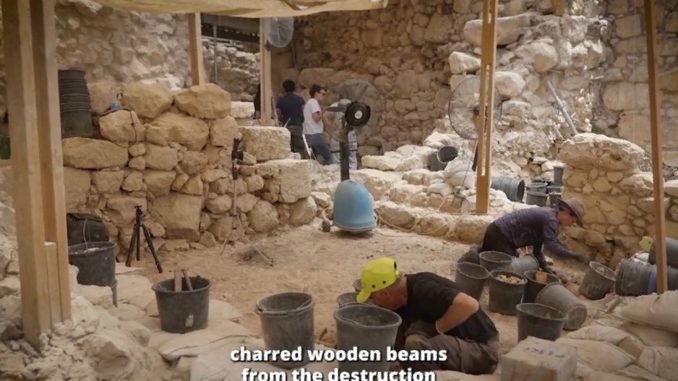
The Israel Antiquities Authority (IAA) announced that IAA and Tel Aviv University archaeologists discovered large wooden beams during an excavation that showed evidence of fire damage, presumably from the First Temple’s destruction by the Babylonians in 586 B.C., The Jerusalem Post reports.
The dig at the Jerusalem Walls National Park in the City of David found the beams in the remains of a building that had collapsed during the fire, and the plaster that melted from the temple’s walls reportedly sealed the wood and preserved it for more than two-and-a-half millennia.
“The beams appear to have served as the roof of an inner courtyard in a building from the First Temple period,” IAA excavation director Efrat Bocher told The Jerusalem Post.
Bocher noted the poignance of the ancient find taking place shortly before Tisha B’Av, which falls this year from the evening of July 22 to July 23. The day of fasting and mourning is commemorated annually in rabbinic Judaism to lament the destruction of both the First Temple by the Babylonians in 586 B.C. and the destruction of the Second Temple by the Romans in A.D. 70.
“We are just before Tisha B’Av. This discovery makes you feel that you are witnessing the very moment of destruction, the moment when it all happened. It’s deeply moving,” she said.
Johanna Regev, another archaeologist with the IAA, told the Israeli outlet that such a find is unusual, and that the growth rings of the wood helped them date it.
“It is very rare in Israel to find wood with such a large number of growth rings. Here in the City of David, we found thick beams with many rings, offering significant research potential, with more growth rings enabling higher dating resolution,” she said.
“Until now, we could date finds within a range of hundreds of years. Now, we can attain much greater precision, narrowing the dating range down to as little as 10 years.”
Israeli Heritage Minister Amichai Eliyahu also noted the significance of the discovery and echoed Bocher’s observation that it happened shortly before Tisha B’Av.

“Jerusalem’s soil continues to provide tangible evidence of the city’s ancient past. The wooden beams burned in the destruction of the First Temple stand as a powerful reminder of the Jewish people’s presence in Jerusalem some 2,600 years ago,” Eliyahu said.
“On the eve of Tisha B’Av, this discovery underscores that our connection to Jerusalem is rooted not only in faith, but also in history, archaeology and collective memory. It is our responsibility to continue uncovering, preserving and passing this heritage on to future generations,” he added.
Built in Jerusalem during the reign of King Solomon in the 10th century B.C., the First Temple replaced the Tabernacle as the permanent place for the Ark of the Covenant and the presence of God in the Holy of Holies.
After more than a century of warnings from prophets such as Isaiah and Micah, who prophesied impending judgment for Israel and Judah’s idolatry, King Nebuchadnezzar of the Neo-Babylonian Empire sacked Jerusalem, burned the First Temple, looted its treasures and took many of the Israelites to Babylon in exile, according to 2 Kings 25:8-17.
The Second Temple’s destruction by the Romans was a fulfillment of Jesus Christ’s prophecy during the Olivet Discourse in Matthew 24:2 that “there will not be left here one stone upon another that will not be thrown down.” According to the contemporary Jewish historian Josephus, the Roman general Titus ordered his engineers to completely dismantle the remains of the temple after it had been set on fire.












Be the first to comment