
Article By David Hawkins
Cuba was thrown into a nationwide blackout this week, underscoring the deepening collapse of the island’s power grid and the broader failure of its communist system as economic conditions continue to deteriorate.
Officials said electricity went down across the country of roughly 11 million people after what the Ministry of Energy and Mines described as a “complete disconnection” of the national grid.
Authorities claimed there were no failures in the operating units at the time and said an investigation is underway.
State media later aired comments from electricity director Lázaro Guerra, who said crews were working to restart thermoelectric plants in phases.
“It must be done gradually to avoid setbacks,” Guerra said.
“Because systems, when very weak, are more susceptible to failure.”
The outage marks the third nationwide blackout in just four months, highlighting the consequences of decades of underinvestment, mismanagement, and centralized control.
As darkness spread across Havana, families were left scrambling.
Many relied on candles and makeshift sleeping arrangements in sweltering conditions.
“We have to prepare a mattress for the girls here so that they can sleep here because we have no choice,” said Yuneici Cecilia Riviaux.
“I don’t have a rechargeable fan or a generator.”
For many Cubans, the blackouts have become more than a temporary hardship as they are pushing people toward leaving the country altogether.
“What little we have to eat spoils,” said Havana resident Tomás David Velázquez Felipe.
“Our people are too old to keep suffering.”
By Monday night, officials said power had been restored to just 5% of Havana, around 42,000 customers, as well as several hospitals.
Authorities warned that even restored circuits could fail again.
Cuba’s leadership has attempted to shift blame to the United States, pointing to pressure from President Donald Trump, who warned earlier this year of tariffs on countries supplying oil to the island.
The administration has tied any potential relief to the release of political prisoners and meaningful political reforms.
President Trump, however, signaled this week that he views the regime as increasingly fragile.
“I mean, whether I free it, take it,” Trump said, describing Cuba as a “very weakened nation.”
“I think I could do anything I want with it.”
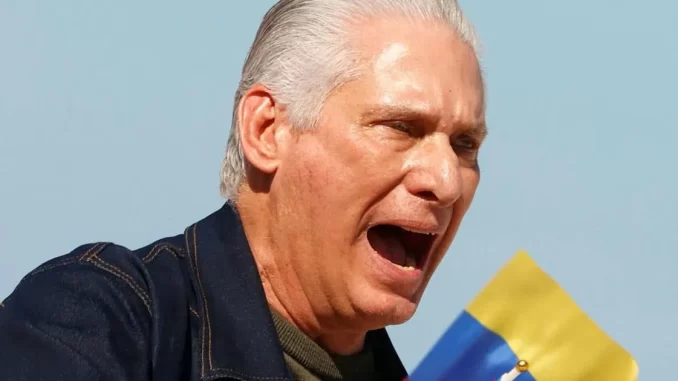
Behind the scenes, U.S. officials are reportedly seeking the removal of Cuban President Miguel Díaz-Canel as discussions continue over the island’s future.
Analysts say the collapse of Cuba’s power grid has been years in the making.
William LeoGrande noted the system has suffered from chronic neglect and deteriorating infrastructure.
“The technicians working on the grid are magicians to keep it running at all given the shape that it’s in,” he said.
For ordinary Cubans, the crisis is becoming unbearable.
Food spoils quickly without refrigeration, and vulnerable residents face growing health risks.
“Every day, she suffers,” said Yaimisel Sánchez Peña, referring to her elderly mother.
Another resident, Mercedes Velázquez, summed up the grim reality facing millions across the island.
“We’re here waiting to see what happens,” she said.
“Everything goes bad.”












Be the first to comment