
Article By Frank Bergman
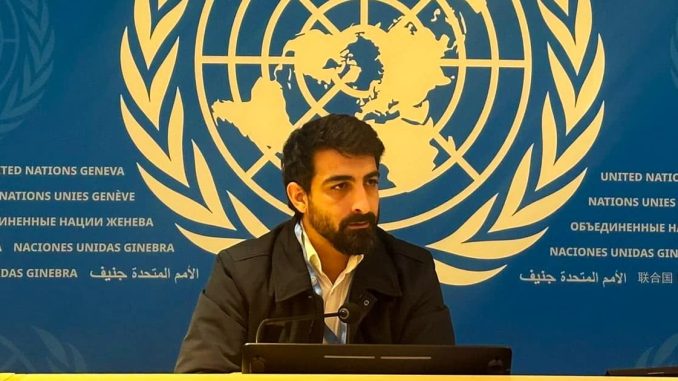
A United Nations (UN) human rights diplomat has suddenly resigned from his role and issued a dramatic warning that nuclear weapons could soon be used in Iran, raising alarm about the trajectory of the escalating conflict.
Mohamad Safa stepped down from his position on Sunday.
In a public statement, Safa blew the whistle on the UN’s preparations for nuclear war.
Safa declared that he could no longer remain part of an organization he believes is moving toward catastrophic military escalation involving nuclear weapons.
Diplomat Claims Nuclear Strike Is Being Considered
“I don’t think people understand the gravity of the situation as the UN is preparing for possible nuclear weapon use in Iran,” Safa said.
“This is a picture of Tehran,” he wrote in a post on X alongside a photo of Iran’s capital city.
“For you uneducated, untraveled, never-served, warhawks licking your chops at the thought of bombing it.
“It’s not some low-population desert.
“There are families, children, family pets.
“Regular working-class people with dreams.
“You’re sick to want war,” he continued.
“Tehran is a city of nearly 10,000,000 people.
“Imagine nuking Washington, Berlin, Paris, London, or beyond, bombed with nuclear weapons.”
Safa said he chose to resign in order to speak out publicly.
“I suspended my duties so as not to be part of or a witness to this crime against humanity, in an attempt to prevent a nuclear winter before it is too late,” he said.
He called for global action, warning: “It’s dangerous. Act now.
“Spread this message worldwide.
“Take the streets,” he urged.
“Protest for our humanity and future.
“Only the people can stop it.
“History will remember us.”
I don't think people understand the gravity of the situation as the UN is preparing for possible nuclear weapon use in Iran.
— Mohamad Safa (@mhdksafa) March 29, 2026
This is a picture of Tehran. For you uneducated, untraveled, never-served, warhawks licking your chops at the thought of bombing it. It's not some low… pic.twitter.com/BnzB4F3001
Nuclear Uncertainty and Ongoing Conflict
While the United Nations itself does not possess nuclear weapons, member states involved in the conflict, including the United States and Israel, have the capability to deploy them.
The warning comes as tensions remain high following U.S. military strikes on Iranian targets and ongoing hostilities in the region.
Iran’s Nuclear Program Damaged But Not Eliminated
International Atomic Energy Agency Director-General Rafael Grossi said Iran’s nuclear infrastructure has taken “enormous damage,” but cautioned that critical elements remain intact.
“There was enormous damage, in particular during the 12-Day War last year, at Isfahan, Natanz, and Fordow,” Grossi said.
He emphasized that while strikes have set the program back, they have not erased Iran’s capabilities.
“Not everything was destroyed,” Grossi said.
Grossi also noted the limits of military action in eliminating nuclear expertise.
“Don’t forget that this activity of uranium enrichment, which is rather complex, is not something that is impossible to do,” he said.
“All of these things Iran has mastered over the years.”
He added that enrichment capabilities could potentially be reestablished in smaller, harder-to-detect facilities.
“You may have, in Iran, thousands – or perhaps more – of workshops, or small factories, where they could reproduce these capacities,” Grossi said.
Debate Continues Over Iran’s Nuclear Threat
Grossi acknowledged that U.S. strikes inflicted “very considerable” damage but confirmed that Iran’s enriched uranium stockpile appears to have survived.
“It is true that the program had reached a concerning level of development,” he said.
He also suggested that limiting Iran’s enrichment activities through negotiations could serve as a path forward.
“Perhaps a suspension of these activities could be agreed for a few years, without Iran resigning permanently, as part of a trust-building process,” Grossi said.
Growing Global Alarm Amid Escalating Risks
The developments come amid ongoing debate over the risks of further escalation in the region, including the potential for broader conflict involving major powers.
Safa’s resignation and warning have intensified concerns about how far the situation could spiral, as world leaders weigh military action against diplomatic solutions.












Be the first to comment