
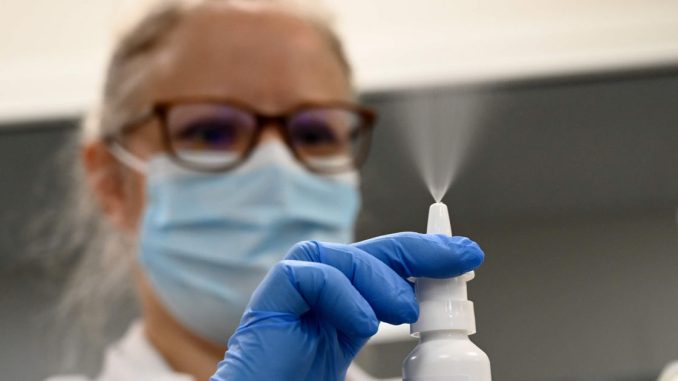
A new Covid “vaccine” is advancing through clinical trials in the United States, but this time it’s not a shot in the arm, it’s a “breathable” mist that “vaccinates” people by entering the lungs.
In what researchers are calling a “first-of-its-kind” study, a team at Cincinnati Children’s Hospital, led by Dr. Paul Spearman, has released early trial results on a Covid “vaccine” spray.
The study was funded by CyanVac LLC and published in Science Advances.
The candidate, called CVXGA1, is delivered via nasal spray, directly into the mucous membranes.
The atomized “vaccine” is being touted as the next frontier in pandemic “prevention.”
However, while legacy media and government researchers call the results “encouraging,” the trial and the technology behind it raise major concerns about safety, transparency, and future public health policy, particularly among Americans who’ve already been burned by broken vaccine promises.
The study involved just 72 people, aged 12–53, and aimed to test how the human body responds to live virus vectors sprayed directly into the respiratory system.
Participants received either low or high doses of the nasal vaccine and were monitored for adverse events and immune responses.
Among those who received higher doses, mild side effects such as runny nose (25%), headache (25%), and nausea (8%) were most common.
According to the study authors, no fevers or grade 3 adverse events were reported, and no hospitalizations occurred.
But even with the optimistic headline, the details paint a more complicated picture.
While researchers highlight a 67% relative reduction in symptomatic infections in high-dose recipients compared to the low-dose group, serum antibody levels were modest, and neutralizing antibodies, the ones that matter most, were rare, showing up in less than 13% of participants.
That means most of the immune “response” touted by researchers came not from traditional antibodies, but from mucosal immunity (IgA/IgG in the nose) and T-cell activation.
These responses are far more difficult to measure and far less understood in terms of long-term protection.
In short, the vaccine may be generating immune “activity,” but it’s unclear what kind, for how long, or whether it translates to meaningful protection.
Meanwhile, the trials are raising serious concerns about efforts to roll out “airborne vaccines.”
The use of live virus vectors to deliver genetic material into the respiratory system poses serious ethical and safety questions, particularly when viral RNA was detected in recipients’ nasal passages just two days after administration.
While researchers insist the vaccine strain remained “genetically stable,” the fact that viral genetic material was detectable at all will alarm those already concerned about shedding, unintended exposure, or mandated transmission-based vaccine delivery.
Moreover, CVXGA1 is based on a parainfluenza virus vector, which raises the possibility of repurposing or expanding similar delivery systems for other vaccines, or potentially even non-consensual public health interventions in the future.
The trial was fully funded by CyanVac LLC, and several of the authors are either employees or equity holders in the company.
One researcher has accepted grants or consulting fees from major pharmaceutical players, including Moderna, GSK, and Sanofi.
This isn’t an independent study.
It’s corporate-funded research conducted by those who stand to benefit from the product’s success.
Even more concerning was that the trial lacked a placebo group, and participants were not randomized.
Many had prior Covid infections or mRNA “vaccinations,” which muddies the waters on what immune responses came from the nasal “vaccine” and which came from previous exposure.
Without a proper control group, how can Americans trust the claims being made?
Intranasal vaccines represent a paradigm shift in how public health officials and pharmaceutical companies could approach vaccination in the future.
These tools don’t just target disease; they target behavior.
If nasal sprays become normalized, it raises the risk of bypassing medical consent, eroding bodily autonomy, and potentially enabling population-wide exposure through aerosols.
And with larger trials already underway, including one aimed at over 10,000 participants by 2027, there’s no sign this is slowing down.
The trial for CVXGA1 may be promoted as a success, but beneath the headlines lies a troubling trend: new, poorly understood “vaccine” technologies with limited transparency and fast-tracked regulatory backing.
For vaccine-injured individuals and those who’ve fought for medical choice, the message is clear: the fight isn’t over, and airborne vaccine delivery may be the next battleground.
READ MORE – Lawsuit Reveals CDC Has ‘ZERO’ Evidence Proving ‘Vaccines Don’t Cause Autism’


Be the first to comment