
Original Article By Cindy Harper
Age checks for chatbots might sound parental, but they flirt with surveillance-state mechanics.
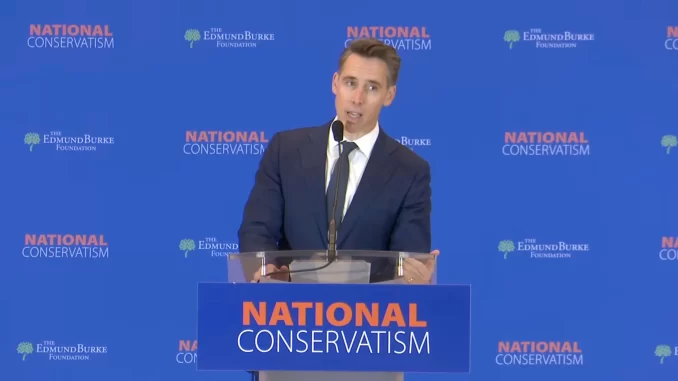
Senator Josh Hawley (R-Mo.) is pushing for broad new regulations on artificial intelligence, including age verification for chatbot access, data ownership rights, and the full repeal of Section 230 of the Communications Decency Act.
While the proposals are framed as efforts to curb corporate overreach in the tech industry, they will ignite concern among digital rights advocates who warn that such measures could undermine online privacy and freedom of expression.
At the National Conservatism Conference, Hawley accused AI developers of building their systems by collecting and using copyrighted material without permission. “The AI large language models [LLMs] have already trained on enough copyrighted works to fill the Library of Congress 22 times over,” he said.
“Let me just put a finer point on that — AI’s LLMs have ingested every published work in every language known to man already.” He claimed that creators were neither consulted nor compensated.
In July, Hawley introduced the AI Accountability and Personal Data Protection Act, which would allow individuals to sue companies that use personal data without consent and would establish property rights over certain categories of digital information.
However, two key components of Hawley’s platform are raising some alarm. His call to repeal Section 230 has been criticized for potentially damaging the open internet.
Section 230 currently shields online platforms from legal liability for content created by users. Without it, many sites could be forced to preemptively remove user content out of legal risk, resulting in widespread over-moderation and silencing of lawful speech.
Critics suggest smaller platforms and startups could be particularly affected, as they often lack the resources to manage large-scale content filtering or litigation.
Another proposal would require users to verify their age before interacting with AI chatbots. While promoted as a child safety measure, the implementation of such a requirement could lead to the normalization of digital ID systems.
These systems would likely require users to submit personal documents or biometric data to access basic online tools, reducing anonymity and increasing the risk of surveillance or data breaches.
Critics argue that requiring identity verification in order to speak or seek information online creates a chilling effect, particularly for those exploring sensitive subjects.
Although Hawley’s efforts have drawn interest, similar initiatives have failed to gain traction in the past. Senators Dick Durbin (D-Ill.) and Lindsey Graham (R-S.C.) floated the idea of sunsetting Section 230, but no legislation has advanced. Previous attempts to overhaul the law have also stalled.
Hawley warned that unchecked AI development threatens the American workforce and democratic norms, framing his proposals as necessary to protect both economic opportunity and individual dignity.
He called for most jobs to remain human-held and stressed the importance of AI being used to assist, not replace, human labor. “AI should serve human beings, not the other way around,” he said.




Be the first to comment