
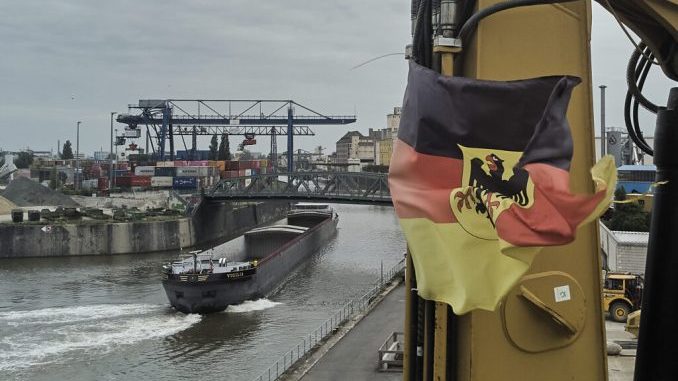
Germany’s economy is seeing red, with a recent, extensive survey of 23,000 businesses forecasting a record third year in a row of economic contraction, which would be a historic low since the federal republic was founded in the aftermath of the Second World War.
The survey, conducted by the German Chamber of Industry and Commerce (DIHK) paints a grim picture. Despite a surprisingly robust start to the year, experts announced on Tuesday that Germany’s GDP is projected to shrink by 0.3 percent.
“The economic recovery that we all desire and that our country needs is not yet in sight,” stated Helena Melnikov, DIHK Executive Director.
The prospect of Germany’s economy contracting for three straight years in its post-war history is a serious concern, prompting Melnikov’s plea: “We must do everything we can to ensure that this is not a lost year.”
As an export-driven nation, Germany is reeling from the trade war with the United States. A stark 29 percent of companies foresee fewer exports, with only 19 percent anticipating growth in international trade.
Although these are only predictions from businesses, and the trade situation is still in flux, negative sentiment can be self-manifesting, which can help feed into a real contraction.
The German export forecast has worsened since February, now predicting a 2.5% decline compared to 1.8 percent in 2024).
President Donald Trump’s tariffs are the primary reason, with Trump citing he sought for them to go as high as 50 percent on EU countries. Although Trump has delayed or suspended some tariffs temporarily, uncertainty is widespread for businesses. The German Bundesbank has described it as the “new normal” in regard to trade policy with Washington.
German news outlet Wirtschafts Woche describes that the domestic situation in Germany is not much better, with most companies holding back on spending and some scaling back.
Only 19 percent plan to expand production capacity—a record low. Job growth is also stagnant: Merely 13 percent of companies plan new hires in the coming months, while 22 percent intend to cut jobs. Adding to the distress, almost half of all German businesses (43 percent) are grappling with financial difficulties.
While the new federal government has promised relief measures, including cheaper energy, increased public investment, and enhanced depreciation options for businesses, 59 percent of companies view the current economic policy environment as their biggest risk.
Common complaints include high labor costs, excessive bureaucracy, and the emergence of new trade barriers; however, those complaints predate the current government. Many businesses view German Chancellor Friedrich Merz and his Christian Democrats (CDU) as business-friendly, but only time will tell if they can turn the ship around for Germany.



Be the first to comment