
Article By Trinity Foundation
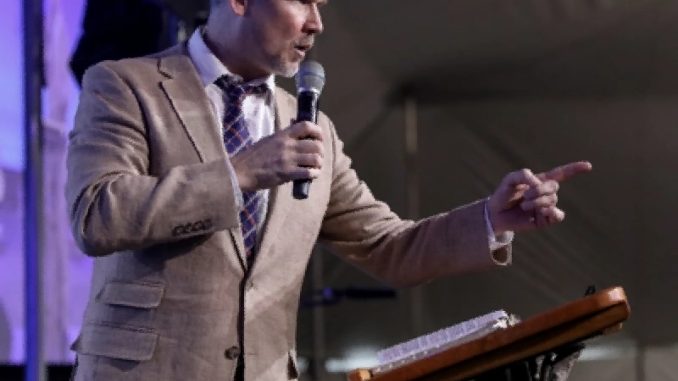
During the July 12th Sunday morning service at Global Vision Bible Church in Lebanon, Tennessee, Pastor Greg Locke disclosed that the feds recently conducted a pre-dawn raid of his home and obtained personal financial records.
Locke told his congregation that roughly 50 to 60 federal agents, using a battering ram, surrounded and forcibly entered his home around 6 a.m.
The raid occurred roughly three weeks into a six-week sabbatical Locke and his wife had taken following the death of their 20-year-old son, Evan, from a drug overdose in May, The Christian Post previously reported.
“For three hours, they served us two search warrants. One for our house, one for Locke Media, and then a subpoena for the church building.”
Locke also revealed that the church no longer had a bank account. “… two weeks ago, we went to conduct our normal business and because the government had subpoenaed the records from our banks, the bank said, ‘Sorry, all of your accounts are canceled immediately.’”
Launching the investigation
Federal investigations of churches and ministries are typically launched for three reasons.
- A victim comes forward to file criminal charges.
- Complaints are filed with a government agency.
- News reports of alleged criminal actions attract the attention of law enforcement.
So far, no criminal charges have been filed against Pastor Greg Locke or his wife, Tai, who oversees church finances. Locke has said the investigation covers financial records dating back to 2020 and has been ongoing for roughly two years, according to CP.
Submitting a complaint to the IRS
It is possible that a former church employee or member provided evidence of criminal financial transactions to the IRS by submitting a Form 13909, which is a simple complaint form for reporting nonprofit abuses, or a 211 Whistleblower Form, which could allow the whistleblower to receive a reward.
When reviewing a complaint or whistleblower form, the IRS will determine if an audit or criminal investigation is warranted. Church audits are performed by the Exempt Organizations Division and criminal investigations are performed by the Criminal Investigations Division.
The Church Audit Procedures Act, passed in 1984, determines how church audits are conducted, and it requires “an appropriate high-level Treasury official” to approve a church inquiry. However, the Church Audit Procedures Act doesn’t apply to criminal investigations.
During his Sunday sermon, Locke claimed, “They’ve subpoenaed everybody you can imagine. … They want to make sure, you know, because they were told that we’re, you know, trafficking children and all of this.”
The FBI Nashville Field Office and the U.S. Attorney’s Office for the Middle District of Tennessee have both explicitly confirmed to The Christian Post that the FBI was not involved in the raid, and referred further questions to the U.S. Attorney’s Office. Separately, Wilson County Sheriff Robert Bryan confirmed to The Tennessean that the IRS was involved, according to CP’s earlier reporting.
After Trinity Foundation contacted the IRS to confirm the raid, a public affairs officer responded, “At this time, the United States Attorney’s Office for the Middle District of Tennessee cannot legally comment on any potential ongoing investigation regarding this case.” That officer, Steve J. Stanley, told CP the office would share updates “if anything ever changes in the future.”
Such disclosures are regulated by the Privacy Act and the Freedom of Information Act which restrict information the federal agencies can make public regarding living American citizens.
For example, Exemption 7 of the Freedom of Information Act exempts “records or information compiled for law enforcement purposes” that might interfere in court proceedings, result in an invasion of privacy or disclose confidential sources.
Meanwhile, Trinity Foundation supports amending the Privacy Act and Freedom of Information Act to allow government agencies to provide better status updates to whistleblowers, journalists, and donors. Currently, the IRS is forbidden from disclosing if it has audited a church or ministry, unless an audit results in litigation.
Search warrants
Locke isn’t the first pastor to be raided recently. On Aug. 27, 2025, the FBI arrested televangelist David E. Taylor following an indictment. On that same day, the FBI executed search warrants of Kingdom of God Global Church properties in Florida, Michigan, Missouri and Texas. Following Taylor’s arrest, the indictment against Taylor was unsealed.
In April 2017, the IRS and Postal Service raided Benny Hinn Ministries in Grapevine, Texas. This investigation ended quietly, with no criminal charges filed. It is likely that Hinn’s organization hired a defense attorney immediately after the raid in order to negotiate a pre-trial agreement.
The Federal Rules of Criminal Procedure – Rule 41 regulates how federal agencies conduct searches and seizures. Rule 41 requires that a “magistrate judge or a judge of a state court of record must issue the warrant to an officer authorized to execute it.”
When a raid is conducted, an officer is required to create an inventory of all items taken, and receipt of this inventory is given to the person or organization for whom property was taken.
Defendants still have the right to due process and may challenge the collection of evidence before a trial is held.
According to Rule 41, “A person aggrieved by an unlawful search and seizure of property or by the deprivation of property may move for the property’s return. The motion must be filed in the district where the property was seized.”












Be the first to comment