
Article By Mary Kiara
Survivors and religious-freedom researchers say environmental stress cannot explain attacks on churches, clergy and Christian villages
(Benue) – A farmer’s murder in Nigeria’s Benue State is forcing a harder question: does climate change explain the violence as Abuja claims, or is it masking deliberate attacks on Christians?
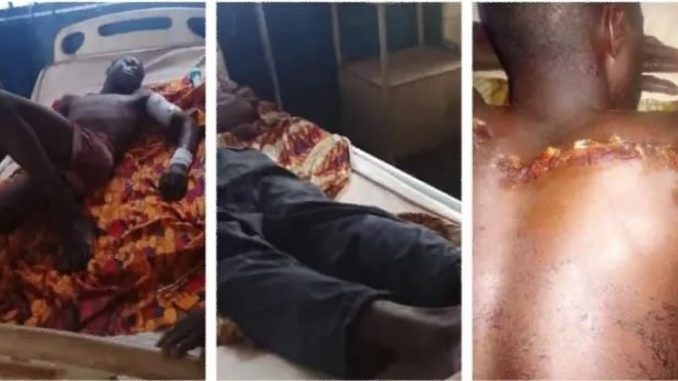
Twenty-year-old Christiana Joseph said her father, Joseph, a Christian farmer, was killed in January after Fulani militants entered his farmland in Guma County, Benue State.
Five other Christians were killed with him, she said.
“Fulani terrorists have constantly encroached on our farms and attacked our people. My family members had to relocate from my ancestral land as a result of the attacks,” Joseph told TruthNigeria.
“We now live in fear because nowhere seems safe.”
On August 15 2026, extreme rainfall sent Indiana’s White River over its banks, trapping the Enciso family inside their home until emergency responders safely pulled them from the rising waters via rescue boats.
In stark contrast, when a “crisis” strikes Nigeria’s Middle Belt, the federal government labels it an environmental disaster, yet the ‘climate change’ occurring there involves armed militants burning down churches, kidnapping clergy, and hacking Christian farmers to death with AK-47s and machetes.
“Climate Change Does not Persecute Christians”
During a March 2026 meeting with British Prime Minister Keir Starmer in London, President Bola Tinubu described Nigeria as facing both terrorism and “conflict from climate change.”
Nigeria’s House Speaker Tajudeen Abbas has likewise argued that climate change has intensified tensions in Nigeria’s middle belt.
The ecological narrative collapses entirely when confronted with the testimonies of those on the front lines.
Clement Kav, the Logo County Chairman in Benue State, recounted a brutal assault to TruthNigeria that strips away any illusion of a resource conflict.
Kav witnessed armed Fulani militants firing at fleeing residents while chanting ‘Allahu Akbar’ (God is greatest). This religious battle cry demonstrates that the attackers are driven by theological warfare and territorial conquest, not a desperate search for grazing land.
“Farmers do not chant religious slogans to resolve agricultural disputes; militants use them to execute holy war.”
“They burned all the heaps of rice already harvested,” Ado Bartholomew, a Benue rice farmer, told TruthNigeria. “This has nothing to do with climate change; humans carried out the attacks to drive us from our ancestral lands.”
The violence has repeatedly reached places with little connection to grazing disputes.
In Kaduna, community leaders have described armed attacks on Christian villages that leave homes, schools and churches abandoned.
David Auta, a community leader in an Adara Christian village, said years of violence emptied much of his community.
Human rights experts also reject the federal government’s framing.
“Climate change does not persecute Christians; people persecute Christians,” International Christian Concern said in a report.
Global Christian Relief analysts similarly questioned federal narratives, noting that if violence were merely a competition over grazing rights, armed groups would not prioritize burning churches and executing clergy before seizing territories.
High-Tech Warfare Defies Resource Myths
Militia operations across central states rely on advanced technology and logistics that contradict claims of spontaneous resource clashes.
In Plateau and Kaduna states, indigenous communities have documented night-vision drone surveillance and unflagged helicopter landings preceding ground massacres.
“They fly a drone in the air at night to track villages,” Emmanuel Dalyop, a youth leader in Jol Ward, told TruthNigeria, noting that militants now occupy 98 percent of his community’s ancestral farmland. “We are just using two percent of our land.”
“These terrorists appear well-coordinated and deliberately target Christian farmers,” Kav told TruthNigeria. “It’s all a calculated assault on our people.”
“Extremist organizations and criminal networks are responsible for acts of religious persecution. This distinction is essential to understanding the challenges facing Christian communities today,” Nina Shea, Director of the Center for Religious Freedom at the Hudson Institute said in a report.
Systematic Targeting of Altar and Field
Statistical benchmarks tracking violence in central Nigeria reveal severe religious asymmetry.
Data from the Observatory for Religious Freedom in Africa (ORFA) shows that between 2020 and 2025, 22,835 Christian civilian deaths were linked to state-sanctioned terrorism and unmonitored militia raids.
The Open Doors 2026 World Watch List recorded 4,849 Christian martyrdoms worldwide, with 3,490 occurring in Nigeria, accounting for over 70 percent of the global total.
Clergy targeting has also intensified. Institutional records from the Catholic Bishops’ Conference of Nigeria confirm that over 200 Catholic priests have been abducted since 2015, with 12 executed in captivity, including the July 2026 murder of Father Samuel Oyetoro in Kogi State.
The descriptions of the violence as “farmer-herder clashes”, “communal clashes” or “climate-induced resource conflict” are misleading and serve to obscure the scale and nature of the attacks,” the Middle Belt Concern, a coalition of over 80 civic organizations, stated to TruthNigeria. The normally respected Reuters news service replicated the false trope of resource conflict in its reporting of the cause of the latest gruesome murder of sleeping villages in Plateau’s Mangu County on the morning of August 18.
International Implications and State Accountability
The persistent displacement has prompted renewed demands from Western lawmakers for diplomatic accountability.
“Christians are being slaughtered across the Middle Belt with impunity,” U.S. Representative Riley Moore stated publicly following an August 2026 attack in Plateau State. “We cannot make the same mistake. We must stop the genocide.”
For millions of internally displaced villagers residing in makeshift camps while armed groups occupy their fields, official attempts to blame rainfall patterns offer no protection.












Be the first to comment