
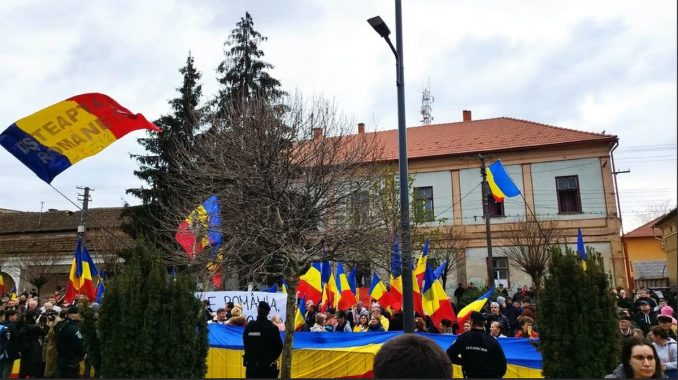
Another anti-Hungarian demonstration took place in Romania at the Úzvölgy military cemetery, while more and more people are warning about the extremist ideological deviation within the Romanian Orthodox Church.
On Sunday afternoon, June 1, about 100 people gathered at the cemetery for those who fell in WWI to “commemorate ” the alleged Romanian soldiers buried there, writes Mandiner. This was due to the call from Mihai Tîrnoveanu, leader of the anti-Hungarian nationalist movement Calea neamului (“The Path of the Nation), for the gathering on Romania’s Heroes’ Day.
The holiday has been increasingly used by many organizations for their own ideological goals.
During Sunday’s event, they marched into the cemetery singing patriotic songs, and reading out the names of the Romanian soldiers who had died and are, according to the Hungarian side, falsely claimed to be buried in the Úzvölgy cemetery.
Activist Cristian Marchiș posted on his social media: “According to the ethics of war, both sides have the right to take their dead and wounded from the front. Thus, both sides buried their fallen soldiers in their own cemeteries. The Úzvölgy cemetery contains the remains of soldiers from the armies of the following countries: Hungary (794), Germany (121), Russia (22), Serbia (3), Austria (2).”
He added that a total of 11 ethnic Romanian soldiers (8 nominally identified and 3 unidentified) were buried in the Úzvölgy cemetery. Of these, 5 ethnic Romanian soldiers were Hungarian citizens and fought in the Hungarian army, and a sixth was Russian. In the case of the other five soldiers, there is no information about which army unit they belonged to.
The “commemoration” concluded with the consecration of crosses by Orthodox priests, which was justified by the fact that the wooden crosses erected last year were damaged by “modern-day oppressors” and are now being replaced with new ones.
Tîrnoveanu had already appeared at the cemetery days earlier to prepare the “recapture” with some of his comrades. In his video message, he said: “Let us be united, my brothers, and protect the crosses of the heroes of the Romanian army.”
He also called not only for the protection of the cemetery, but also for a kind of spiritual and national unity, of which the presence of Orthodox priests was a prominent part. The event was not so much about the memory of the soldiers but more of a symbolic and political message to the Hungarian community.
Marchiș noted in his Facebook post that the event was for the sake of a “political war: The dead deserve peace. Because the war in which they lost their lives was enough. Instead, in Romania, they are still at war – a war in which they can no longer defend themselves.”
According to Marchiș, Romania betrays its own dead when it uses their graves for political purposes and when it tries to “Romanianize” soldiers through Orthodox religious rituals who often lived and died with a completely different identity, language, and faith.
More and more warn that certain circles of the Romanian Orthodox Church are also deeply involved in the spread of national ideologies. Journalist Paul Palencsar speaks of the “demon of phyletism,” which he says has flooded monastic cells, rectories, and even episcopal palaces.
According to Palencsar, the conflation of ethnic nationalism and Christianity has led to sermons no longer being based on the teachings of Jesus, but on quotes from Codreanu and Antonescu. The essence of Christianity, which is to “love your neighbor as yourself” has been completely sidelined, replaced by a geopolitical God who only accepts “Romanians by blood” as “his own people.”
Palencsar warns: “To preach phyleticism is to deny Jesus – this is the very teaching of the antichrist.”
The Úzvölgy cemetery has become a symbolic battlefield of Romanian-Hungarian relations again and again, with hatred of Hungarians, led by the Orthodox Church, increasingly present.
“It is not Mihai Tîrnoveanu’s antics that are most dangerous – it is the silence of the Romanian state and the Orthodox Church.”
Zsolt Pászkán, an external expert at the Hungarian Institute of Foreign Affairs, calls out the Romanian power elite for their “consensual cooperation” in the Úzvölgy outrages.
He also specifically called out Patriarch Dániel, who is being sold as a symbol of the “Westernization” of the Romanian Orthodox Church, but has not once raised his voice against the desecration of the Hungarian military cemetery in Úzvölgy since 2019.
Moreover, he did not even attempt to discipline the priests of the church, who openly supported the anti-Hungarian actions.
Pászkán also harshly criticized the institutions of the European Union and the “international media justice NGO” network, which strongly advocate for the protection of sexual minorities, but ignore the cause of national communities – for example, the rights of the Hungarian community:
“In the EU’s value system, national communities come after sexual minorities, animals, plants and moths – or they do not even exist,” he said.
According to Zsolt Pászkán, the Hungarian community in this hostile environment “must fight for its rights with gritted teeth,” especially when “its own intellectuals, who have transformed from communist to liberal and then progressive, are ready to betray it in the hope of some of its old privileges.”




Be the first to comment