
Article By Leah MarieAnn Klett
A 1,700-year-old inscription discovered at a Roman-era temple in southeastern Turkey is offering archaeologists rare evidence of how Christianity replaced one of the Roman Empire’s most influential mystery religions.
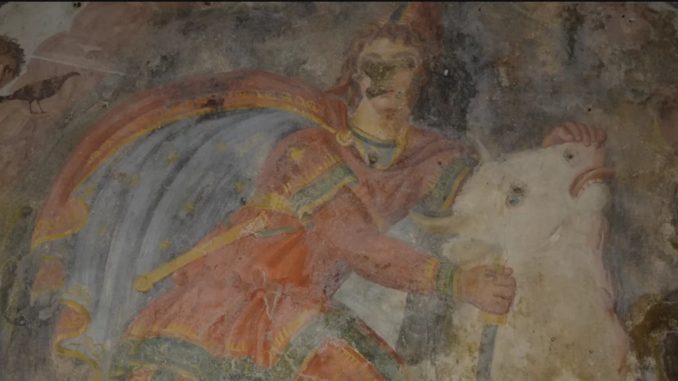
Researchers say the Aramaic inscription, carved at the entrance to an underground Mithras temple at Zerzevan Castle in Turkey, records the sanctuary’s closure during Christianity’s rise in the late Roman Empire.
The inscription, which had resisted interpretation since the temple was unearthed in 2017, appears alongside a carved cross and suggests the site was deliberately sealed after falling under Christian authority, according to a report from Anatolian News.
Located near modern-day Diyarbakır, about 40 miles north of the Syrian border, Zerzevan Castle served as a Roman frontier fortress guarding the route between the cities of Amida and Dara. Archaeologists have uncovered military structures, water systems and one of the best-preserved Mithraic sanctuaries in the Roman world beneath the fortress.
Mithraism, an all-male mystery religion centered on the Iranian god of the sun, Mithras, flourished throughout the Roman Empire during the second and third centuries A.D., particularly among soldiers and imperial officials. Mithraic rituals were conducted in enclosed, often subterranean sanctuaries and emphasized themes of light, cosmic order and initiation.
Roman soldiers reportedly encountered this religion during military excursions to areas known today as Iran and Iraq. However, after Emperor Constantine embraced Christianity in the early fourth century, Mithraism rapidly declined.
The newly deciphered inscription was analyzed by Mehmet Sait Toprak, head of the Department of Syriac Language and Literature at Mardin Artuklu University. By comparing the inscription’s language and letter forms with Syriac and Aramaic inscriptions from the second and third centuries A.D., Toprak concluded the engraving dates to the third or fourth century.
According to Toprak, the inscription references the Holy Cross and invokes God as one who “orders, reforms, and spreads love.” He said the text and accompanying cross appear to have functioned as a religious seal marking the temple’s closure and the end of its sacred status.
“This is an extremely important archaeological discovery,” Toprak told the state-run Anadolu Agency.
Excavation director Aytaç Coşkun told the outlet that researchers had studied the inscription since the temple’s discovery in 2017, both in Turkey and abroad, but its meaning remained unclear until the latest analysis. He said earlier coin discoveries suggested the temple was abandoned during the third or fourth century, while the inscription now provides direct evidence that it was shuttered during the Christian period.
The inscription also mentions both Mithras and Jesus Christ, according to Toprak, who added that as Christianity spread, Mithraism came to be viewed as a rival faith.
Archaeologists say the find provides unusually clear evidence of that transition. While Mithraic temples have been discovered across the former Roman Empire, from Britain to the eastern provinces, many were simply abandoned, damaged or repurposed, leaving few written records explaining how the religion disappeared.
At Zerzevan Castle, however, researchers say the combination of a cross and a written inscription at the temple entrance preserves a record of Christianity replacing an older Roman cult within a specific sacred space.
The discovery adds to a series of recent archaeological finds connected to early Christianity in Asia Minor.
Last year, archaeologists excavating the ancient city of Olympus uncovered the remains of a fifth-century Christian church bearing an inscription hidden for more than 1,000 years. During the same year, excavations at Kaunos revealed the remains of a Roman hospital that was later converted into a Christian sanctuary.
In March, Egyptian archaeologists unearthed a 1,500-year-old monastic complex in the Nile Delta, including a fifth-century building believed to have served as a reception facility for pilgrims.












Be the first to comment