
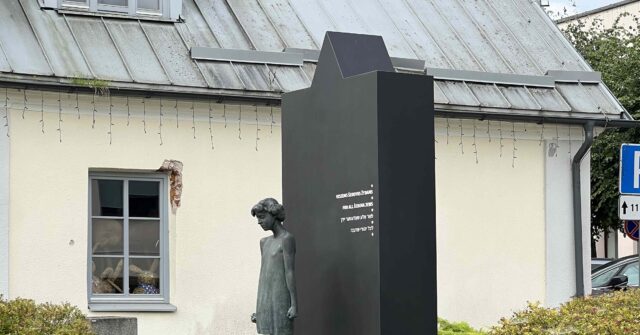
I spent several days this week in Lithuania studying the country’s history during the Second World War, when some 95% of its Jewish population was murdered.
The Holocaust began, in that sense, in the formerly Soviet-occupied Baltics — not with the concentration camps and gas chambers familiar from the dominant narrative, but with thousands of Jews being shot at close range — often by their Lithuanian neighbors.
At Auschwitz, the Nazis turned mass murder into an industrial process — shocking in its indifference to human life, and in its indictment of modernity, but also less emotionally difficult for the perpetrators.
In small Lithuanian towns like Seduva, home of the new Lost Shtetl Museum (which opens next month), the murderers included some 20 local residents, who had to be operating at a more intense level of motivation.
How did it happen?
Some of the killers were psychopaths — the kind that exist in every society, for whom the chaos of war presented a unique opportunity.
Others, however, were ideologically-committed nationalists, who believed they were ridding their nation of a “foreign” element, and who believed the Nazis’ promises to restore Lithuania’s independence as long as Lithuanians helped them get rid of the communists and the Jews.
At the same time, it is important not to overlook the role of the Soviet Union in setting the stage for genocide. The Soviets destroyed the Lithuanian state, murdering or deporting its leaders and its intellectuals. The communists also seized large businesses and property.
Though the first Soviet occupation only lasted a year, it caused intense suffering and destroyed institutions that might have restrained the nationalist backlash.
The Soviets targeted Jews in particular, shutting down Jewish communal institutions, impoverishing Jewish business owners, and deporting Zionist leaders to Siberia in 1940.
The following year, however, the German Nazis would urge Lithuanian militias to exterminate the Jews by linking them to communism, based on the fact there were some pro-Soviet Jewish groups, and that a few Soviet officials were, in fact, Jewish in origin.
The extreme left, with its penchant for overturning social norms, undermining independent institutions, and leveling economic differences, creates an environment in which the only morality left is obedience to power. And the extreme right, in its obsession with purity — whether racial or national, or both — makes a virtue out of confrontation with, and destruction of, the perceived “other.”
Jews were targets of both, in Lithuania.
I am skeptical of claims that what happened in Nazi Germany — or Lithuania — could happen here in the United States. But we must acknowledge that there are loud voices within our own politics, left and right, repeating some of the themes that were salient in the dark Lithuanian past.
And Lithuania reminds us that atrocities are not always a feature of totalitarian governments: they can grow from the grass roots as well.
Today, a new generation of Lithuanians has a completely different outlook. Raised in the freedom of post-Soviet Europe, young Lithuanians are looking for answers about their past, and are reaching out to Jewish visitors like me. They are filling in their gaps of knowledge, silences about facts that were suppressed.
But they are also teaching us the dangers of extremism in politics, both left and right, that we must confront.
Joel B. Pollak is Senior Editor-at-Large at Breitbart News and the host of Breitbart News Sunday on Sirius XM Patriot on Sunday evenings from 7 p.m. to 10 p.m. ET (4 p.m. to 7 p.m. PT). He is the author of Trump 2.0: The Most Dramatic ‘First 100 Days’ in Presidential History, available for Amazon Kindle. He is also the author of The Trumpian Virtues: The Lessons and Legacy of Donald Trump’s Presidency, now available on Audible. He is a winner of the 2018 Robert Novak Journalism Alumni Fellowship. Follow him on Twitter at @joelpollak.













Be the first to comment