
Article By Frank Bergman
Scientists in Singapore have unveiled plans for a disturbing new “biological data center” that uses hundreds of thousands of living human brain cells wired to electronic hardware to process computer data.
The prototype replaces conventional silicon-only computing with lab-grown human neurons derived from stem cells and connected directly to electronics, also known as “wetware.”
Researchers stimulate the living cells with electrodes, record their responses, and use conventional computers to translate the resulting brain activity into software commands.
The National University of Singapore Yong Loo Lin School of Medicine developed the system in partnership with Cortical Labs and data center company DayOne.
The university hailed the project as “a powerful glimpse into how biology and technology can come together to transform the future of computing.”
200,000 Human Neurons Wired Into Each Machine
The human cells originate from donated skin or blood cells that scientists reprogram into stem cells before turning them into neurons.
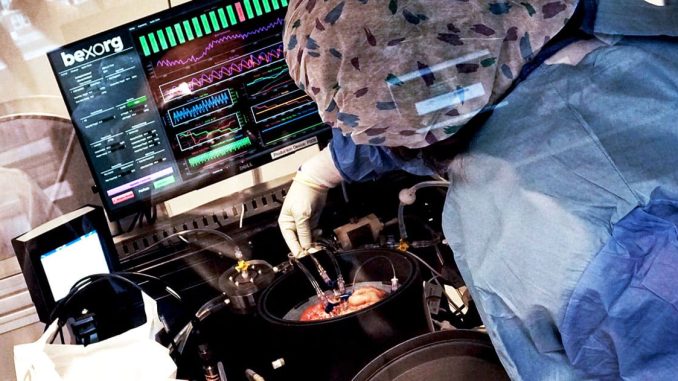
Each CL1 biological computer contains approximately 200,000 human neurons grown across a silicon chip fitted with a microelectrode array.
Electronic signals stimulate the cells while the hardware records how they respond.
The neurons live for approximately six months.
Life-support equipment keeps them in sterile, temperature-controlled conditions and continuously supplies the nutrients required to keep them alive.
The cells must then be replaced when they die.
Cortical Labs has already demonstrated the ability to “grow neurons on a chip” and train them to play the video games Pong and Doom.
The company argues that living neurons offer an advantage over conventional computer chips because their patterns and behavior can change over time.
However, the technology’s creators have yet to prove that their brain-cell machines can compete with modern computers outside small, carefully controlled experiments.
Developer Claims Living Computers Will Save Energy
Researchers are promoting biological computing as a possible answer to the massive energy and water consumption caused by the global artificial intelligence boom.
The human brain operates on roughly 20 watts of power, a fraction of the electricity consumed by sprawling AI data centers.
Yet the developers have not publicly disclosed the full energy and resource demands involved in keeping hundreds of thousands of human neurons alive, sterile, fed, and temperature-controlled.
Other industries built around lab-grown cells, including cultivated meat, have proven highly energy-intensive.
All public performance claims surrounding the biological data center come from its developer.
No large-scale, independent evidence has demonstrated that the technology can deliver its promised benefits in real-world conditions.
‘Huge Numbers’ of Cells Would Be Needed
Cortical Labs has opened a 120-unit facility in Melbourne, Australia, and is planning a larger biological computing site in Singapore.
The existing systems remain “bench-scale,” while conventional data centers commonly contain tens of thousands of servers.
Critics warn that teaching a cluster of neurons to perform simple tasks is a long way from creating reliable infrastructure capable of replacing modern computing systems.
“Scaling living cells into something reliable enough for infrastructure use is a major engineering hurdle,” Live Science reported.
GMWatch founder Claire Robinson warned that building the technology at data-center scale would require enormous funding and a constant supply of new human cells.
Scaling up “will require huge numbers of cells, which will have to be regularly replaced, as they don’t last forever,” Robinson said.
The fast pace of AI development creates another major obstacle.
Critics warn that new data centers and their hardware can become obsolete before they are even completed.
CIA-Funded Venture Firm Among Investors
Cortical Labs was founded in 2019 and had raised $11 million in funding as of March.
Its investors include Horizons Ventures, Blackbird Ventures, LifeX Ventures, Radar Ventures, and In-Q-Tel, a venture capital organization funded by the CIA.
The biological data center also marks a dramatic pivot for Cortical Labs.
When the company debuted its technology in 2025, it marketed the machines as a “platform technology” for drug discovery and disease modeling, including research into epilepsy and Alzheimer’s disease.
The company is now attempting to transform the same living-neuron technology into computing infrastructure.
Critics Sound Alarm Over ‘Transhumanist’ Agenda
Critic Patrick Wood compared the project to former President Barack Obama’s brain-mapping initiative, which received support from the National Institutes of Health and the Defense Advanced Research Projects Agency.
“The people have too much time on their hands, and if it wasn’t for public tax money, they would starve to death,” Wood said.
Robinson warned that the project belongs to a broader “transhumanist” movement seeking to erase the boundaries between human life and machines.
She raised concerns “about the wider ‘transhumanist’ landscape in which scientists and billionaire investors are trying to blur the line between living beings — including humans — and AI/computers.”
“We’ve all seen articles enthusing about AI robot soldiers — basically computers with a human appearance and attributes,” Robinson said.
“There are worries about who is controlling these technologies, what their motivation is, what happens when something goes wrong and/or the robot gets out of control, and who is responsible and accountable for any harm caused.”
Robinson also warned that much of the research is conducted outside public view.
“We urgently need to demand transparency and accountability for where research and investment is being directed and engage in the ethical issues involved,” she said.
“We need to govern the technology before it governs us.”












Be the first to comment