
Article By Behrouz Turani
Tehran is signaling that its response to US pressure may be to widen the conflict, turning restrictions on its shipping and aviation into risks for airports and waterways stretching from the Persian Gulf to the Red Sea and potentially the Indian Ocean.
The emerging pattern is one of horizontal escalation: rather than confining its response to the point of pressure, Iranian officials are increasingly warning that action in one arena could produce retaliation elsewhere.
IRGC spokesman Hossein Mohebbi made that logic explicit on September 23, declaring that “Iran will certainly change the geography of the war” and adding that “our targets will no longer necessarily be the same as before”.
A day later, Yahya Rahim Safavi, military adviser to Iranian Supreme Leader Mojtaba Khamenei, gave the clearest indication yet of how far that geography might extend.
In a video released by the IRGC-linked Fars News Agency, Safavi said the front could expand further in response to continued warfare, “reaching the Indian Ocean and perhaps beyond”.
He added that linking Hormuz and Bab el-Mandeb “will change the battlefield”.
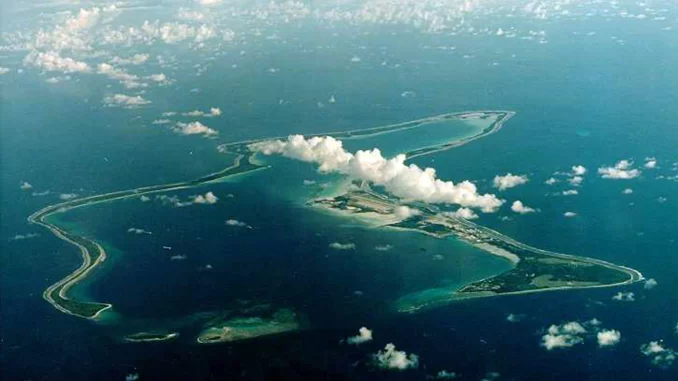
Fars noted that it was the first time an adviser to Khamenei had explicitly mentioned the Indian Ocean, home to the US-British base at Diego Garcia, nearly 4,000 kilometres from Iran.
In an earlier interview reported by Fararu, Safavi said Houthi advances mean the United States now faces a new challenge at Bab el-Mandeb and in the Red Sea.
IRGC Aerospace Force commander Majid Mousavi warned that “if you make the sacred Strait of Hormuz unsafe, we will turn the entire region into hell for you from across Iran”.
From shipping to aviation
The same logic has increasingly appeared outside the maritime arena.
Secretary of the Supreme National Security Council Mohsen Rezaei addressed Iran’s neighbouring Arab states in an interview with state broadcaster IRINN on September 23, saying: “If you stand with America, we will not just watch you.”
He warned that if Iranian flights were banned with their cooperation, “their airports will have no flights”. He did not specify any country, airport or method of disruption.
Rezaei linked the warning to the Hormuz standoff.
He also said Foreign Minister Abbas Araghchi was due to convey Iran’s seven conditions through mediators and that, until they were met, neither the strait would reopen nor negotiations resume.
Tehran had given the Americans “four to five days” to meet the conditions, he asserted.
A widening map of pressure
The statements suggest Tehran is increasingly answering different elements of Washington’s pressure campaign with threats or measures in corresponding domains.
Safavi’s framing of Hormuz and Bab el-Mandeb as a connected theatre suggests Tehran increasingly sees pressure around the two strategic chokepoints as interconnected.
The most immediate audience for many of these warnings is Iran’s Arab neighbours, whose airports, ports and territory are exposed to the consequences of US-Iran escalation.
Rezaei’s remarks appear designed to raise the potential cost for those states of cooperating with Washington’s pressure campaign.
Iran has already demonstrated a willingness during the conflict to target regional aviation infrastructure, repeatedly striking Kuwait International Airport and damaging terminals and a radar system.
The Indian Ocean references extend this widening map further.
For now, the shift is clearest at the level of rhetoric: none of the statements reviewed sets out a specific Iranian plan for operations there.
But combined with threats against regional airports and repeated references to Bab el-Mandeb, they point to an increasingly explicit message from Tehran that further US pressure could carry risks well beyond the Strait of Hormuz.












Be the first to comment