

Article By Hooman Abedi
he Islamic Republic has launched a platform asking citizens to identify and report opponents living abroad. Iranians met it with ridicule, pointing to how deeply the state’s own security apparatus has been infiltrated.
The Alaj platform – whose name means “remedy” or “cure” in Persian – accepts information through its website, a Telegram bot and Iran’s Bale messaging service.
“Alaj operates with the aim of safeguarding national security against anti-Iranian currents,” the Guards-affiliated Fars News Agency said in announcing the project on Monday.
State television also promoted Alaj, giving wider exposure to a system Iranian media had previously discussed but not promoted on the same scale.
Alaj says it has identified and monitored 1,600 people, including 600 identified through reports from members of the public, according to Iranian state media.
Its website publishes information about Iranians abroad, including names and photographs and, in some cases, national identification numbers, dates of birth and fathers’ names.
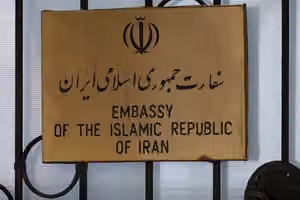
The platform says it targets people outside Iran who act “against the country’s interests and security,” including those advocating sanctions or military action and members of separatist groups.
Alaj also lists potential measures against people it identifies, including freezing assets and withdrawing access to consular and citizenship services.
The project’s name carries a pointed connotation. Alaj translates as “remedy” or “cure,” framing the people targeted by the platform as a problem to be treated.
People ridicule campaign
Responses to the post promoting Alaj ranged from mockery of Iran’s security establishment to explicit warnings that people who inform on opponents could themselves be identified and punished in the future.
One commenter predicted the platform would be hacked and the identities of those submitting reports made public, arguing that previous breaches of major Iranian institutions gave little reason to trust Alaj with sensitive information.

Another suggested the government’s turn could eventually come, writing that authorities appeared to have little hope left even of securing future amnesty.
Others portrayed the campaign as a tactic opponents of the Islamic Republic could use themselves. One user said supporters of the Revolutionary Guards and Hamas abroad had already been publicly identified by opponents and several had lost their jobs as a result.
Several responses contrasted the effort to identify ordinary Iranians overseas with Israel’s apparent intelligence penetration inside Iran.
Iranian state media are promoting Alaj, an intelligence-gathering platform that asks the public to identify and report Iranians living abroad whom authorities consider opponents. The campaign, promoted by state television and Guard-affiliated Fars News Agency, says it has… pic.twitter.com/C6F9TOyo0Z— Iran International English (@IranIntl_En) September 15, 2026
“Start with the infiltrators inside your own ranks,” one person wrote, arguing that Israeli intelligence appeared to have extensive knowledge of Iranian officials.
Another mocked the limits of Iran’s controls over information, asking whether authorities intended to “nationalize the internet outside the country” to prevent overseas opposition activity.

Other comments were considerably more explicit, threatening revenge against people who cooperate with Alaj after any future change of government.
Pezeshkian targets Iranians abroad
The campaign coincides with sharper official rhetoric toward politically active Iranians overseas.
“Some Iranians abroad, aligning themselves with the enemy, seek to incite the public within the country,” President Masoud Pezeshkian said during a social event on Monday, according to state media.
Pezeshkian accused Washington of seeking “to cause social collapse through the problems and restrictions they have imposed,” and said preserving domestic unity would prevent Iran from yielding to US pressure.
Guards used similar model at home
Alaj follows a similar crowdsourcing project launched by the Revolutionary Guards Intelligence Organization in June to identify citizen journalists and social-media users inside Iran.
Known as Jasous-Yab, or “Spy Finder,” the project used channels on the Iranian Eitaa and Bale messaging platforms to ask members of the public to identify people photographing or filming missile strikes and other sensitive locations.
“This time, you identify the spies,” the campaign told users.
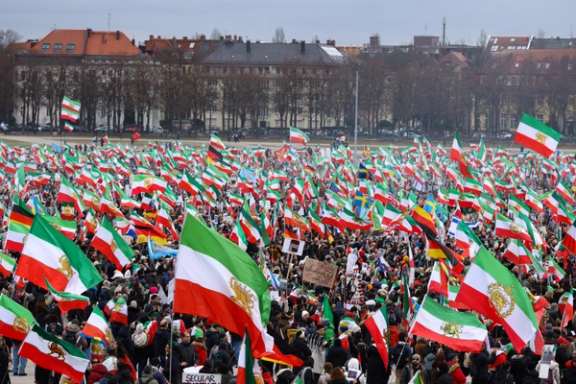
People were instructed to scrutinize buildings, roads, sounds, distances and other details visible in photographs and videos to determine where material had been recorded and submit information to Revolutionary Guards intelligence.
The project also sought to identify social-media users opposing the Islamic Republic, extending its scope beyond people recording events on the ground.
Alaj takes that crowdsourcing model beyond Iran’s borders, asking citizens to help identify overseas opponents and feeding the resulting information into a system that advertises consequences for those it identifies.
Overseas operations
Iranian intelligence activity targeting dissidents and journalists overseas has previously prompted criminal investigations, sanctions and warnings from Western governments.

Authorities in the United States and Europe have accused Iranian security bodies and people working on their behalf of conducting surveillance and plotting abductions or killings of opponents abroad.
Activities linked to Alaj could therefore face scrutiny under espionage, foreign-interference or transnational-repression laws in countries where targets live, depending on how information is gathered and subsequently used.












Be the first to comment