
Article By Chaim Lax
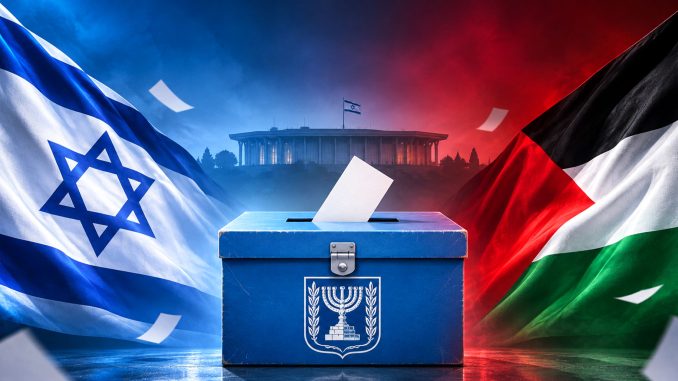
How do Israel’s Arabs self-identify? Why can’t Palestinians in the West Bank and Gaza vote in Israeli elections?
Key Takeaways:
- While some in the media portray Israeli Arabs as Palestinians, a May 2026 Moshe Dayan Center study found only 13.5% of Israeli Arabs call their Palestinian identity a key part of who they are.
- Israeli Arabs are not an ideological monolith, with some backing Jewish Zionist parties, some the secular Arab nationalist Joint List, and others the conservative Muslim party Ra’am.
- Palestinians in the West Bank and Gaza cannot vote in Israeli elections because they are not Israeli citizens, unlike the two million Israeli Arabs who do have the right to vote.
Following Israel’s recent national elections, two separate (but connected) anti-Israel talking points have made waves in both traditional media outlets and on social media.
The first is the prevalence of the term “Israel’s Palestinian citizens” (or a derivative of it) in news reports on the surge in votes from Israel’s Arab minority.
The second talking point is the claim that while the number of Israeli Arabs (or, as the media prefers, “Israeli Palestinians”) who participated in this election surged in comparison to previous elections, Palestinians in the West Bank and Gaza did not have the right to participate in this election.
Both talking points are meant to cast aspersions on the Jewish state; the term “Palestinian citizens of Israel” is meant to give the impression that Israel’s Arab minority should be viewed as bearing closer ties to neighboring Palestinian societies than to Israeli society, while the second talking point is meant to characterize Israel as an undemocratic society that denies democratic privileges to millions of its subjects based on their ethnicity.
As HonestReporting observed soon after the election results had come out, the media’s reference to Israel’s Arab minority as “Palestinian citizens of Israel” is a politicized misnomer. It is a case of outside observers attempting to recklessly force their political narrative into what is meant to be objective reporting.
The media outlets that use the term “Palestinian citizens of Israel” or a similar phrasing are attempting to cast Israel’s Arab minority as an ideologically homogenous monolith that identifies more closely with neighboring Palestinians than with Israeli society.
However, the truth is that Israel’s Arabs share a wide variety of ideologies and political allegiances. In this recent election, some voted for Jewish Zionist parties, some voted for the secular Arab nationalist Joint List, while others voted for the conservative Islamic party, Ra’am.
Further, when it comes to the self-identification of Israeli Arabs as Palestinians, a recent study (May 2026) by the Moshe Dayan Center for Middle Eastern and African Studies revealed that only 13.5% of Israeli Arabs view their Palestinian identity as a key component of their personal identity (down from 16.5% in May 2023). The study further found that Israel’s Arabs chiefly prioritize their Arab identity (33.3%) while also including their religious affiliation (24.5%) and Israeli citizenship (27.7%) as key components of their personal identity.
This is not to say that Israel’s Arabs don’t feel some sort of Palestinian identity. However, it is clear from this study that Palestinian identity is not the key component of their personal identity for most Israeli Arabs, and to label them as “Palestinian citizens of Israel” is to force upon them a classification that they do not identify with.
Who gave the media the right to tell Israel’s Arabs who they are? Throughout Israel’s election coverage, we’ve seen a familiar description repeated by international news outlets: “Palestinian citizens of Israel.” And yet, just 13.5% of Arab Israelis actually identify as Palestinian. The majority identify as either Arab or simply Israeli. Israel’s Arab citizens are not a monolith. Their identities are complex and varied. Yet journalists routinely flatten that diversity into a single description, as though millions of people must share the same understanding of who they are. So why do the media do this? By presenting Arab Israelis primarily as Palestinians, they blur a fundamental distinction between Israeli citizens and Palestinians living in Gaza or the West Bank. And in doing so, they give oxygen to the apartheid libel: the false impression that Israel grants voting rights to some while denying them to others simply because of their ethnicity. But Israeli national elections, just like those in the United States, Canada, France, Germany and countless other democracies, are based on citizenship, not ethnicity. An Arab Israeli votes for exactly the same reason a Jewish Israeli does: because they’re an Israeli citizen. Israel’s Arab citizens are woven into the very fabric of Israeli democracy. They run for office, lead political parties, sit in parliament and help determine the country’s direction. This week’s election offered an extraordinary demonstration of that political power. Arab-led parties are set to secure a record 19 seats in Israel’s 120-member Knesset, potentially giving them a pivotal role in determining who governs the country. Think about what that represents. In a Jewish-majority state, Arab citizens are exercising the democratic power to influence the composition of its next government. Not as outsiders. Not as spectators. As Israelis. And that’s what makes the media’s blanket terminology so troubling. It reduces a diverse community of Israeli citizens to a political cudgel, rather than recognizing them as individuals with their own identities, political voices, priorities and aspirations. Israel’s Arab citizens don’t all think alike. They don’t all vote alike. And they certainly don’t all identify alike. But they share something fundamental: a stake in the future of the country they call home, and the democratic right to help shape it.
— HonestReporting (@HonestReporting) October 29, 2026
With regard to the second anti-Israel talking point, the implied undemocratic nature of Israeli elections due to Palestinians in the Gaza and the West Bank not having the right to vote, it is simply a libel based on a distortion of reality.
The key to understanding why Israelis (both Arabs and Jews) can vote in Israeli national elections but not Palestinians living in the West Bank or Gaza is quite simple: The latter are not Israeli citizens.
If Israel were to grant them the right to vote in Israeli national elections, that would be tantamount to annexation of the territories, something that those putting forward this baseless talking point would vehemently oppose.
It should also be noted that Palestinians in the West Bank and Gaza can participate in elections. As enshrined in the Oslo II Accords, Palestinians in these two territories have the right to vote in elections for the Palestinian Legislative Council.
The fly in the democratic ointment is that these elections have not been held for 20 years. The last Palestinian legislative election was held in 2006, when Hamas won a plurality of seats and civil conflict broke out between the Islamist terror organization and Mahmoud Abbas’ Fatah party. This led to Hamas gaining complete control over the Gaza Strip.
A quick civics lesson for @guardian: 🇮🇱 Israeli citizens, including Arab Israelis, vote in Israeli elections. 🇵🇸 Palestinians in the West Bank and Gaza vote in Palestinian elections — when their leaders bother holding them. The fact that Palestinians who are not Israeli citizens don’t vote for Israel’s government is not shocking. The fact that The Guardian apparently finds this confusing is.
— HonestReporting (@HonestReporting) November 2, 2026
While there are some who claim that since Israel’s policies in the West Bank and Gaza have a direct impact on the local Palestinian populations, the Palestinians should be able to vote in Israeli elections, this is a bad faith argument and a red herring.
Whatever one thinks of Israel’s relationship with the West Bank and Gaza Strip, there is no law that requires Israel to extend the right to vote to the Palestinians in these territories. When the United States militarily occupied Germany after the Second World War, there was no argument that Germans had the right to vote in American elections. The same goes for when the U.S. and its allies helped administer Afghanistan and Iraq in the 21st century.
Just because one country’s domestic politics affects a group of non-citizens does not mean that those non-citizens have a right to vote in another country’s elections. If such a justification were enacted in this globalist day and age, it would create a system of anarchy where everyone would assert the right to vote in other countries’ elections, claiming that these elections would have a bearing on their own countries.
Just as it is ridiculous to claim that Canadians should have the right to vote in U.S. elections because the United States’ policies have a direct effect on Canada, it is equally ridiculous to claim that Palestinian non-citizens should have the right to vote in Israeli elections.
So, if the claim that Palestinians should vote in Israeli elections is baseless, why is this argument being put forward by mainstream media organizations and pundits on social media?
It appears that this is merely the latest instance of anti-Israel personalities attempting to smear Israel as a racist and apartheid state. This particularly vapid argument about Palestinians not having the right to vote in Israeli elections proving apartheid is clear proof of how immature and unserious the case against Israel is.












Be the first to comment