
Original Article By Thomas Brooke
The measures give police officers greater powers to stop and search without suspicion, but police unions have previously dismissed the city’s weapons-free zones as ineffective.
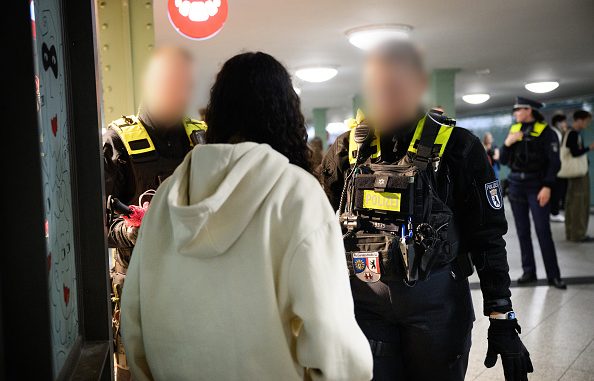
German Federal Police will enforce a month-long weapons ban at 15 train stations across Berlin from Oct. 1, a measure that allows officers greater powers to stop and search passengers.
The move is aimed at combating what authorities describe as a growing problem of violent crime on the German capital’s public transport.
In a statement, the Federal Police said, “The number and intensity of violent crimes on railway premises continue to increase. Knives and other dangerous objects are frequently used.” The ban extends beyond knives to include tear gas, blunt instruments, and other potentially dangerous items.
The prohibition will be in effect daily between 2 p.m. and 4 a.m. until Oct. 27. The last time such a measure was imposed, from late May through July, police conducted nearly 10,000 checks and confiscated more than 700 weapons and other prohibited objects.
🇩🇪🗡️ Machetes are on sale from a Berlin discount store despite a huge surge in knife attacks across Germany.
— Remix News & Views (@RMXnews) May 30, 2025
"79 knife crimes per day in 2024 and at the discount store you can buy a machete with a barb for €9.90," wrote the German police union deputy chairman @M_Ostermann.
The… pic.twitter.com/gL5YuUKi9X
The affected train stations include major hubs such as Berlin Central Station, Zoologischer Garten, Alexanderplatz, Ostkreuz, and Lichtenberg, as well as suburban locations like Spandau, Neukölln, and Südkreuz.
The move comes amid heightened concern about knife crime in the capital. Since mid-July, Berlin has already banned knives on all buses, trains, and at stations, with fines of up to €10,000 for violations.
According to police data cited by Berliner Zeitung, 324 knife attacks have taken place in the city over the past three years.
Public concern intensified in April after a Syrian migrant fatally stabbed a passenger on the U12 subway line. The 43-year-old attacker was shot by police and later died in hospital. In the aftermath, Interior Senator Iris Spranger of the Social Democratic Party proposed expanding weapon ban zones across the city’s transport network.
“Regardless of yesterday’s homicide, we are examining the establishment of further knife and weapon ban zones in Berlin,” Spranger told Tagesspiegel at the time, arguing that the zones act both as deterrents and as a symbolic message that violence will not be tolerated.
However, the measures have drawn criticism from police representatives. Benjamin Jendro, spokesperson for the Berlin Police Union, dismissed the expansion of prohibition zones back in April as “too short-sighted.” He said recent fatal stabbings demonstrate that what he called “placebo” bans do little to stop determined attackers.
“The police, however, will not be able to control this permanently and comprehensively in the future,” Jendro warned, noting that knives are already banned under Berlin’s public transport rules, which have not prevented violent incidents or deterred the significant numbers still intent on carrying weapons.
🇩🇪🎄 German police are now confiscating pocket knives from elderly women at Christmas markets.
— Remix News & Views (@RMXnews) December 17, 2024
Exploding knife crime in Germany, which the police openly says is tied to mass immigration, has led to a security state at German Christmas markets. pic.twitter.com/nRTQRIOr2d
The rise in knife crime across Germany is undeniably linked with its policy of mass immigration. A total of 730 cases of violent knife crimes were recorded across the country in the first half of 2025, a 17 percent increase compared to the same period last year.
This data, provided by the German government in response to a parliamentary query from Alternative for Germany (AfD) domestic affairs spokesman Martin Hess, showed a disproportionate overrepresentation of foreign suspects.
Out of the recorded offenses, 278 involved German suspects and 270 involved non-Germans, despite foreigners comprising just under 15 percent of Germany’s population. This figure is already distorted due to the fact that naturalized foreign-born individuals are categorized as “German” in federal crime statistics.
Among the foreign perpetrators, Syrians formed the largest group with 29 cases, followed by Afghans with 23 and Poles with 20. Algerian and Afghan suspects were among the most likely to use a knife rather than merely carry one, with 83 percent of cases involving actual use.



Be the first to comment