
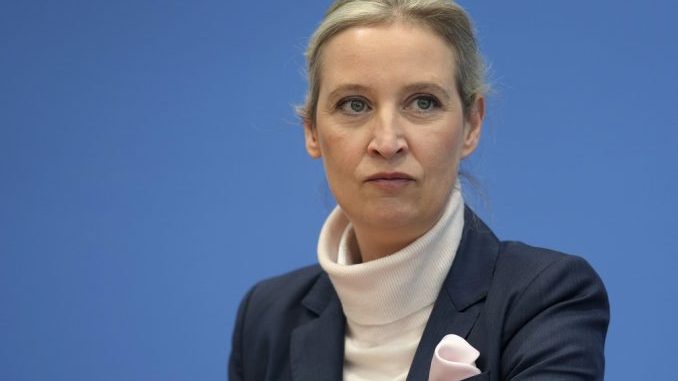
The co-leader of the Alternative for Germany (AfD), Alice Weidel, is reportedly filing criminal charges in cases where citizens insult her, which the AfD has harshly criticized as a violation of free speech.
The law, known as Section 188 of the Criminal Code (StGB), allows for criminal charges in cases involving “insults, slander, and defamation directed against political figures.” The law has been harshly criticized after it was revealed that top politicians, including former Economic Minister Robert Habeck, had used the law hundreds of times to go after those deemed to have used “insults.” In fact, Habeck himself is said to have filed at least 800 complaints.
The law, in its current form, is relatively new. The basis of it was already established in 1951 regarding “defamation” and libel, but the clause for “insults” was added in 2021.
Since then, it has become a thriving industry for lawyers and politicians, both which earn significant sums of money every time a citizen is successfully prosecuted for an “insult.”
However, the revelation that Weidel has been also using it has been met with criticism, especially because Weidel has officially said she wants the law abolished. That also happens to be the position of the AfD.
Weidel’s spokesperson defended the party leader’s use of the law as “legal equality of arms.” The spokesperson said the AfD continues to reject the law, but “it would be foolish for the AfD not to defend itself until it was abolished.”
There may be some sound reasoning in this argument, but abolishing the law is probably made more difficult when those advocating against the law continue to use it.
So far, it is unclear who Weidel has filed criminal complaints against and what was said or written. Was she called a “Nazi pig” or just labeled an “idiot?” There are broad range of possible insults, with some more extreme than others.
Habeck infamously filed a complaint against someone who called him an “idiot.” Former Interior Minister Nancy Faeser filed a complaint against a photoshopped picture of her holding a sign stating: “I hate freedom of expression.” Former Foreign Minister Annalena Baerbock filed a complaint against someone who called her the “worst foreign minister ever.”
When these cases were picked up by the press, they painted a picture of thin-skinned politicians getting rich off filing ridiculous complaints. In some cases, such as the “idiot,” comment, police house raids even occurred, painting the picture of a German political class sliding into authoritarianism.
Being a politician is a rough business, and there is no doubt levels of harassment and sometimes even death threats many of these politicians, both on the right and left, are constantly dealing with. Death threats, however, were always illegal, long before this “insult law” came into effect.
Weidel is setting herself up for serious criticism here, and at least one party is already dishing it out.
“Wanting to abolish something politically, but then using it hundreds of times yourself, is – to say the least – inconsistent. This puts Alice Weidel on Habeck’s level,” said left-wing politician, Sahra Wagenknecht, leader of BSW while speaking with Welt.
Wagenknecht said she sees the law, Section 188, as an “authoritarian restructuring of society” and wants it abolished.
“A lèse-majesté clause is inappropriate for a liberal country. It is part of an authoritarian restructuring of society in which politicians no longer want to face public criticism, but instead let public prosecutors loose on them,” she said.
Wagenknecht also noted that she believes there were numerous instances when she could have used the law but did not.
“I could have reported Karl Lauterbach alone several times for outrageous insults, but I didn’t,” said Wagenknecht regarding the former federal minister of health, an SPD politician. Just last week, Lauterbach viciously described the BSW as a “party of Putin’s servants” and called Wagenknecht’s party’s failure to enter the Bundestag a “blessing.”
“This can be used to silence any criticism of the government. If a citizen considers Habeck an ‘idiot,’ that is covered by freedom of expression in a liberal society,” she added.
Perhaps one of the most ridiculous aspects of the “insult” law is that it only appears to apply to the “smallest” people. These comments from social media users are often found by AI software and the comments of themselves often have little to no engagement. In other words, these insults are not “impeding” the work of the politicians involved. Those delivering the biggest insults to the biggest audiences, such as the court jester of the German establishment, Jan Böhmermann, freely dish out insults with little consequence.
In a free society, the “little people” can speak their minds as much as the elite, but that is clearly not the case here. Weidel is not helping the degradation of free speech in Germany either by joining the bandwagon.





Be the first to comment