
Article By Ken Macon
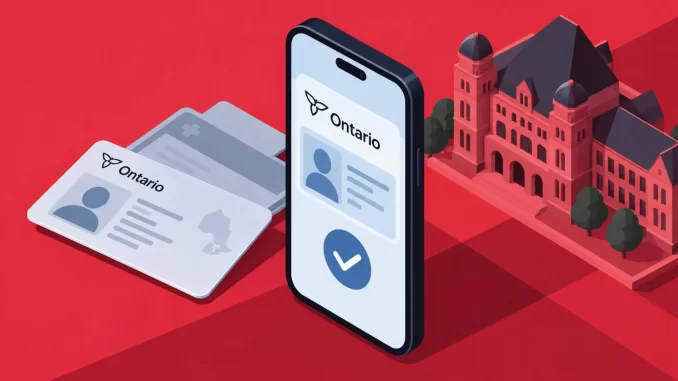
The Canadian province of Ontario announced that it is starting a phased rollout of its digital provincial ID, starting with a digital version of the Ontario Photo Card, with other documents, such as driver’s licenses and health cards, to follow at a later date.
The Ontario Photo Card is a government-issued photo ID for residents 16 and older who do not have a driver’s license, and is used for “day-to-day business transactions” and as proof of identity for travel within Canada. The digital version is to be tested first, and the physical one is not going away – at least, not yet.
“Digital credentials will provide a trusted and seamless way to present identification, helping protect personal information while retaining every Ontario resident’s right to use physical I.D.,” said Minister of Public and Business Service Delivery and Procurement Stephen Crawford.
Crawford also said that the digital ID will be “more secure, convenient and cost-effective” as the province modernizes its services.
The government promises that the digital credentials will offer “an added layer of security by reducing the risk of lost or stolen identification and identity theft.”
The press release does not go into how exactly this will be achieved, nor does it reveal which company is building the app for the digital ID, what data each check sends, whether the province logs each check, or how long the records are kept.
There is also no information on who will be able to demand to see the digital credential, but the release does say that the government will “explore potential cost-savings for government and taxpayers.”
The province will start consulting the public “in a way that protects privacy, builds public trust and meets the needs of Ontarians” later in 2026, and is planning to pass legislation to make sure that people can continue to use physical ID, in late 2027.
That is more than a year from now, and a lot can happen between now and then. And even if the promise is kept, the question remains how useful a piece of paper will be in a world that has moved on to using phones for this purpose.
This is how Minister of Transportation Prabmeet Sarkaria described digital ID: “a convenient, secure, and fraud-proof method of accessing public and business services.”
“Advancing plans to provide optional access to secure digital credentials, including health cards, is one of many ways we are doing just that,” said Health Minister Sylvia Jones.
The move “aligns with numerous jurisdictions, including Alberta, Quebec and British Columbia,” the announcement said.
A year ago, at a committee hearing, MPP Karen McCrimmon said that the topic “creates a bit of angst in people.”
However, at the time, Crawford responded that “digital credentials are something that we are actively considering.”
Which countries now demand ID online?
53 countries and territories have passed age ID check laws. See where yours stands.
Open the world mapUS mapTake action
At the same hearing, the ministry’s Chief Information Officer Mohammad Qureshi said that “the official digital credentials program was officially closed in 2024” and that at the time, “we are not doing any work on digital identity or digital credentials.”
A year later, the province has a plan to roll out digital ID, starting with the Ontario Photo Card.
In the US, several states have already introduced mobile ID, which is often first used for airport security checks, and then for age verification purposes. Kentucky is one of those states, and its mobile ID was promoted as “a secure and convenient option.”
The digital ID trend is global, with Germany’s Bundestag passing its EU wallet law this month, and Apple expanding the use of its Wallet ID, which was first introduced for airport security checks, and is now also used to prove a user is over 18 when using apps that are rated 18+.
The “optional” nature of digital ID is something that is often promoted by governments, but this is a status that holds only as long as the places that check ID keep accepting physical documents. Once banks, services, and websites start relying on the digital version as the primary, or only form of ID, those who opt for physical ID will be relegated to the slow lane, unable to access services, and eventually, they will be forced to upgrade to the digital version.
Another point that is often glossed over by digital ID advocates is that presenting your credentials on a phone can leave a digital trail of every single instance when the ID is checked, creating a highly detailed profile of a person’s movements and activities. Ontario has chosen to paper over this issue by promising to protect people’s right to use physical ID before it has even explained what data the digital version will collect and how it will be used.












Be the first to comment