
Article By David Lindfield
The United States has deployed weapons in space capable of defending American forces against hostile actions, Air Force Secretary Troy Meink revealed in an extraordinary public acknowledgment of U.S. military capabilities in orbit.
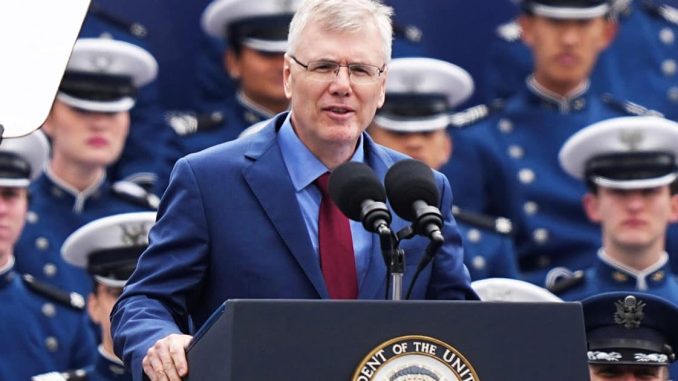
Meink disclosed the existence of the weapons during his keynote address at the Air & Space Forces Association’s annual conference in National Harbor, Maryland.
“Today, we continue to ensure we remain ready to meet the challenges of evolving threats wherever they exist,” Meink said.
“This is why the United States now has on-orbit space control weapons capable of defending the joint force against hostile adversary actions.”
The declaration came during Meink’s speech, “Advancing Combat Power in Air and Space,” but the Air Force secretary offered no details about the weapons, their capabilities, or precisely what missions they are designed to perform.
Meink made clear afterward that the wording of his revelation was deliberate.
Asked about the statement during a question-and-answer session, Meink declined to elaborate.
“That phrase was very well thought out,” he said.
U.S. Moves to Protect Critical Assets in Space
The acknowledgment marks a significant moment in the military competition over space, which has been a strategic concern since the Soviet Union launched Sputnik in 1957.
Meink said America’s growing dependence on satellites and other orbital systems means the military must be capable of protecting those assets as adversaries develop technology designed to threaten them.
“Our maintaining and being able to count on those space capabilities is important, and as everybody knows, there have been many who have developed capabilities to take those away from us, to threaten those things,” Meink said.
“So it is critically important that we maintain our dominance not only in the air but in space.”
The secretary said the United States has therefore been forced to develop the means to respond when those systems come under threat.
“So, we’ve had to take steps to make sure that when we’re threatened, we can take care of that,” he said.
Space Force Prepares for Combat beyond Earth
The disclosure follows the U.S. Space Force’s release of its space warfighting framework in 2025, which identified “Space Control” as a core military function necessary to achieve superiority in the domain.
“Space control comprises the activities required to contest and control the space domain,” the framework states.
Those activities include “counterspace operations,” ranging from offensive orbital and terrestrial strikes to what the military calls Space Link Interdiction.
Space Link Interdiction involves “actions taken to disrupt, deny, or degrade an enemy’s critical space links,” including non-kinetic methods such as electromagnetic and cyberattacks.
The framework also includes defensive operations such as threat warnings and counterattacks.
Meink’s carefully worded announcement indicates that at least some U.S. space-control capability has moved beyond doctrine and planning and is already operating in orbit.
What those systems actually do remains undisclosed.
Trump’s Golden Dome Expands Space-Based Defenses
Meink separately highlighted the Space-Based Interceptor Program under President Donald Trump’s Golden Dome missile defense initiative.
The interceptor program remains under development and is intended to form part of a broader architecture designed to defend the United States against missile attacks.
Meink said the military’s fundamental mission remains straightforward:
“Defend the homeland, deter all adversaries, and, if necessary, win in combat.”
But the battlefield is rapidly changing.
From one-way attack drones to artificial intelligence and increasingly sophisticated space capabilities, Meink warned that America’s adversaries are moving aggressively to exploit emerging technology.
“Today we face a mix of rapidly changing technologies and adversaries moving aggressively to employ them,” he said.
“If we expect to deter our adversaries, we must increase our combat power, innovate faster than anyone else, affordably.
“We need cost-effective combat power.”
The United States has spent decades relying on orbital systems for communications, intelligence, navigation, missile warning, and military operations around the world.
Now, the Air Force secretary has publicly confirmed another part of America’s presence above Earth: weapons already in orbit designed to ensure hostile powers cannot take those capabilities away.












Be the first to comment