
Article By Frank Bergman
Fresh concerns are being raised about the rapid expansion of America’s AI-powered surveillance network after reports highlighted an alleged connection between a major investor in Flock Safety and an Israeli cyber company capable of secretly hacking security cameras and altering video footage.
The allegations have fueled fears that emerging surveillance technologies could one day be weaponized to fabricate evidence or conceal criminal activity.
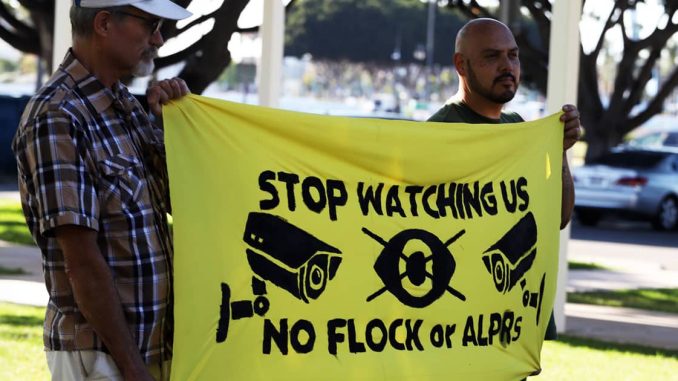
Flock Safety operates one of the nation’s fastest-growing automated license plate reader (ALPR) networks, with tens of thousands of AI-powered cameras tracking vehicle movements across the United States.
Meanwhile, Israeli cyber firm Toka has developed technology that reportedly enables government clients to hack internet-connected security cameras, monitor live video feeds, and even manipulate both live and previously recorded footage.
The reported overlap has sparked intense debate online about the risks of combining mass surveillance with increasingly sophisticated cyber capabilities.
Report Highlights Alleged Investment Link
According to Gadget Review, Bedrock Capital led Flock Safety’s $275 million funding round.
The outlet also examined claims circulating on social media alleging that Bedrock has ties to Toka.
“Bedrock Capital leads Flock Safety’s $275M round while alleged ties to Toka, which reportedly erases camera footage without a trace, draw scrutiny,” Gadget Review reported.
An X post from user @OrwellDay alleged that Flock’s lead investor also backs Toka.
However, Gadget Review noted that while Flock’s investors are well documented, publicly available evidence does not currently confirm whether those same investors also hold a stake in Toka.
“That gap between allegation and evidence is the story—not a footnote,” the outlet wrote.
Israeli Firm Reportedly Can Alter Security Camera Footage
Toka first drew international attention in 2022 after an investigation by Israeli newspaper Haaretz detailed the company’s capabilities.
According to the report, Toka was co-founded by former Israeli Prime Minister Ehud Barak and retired Israel Defense Forces cyber chief Brig. Gen. Yaron Rosen.
Haaretz reported that the company develops cyber tools allowing government customers to locate internet-connected security cameras within a specific area, gain unauthorized access to those cameras, monitor live video, and alter both live and archived footage.
The publication reported that Toka works almost exclusively with government agencies, intelligence services, and law enforcement organizations.
Israel’s Defense Ministry regulates its activities.
As of 2021, internal documents reviewed by Haaretz indicated the company held contracts worth approximately $6 million with the Israeli government while seeking to expand those deployments.
Flock’s Surveillance Network Continues to Expand
Flock Safety’s controversial AI-powered camera system has rapidly spread across the United States.
According to Gadget Review, the company retains vehicle data for roughly 30 days, allowing participating law enforcement agencies to search historical vehicle movements.
Flock maintains that its system tracks vehicles rather than individuals.
Privacy advocates argue that distinction offers little reassurance because vehicles typically reveal where people live, work, worship, travel, and socialize.
Independent security researchers have also claimed that certain Flock camera hardware can reportedly be physically compromised in under 30 seconds, potentially exposing credentials and video streams.
Those findings have not been independently verified by government regulators.
BREAKING: Lead investor behind Flock Camera Technologies caught funding a firm that is able to locate, hack, and ALTER both live and archived security camera footage without a detectable trace.
— Douglas Macgregor (@DougAMacgregor) August 6, 2026
Guess who he is also linked to… https://t.co/HexoxsMkGW
Security Camera Vulnerabilities Well Documented
Concerns over surveillance systems extend well beyond any one company.
Researchers have repeatedly demonstrated that internet-connected security cameras can be compromised.
In 2019, Forbes detailed how researchers successfully hacked surveillance systems and replaced live camera feeds with prerecorded footage.
Since then, rapid advances in artificial intelligence have dramatically expanded the ability to generate highly realistic synthetic video.
Cybersecurity experts have also identified vulnerabilities across numerous commercial surveillance platforms.
One of the most high-profile incidents occurred in 2021 when hackers breached cloud-based surveillance company Verkada.
According to the American Civil Liberties Union (ACLU), attackers gained access to approximately 150,000 cameras installed inside hospitals, schools, prisons, police stations, offices, gyms, and women’s health clinics.
The hackers reportedly viewed live feeds from highly sensitive locations, including patient rooms inside hospitals.
The ACLU warned that cloud-connected surveillance networks create centralized targets capable of exposing enormous volumes of private video if compromised.
BREAKING: Lead investor behind Flock Camera Technologies caught funding a firm that is able to locate, hack, and ALTER both live and archived security camera footage without a detectable trace.
— Douglas Macgregor (@DougAMacgregor) August 6, 2026
Guess who he is also linked to… https://t.co/HexoxsMkGW
Surveillance Expanding Beyond Fixed Cameras
The expansion of AI surveillance is no longer limited to fixed camera systems.
Gadget Review recently reported that police in Lancaster, New York, plan to begin deploying drones capable of livestreaming neighborhoods while automatically recording license plates from the air.
The program is expected to begin in September.
Combined with increasingly sophisticated AI systems, expanding surveillance infrastructure, and documented cyber vulnerabilities, critics argue the technology raises profound questions about privacy, accountability, and the integrity of digital evidence.
While the reported financial link between Flock Safety’s investors and Toka remains unconfirmed, the broader concern extends far beyond any single company.
As surveillance networks continue expanding nationwide, many observers warn that hacked cameras, manipulated footage, and AI-generated video could eventually pose challenges for law enforcement, the courts, and public trust.












Be the first to comment