
Article By Frank Bergman
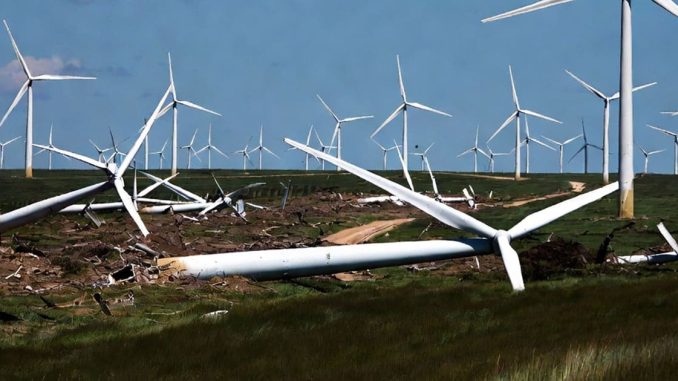
A South Dakota wind farm has been left crippled after powerful winds tore through the facility and destroyed or damaged more than 20 turbines.
The storm struck earlier this week with hurricane-force gusts that ripped across Hyde County, northwest of Sioux Falls.
Engie North America said Friday that it is assessing the damage at the Triple H Wind farm.
The site, which has 92 turbines, remains out of service.
South Dakota Governor Larry Rhoden declared a state of emergency after the June 29 storm caused widespread damage across the region.
The winds reached extraordinary speeds.
Gusts of 131 mph were recorded near Holabird in Hyde County around 6:15 a.m. local time.
Officials said the winds were produced by a severe thunderstorm rather than a tornado.
That means the turbines were not destroyed by rotating tornadic winds.
They were ripped apart by straight-line winds.
Turbines Toppled Across Prairie
The storm devastated the South Dakota Wind Energy Center, also known as the Highmore Wind Farm.
The facility sits about 10 miles south of Highmore.
Images from the scene showed collapsed towers, mangled blades, and twisted debris scattered across the prairie.
Storm chaser Jakob McMillin captured dramatic photos of the destruction and shared them on X.
His images showed multiple turbine towers either fully toppled or severely damaged.
Shattered blades and warped structural debris could be seen across the open landscape.
Unbelievable damage to a wind farm near Highmore, South Dakota after this morning’s storm. #sdwx pic.twitter.com/Uucyapxfej
— Jakob McMillin (@McMillinWx) June 29, 2026
McMillin later reported seeing “over 20” turbines destroyed or critically damaged at the site.
Visual evidence showed at least seven towers visibly bent or knocked down by the storm.
The damage exposed a basic weakness of wind infrastructure.
When extreme weather hits, the same machines sold as a reliable part of the energy future can be left useless in a matter of minutes.
Rare Winds Crush Renewable Energy Site
Meteorologists described the event as highly unusual.
One widely shared update noted that wind turbines rarely suffer this level of damage from straight-line winds.
“This is very rare,” the update stated.
“We hardly ever see windmills take this much damage from straight-line damaging winds.
“But when you push over 110 MPH winds, it becomes a lot easier for the windmills to crumble.”
The storm’s macrobursts delivered sustained destructive force across the region.
Agricultural structures surrounding the wind facility were also hit.
No immediate injuries were highlighted in initial reports.
However, the scale of the physical destruction at the wind farm underscores the risks facing renewable energy infrastructure in volatile weather zones.
The affected site came online in 2003 as South Dakota’s first major wind installation.
It includes 27 turbines manufactured by GE Vernova.
Each turbine is rated at 1.5 megawatts, giving the facility a total nameplate capacity of 40.5 megawatts.
The wind farm is owned and operated by NextEra Energy Resources and supplies power to Basin Electric Power Cooperative.
Wind Power’s Weather Problem
The destruction in South Dakota creates an obvious problem for the green energy narrative.
Wind farms are promoted as the backbone of a cleaner, more resilient power grid.
But the Highmore damage shows that wind turbines can be highly vulnerable to the very forces they are supposed to harness.
A severe thunderstorm swept through the area, and more than 20 turbines were destroyed or critically damaged.
The facility is now out of service.
Crews are still assessing how much equipment can be repaired and how much must be replaced.
That process will likely be expensive, time-consuming, and disruptive.
The incident also raises broader questions about the reliability of renewable energy infrastructure in regions prone to violent storms.
Wind turbines are massive, costly machines placed in open landscapes precisely where wind is strongest.
That makes them productive under normal conditions.
It also exposes them when the weather turns extreme.
For South Dakota, the storm was a reminder that nature does not obey green energy planning.
The same winds that power turbines can also tear them apart.












Be the first to comment