
Original Article By Newser
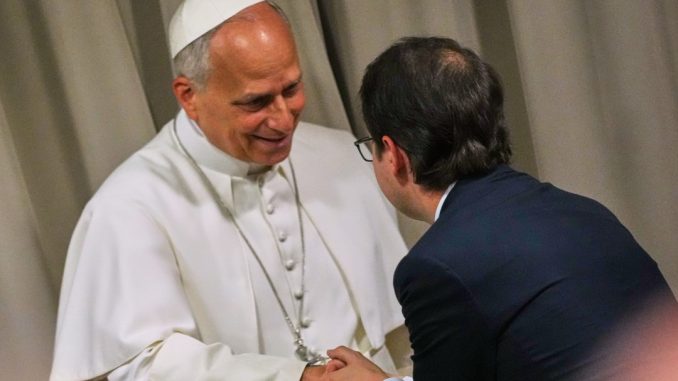
At a Vatican rollout on May 25, 2026, the Vatican published a roughly 42,000-word encyclical titled “Magnifica humanitas”, focusing on the social and moral risks of artificial intelligence, reporting by The Washington Post and Newser says. Christopher Olah, co-founder of Anthropic, joined Pope Leo XIV at the event and urged that AI decisions not be left to technologists alone, per Forbes and The Washington Post. The encyclical calls for limiting algorithmic warfare and reducing monopolistic control of AI, The Next Web reports. Reporting by Newser and The Next Web notes that Anthropic has recently clashed with the Trump administration and the Pentagon over conditions on military and surveillance uses of its technology. Public reaction ranged from praise for centering human dignity to memes and political pushback, according to coverage in The Guardian and Newser.
What happened
The Vatican released a new papal encyclical, “Magnifica humanitas,” on May 25, 2026, that addresses the moral and social implications of artificial intelligence, according to The Washington Post and Newser. The document is described in press coverage as roughly 42,000 words and comprises 245 paragraphs, per The Next Web and The Guardian. At the Vatican rollout, Christopher Olah, identified in multiple reports as an Anthropic co-founder and research lead, appeared alongside Pope Leo XIV and spoke about the need for outside scrutiny of AI development, per Forbes and The Washington Post. The encyclical explicitly criticises concentration of power in AI and rejects algorithmic warfare, with passages quoted by The Next Web including, “To disarm means discrediting the assumption that technical power automatically confers the right to govern.”
Technical details
Editorial analysis – technical context: The coverage notes that Olah is associated with research into model interpretability and that Anthropic is the maker of the Claude chatbot and the Mythos model, details reported by Forbes and Newser. Reporting also highlights Anthropic’s public positioning on safety and stricter AI rules, and cites recent disputes between Anthropic and US officials over military and surveillance uses of its tools, per The Next Web and Newser. These items frame the engagement as one where questions about model behaviour, transparency, and dual use are central to the public debate.
Context and significance
Multiple outlets place the encyclical in a broader policy debate. The Guardian frames the letter as an attempt to foreground human dignity in the AI era and connects it to historical Catholic social teaching. Forbes and The Washington Post report that Olah warned of large-scale job displacement and called for civil society and religious institutions to apply moral scrutiny. The Next Web and coverage in The Washington Post note tension between the Vatican’s call for limits and recent actions by the White House and parts of the US political landscape, including an executive order discussed in press reports.
Observed reactions and frictions
Reporting by Newser and The Washington Post documents immediate pushback from political quarters and public commentary; The Guardian editorial welcomed the moral framing, while social-media responses included memes that lampooned the alliance between the Vatican and a Silicon Valley AI lab. Forbes published valuation figures and personal-wealth estimates for Anthropic and Olah, noting Forbes estimates Anthropic at $380 billion and reporting on commentary that the company has sought larger valuations in private markets.
What to watch
For practitioners: Observers should follow three indicators in coming weeks: how policymakers cite the encyclical in legislative debates on AI governance; whether faith-based and civil-society groups form cross-sector coalitions with research labs; and any changes in procurement or licensing rules for military AI that reference ethical or religious arguments. Reporting to date does not include an official Vatican statement of implementation steps, and none of the covered sources attribute a specific policy roadmap to Anthropic or the Holy See.
Summary takeaway
Reporting across The Washington Post, Forbes, The Next Web, The Guardian, and Newser documents an unusual public alignment at the Vatican event that foregrounds ethical limits on AI, highlights interpretability research and safety messaging from an industry figure, and brings religious moral language into active proximity with ongoing US policy disputes over AI and military use. Editorial analysis: This convergence is significant for public discourse about governance and for practitioner conversations about accountability, but the sources do not record an announced operational plan from either the Vatican or Anthropic.
The Bible tells us in Revelation 13:
11 Then I saw another beast coming up out of the earth; it had two horns like a lamb, but it spoke like a dragon. 12 It exercises all the authority of the first beast on its behalf and compels the earth and those who live on it to worship the first beast, whose fatal wound was healed. 13 It also performs great signs, even causing fire to come down from heaven to earth in front of people. 14 It deceives those who live on the earth because of the signs that it is permitted to perform in the presence of the beast, telling those who live on the earth to make an image of the beast who was wounded by the sword and yet lived. 15 It was permitted to give breath to the image of the beast, so that the image of the beast could both speak and cause whoever would not worship the image of the beast to be killed. 16 And it makes everyone—small and great, rich and poor, free and slave—to receive a mark on his right hand or on his forehead, 17 so that no one can buy or sell unless he has the mark: the beast’s name or the number of its name.
In my opinion, the “image” of the beast will be an AI, because AI will be globally tied in to track everyone on earth. It makes perfect sense.














Be the first to comment