
Article By David Lindfield
Minnesota authorities are warning about a growing threat from Somali street gangs as young members turn social media disputes into shootings across suburban Minneapolis-St. Paul, endangering residents and forcing police to redirect resources.
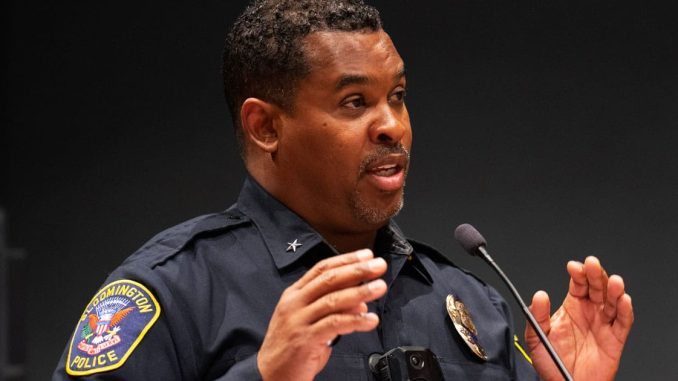
Bloomington Police Chief Booker Hodges said the gang members under investigation come from families with money and resources, defying traditional explanations centered on poverty, drug trafficking, or financial gain.
“They’re coming from families,” Hodges told Fox News Digital.
“They got money, and they have resources.”
The violence has raised urgent questions about recruitment, assimilation, parental involvement, and whether local prosecution policies are hampering efforts to intervene.
Police Redirect Resources Toward Gangs
Hodges said police are shifting task force resources toward the gangs following a string of suburban shootings.
The chief also questioned whether some Hennepin County prosecution policies could limit intervention.
Investigators have identified social media disputes as a factor but have struggled to explain what else is driving young people from financially comfortable households into gang violence.
“I don’t know,” Hodges said when asked about the underlying motivation.
“I can’t tell you. I really wish I could.”
The danger was demonstrated by a late-night Bloomington gunfight that involved more than 100 rounds and left one person injured.
Hodges warned that the consequences could have been far worse with more people outside.
“If that had been one o’clock in the afternoon, it would have been a different story on that block,” Hodges said.
Expert Warns Gangs Could Become Entrenched
Jessica Vaughan, director of policy studies at the Center for Immigration Studies, warned that the gangs could become more organized without intervention.
Although the groups have not reached the sophistication of transnational criminal organizations such as MS-13, Vaughan said families, schools, local institutions, and law enforcement must act before recruitment and violence become entrenched.
She also questioned whether the federal government’s approach to refugee resettlement had made integration more difficult.
More than 111,000 Somali refugees entered the United States through the federal refugee resettlement program between 2001 and 2023.
Minnesota became a major destination, alongside sizable Somali American communities in New York, Texas, and Ohio.
“We have to remember also that this population’s origins were as refugees who were a vulnerable population and traumatized in many cases,” Vaughan told Fox News Digital.
“But they were settled in clusters in certain places in the United States.
“And I believe that is a policy that has facilitated the formation of these gangs because it removes a lot of the incentives for people to assimilate.
“And it just makes assimilation to the larger society much more difficult because it’s not necessary for people to get by,” Vaughan continued.
Vaughan described prioritizing the preservation of homeland cultures over integration as a “missed opportunity,” arguing that it can leave immigrants in a “separate society within the larger Minnesota community.”
She had not established that specific schools or resettlement policies prompted the shootings.
Community Leaders Point to Parenting and American Upbringing
Somali community figures have offered their own explanations for the violence.
At an Eden Prairie news conference Wednesday, teacher Fardousa Yossuf suggested that parents working long hours may have neglected their children’s needs.
According to Alpha News, she also expressed disbelief that people raised with Islamic values would engage in gun violence.
Imam Yusuf Abdulle rejected describing the shootings as a Somali problem.
“These kids are Americans,” Abdulle told WCCO.
“They’re born and raised here.
“It is an American problem.
“It is not a Somali problem.”
Hodges said investigators have found no evidence that longstanding Somali clan rivalries are driving the violence.
“No, we have not seen that. I haven’t seen it,” Hodges said.
He noted that people from groups in conflict in Somalia can belong to the same cliques in Minnesota.
Assimilation Debate Does Not Resolve Immediate Threat
Stanford sociologist Tomás Jiménez argued that gang involvement among some second-generation immigrants should not be treated as evidence that an entire community has failed to integrate.
“I would actually not think of it as, like, a failed assimilation, as much as a particular kind of assimilation,” Jiménez said.
He pointed to gang activity among earlier Italian, Irish, Mexican, and Salvadoran communities while broader integration continued.
Queensborough Community College immigration scholar Donald Tricarico likewise emphasized that integration unfolds over generations.
“There isn’t a switch that gets flipped,” Tricarico said.
“Assimilation is a slow crawl,” Tricarico added.
Meanwhile, police are confronting the immediate consequences: armed gangs, repeated shootings, and online arguments escalating into violence in residential neighborhoods.
Vaughan’s warning is that waiting to intervene could allow those groups to become a far more organized and enduring threat.












Be the first to comment