
Article By RT
The two nations’ leaders are slated to discuss the Iran war, AI rivalry, Taiwan, and trade frictions
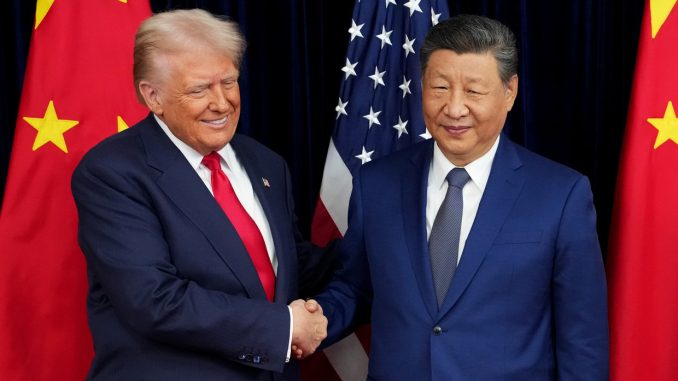
Donald Trump is set to touch down in Beijing, China, on Wednesday for a two-day state visit – the first by a US president in eight years – as relations between the world’s two largest economies teeter at a crossroads defined by the Iran war, trade friction, and technological rivalry.
The visit is expected to feature a bilateral meeting with President Xi Jinping on Thursday morning, to be followed by a visit to the Temple of Heaven and a state banquet, as well as a working lunch on Friday before Trump departs for home.
White House Principal Deputy Press Secretary Anna Kelly described the trip as “a visit of tremendous symbolic significance” while teasing “more good deals on behalf of our country.”
The high-stakes talks will likely revolve around the US-Israeli war on Iran – which was the reason for postponing the visit, originally scheduled for late March – as well as Taiwan, artificial intelligence, and critical minerals.
Iran and oil
The Iran war and the Hormuz crisis are expected to loom large over the agenda, with an unnamed US official telling reporters during a briefing that Trump would likely “apply pressure” on China on the purchase of Iranian oil and on the alleged supply of dual-use components to Tehran.
The hallmarks of this approach became evident last week when the US sanctioned Chinese refineries buying Iranian crude, as well as what Washington described as “China-based entities providing satellite imagery to enable Iran’s military strikes against US forces.”
In response, China ordered its firms to ignore US sanctions, a move Max Meizlish, a research fellow at the Foundation for Defense of Democracies, described as an “unprecedented… measure of defiance by Beijing.”
Trump is also expected to call on Xi to leverage Beijing’s unique clout over Tehran to reopen the Strait of Hormuz, a critical waterway accounting for around 20% of pre-war seaborne oil trade. China, itself the world’s largest buyer of Gulf oil, has been sympathetic to the cause, urging Tehran to remove obstacles to maritime traffic.
The ‘Five Bs’ of trade
The two leaders are poised to discuss what observers have labeled the ‘Five Bs’: Chinese purchase of Boeing aircraft, American beef and soybeans, and the creation of a Board of Trade and a Board of Investments.
On Boeing, the leaders could greenlight the purchase of as many as five hundred 737 MAX aircraft and about 100 widebody jets for several Chinese flight operators. The deal would be valued at tens of billions of dollars, and Boeing CEO Kelly Ortberg is reportedly a member of the US delegation.
As the world’s largest importer of soybeans, China has historically purchased half of US exports of the crop and has been a primary market for American agricultural produce. The soybean trade has not been problem-free, however, as US beans currently face a total duty of 13% from China, while Brazilian beans are subject to only 3%. In addition, while China fulfilled its pledge to purchase 12 million metric tons of beans in 2025, it is unclear whether Beijing will meet the larger target of 25 million tons annually for 2026-2028.
Taiwan hotspot
Taiwan, which China regards as part of its sovereign territory, has long been a sore point in relations between Washington and Beijing. Chinese Foreign Minister Wang Yi has described the self-governed island as “the biggest point of risk” in the bilateral relationship and urged Washington to “honor its commitments and make the right choice, to open up new space for China-US cooperation.”
Several media reports have indicated that China wants Trump to say the US “opposes” Taiwanese independence, rather than the current language, with officials in Taipei nervous that the US president could oblige.
An unnamed American official told the Financial Times, though, that “we don’t expect to see any changes in US policy [on Taiwan] going forward.”
While the Trump administration has continued to supply Taiwan with weapons, the US president has previously expressed skepticism about defending the island and accused it of stealing the US semiconductor manufacturing industry.
Rare earths and tariffs
China holds a powerful card in its near-total grip on rare earth mineral supply chains, with analysts cited by the Guardian suggesting Beijing may dangle a long-term commercial arrangement to grant US access to the commodities, on condition they are not used for military ends.
The issue has been a flashpoint in relations for years, with China’s decision to introduce export restrictions on rare earth elements in 2025 sending the US high-tech industry into turmoil. While in late 2025, Washington and Beijing reached a tentative “trade truce” – which expires this November – US industry leaders have complained of delays in export licenses and overall volatility in supply chains.
As for the wider trade war, both sides are also locked in a “ceasefire” that puts Trump’s effective tariffs at between 19% and 24% after peaking at 145% during intense tit-for-tat escalations. The US and China are reportedly debating a one-year extension in exchange for guaranteed rare earths flows.
The digital battleground
Trump’s visit comes as the White House has accused China of “stealing” AI technologies, including running “deliberate, industrial-scale campaigns” to extract capabilities from America-based AI models to train cheaper rivals.
In response, the Chinese Embassy in Washington said Beijing “opposes the unjustified suppression of Chinese companies by the US,” adding that it “attaches great importance to the protection of intellectual property rights.”
Beijing has long protested what it views as a US crackdown on its tech companies, including restrictions on Huawei and a push to replace China-linked technology in American-connected cars, a policy widely seen as a blow to Chinese EV manufacturers.













Be the first to comment