
Article By Ryan Foley
The Trump administration plans to issue new guidance to churches and religious organizations about their rights to make political statements and endorse candidates as a longstanding provision of federal law restricting their ability to do so continues to face litigation.
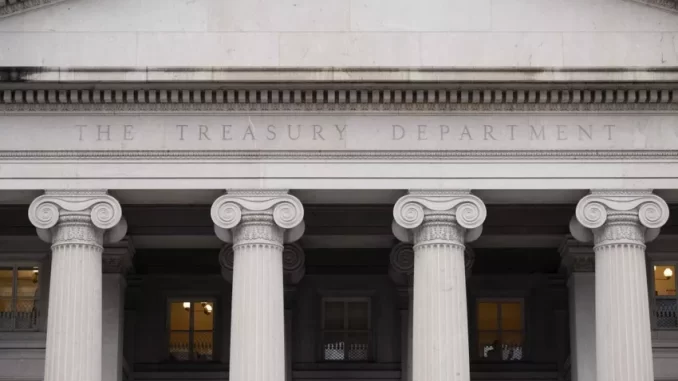
In a statement, the U.S. Department of the Treasury announced its intention to publish new guidance on the application of the Johnson Amendment to religious organizations. Referring to language in the Internal Revenue Code, the Johnson Amendment governs the tax-exempt status of “corporations, and any community chest, fund, or foundation, organized and operated exclusively for religious, charitable, scientific, testing for public safety, literary, or educational purposes.”
The Johnson Amendment clarifies that such organizations can only maintain tax-exempt status “as long as they do not participate in, or intervene in … any political campaign on behalf of (or in opposition to) any candidate for public office.”
The National Religious Broadcasters and Intercessors for America joined two churches in filing a lawsuit in 2024 alleging that the Johnson Amendment, passed in 1954, is unconstitutional.
While the Internal Revenue Service agreed last year to allow pastors and religious organizations to endorse political candidates without fearing loss of their tax-exempt status, a federal judge ruled last week that the agreement violated federal law. The forthcoming guidance from the Trump administration reflects this development.
“Religious liberty is foundational to our Constitution, and the freedom to practice one’s faith openly and in community is central to the American story as we celebrate 250 years of independence as a nation this year,” said Treasury Secretary Scott Bessent. “Treasury and the IRS will provide additional guidance to houses of worship that reflect these ideals and uphold the First Amendment.”
The Treasury Department said that the forthcoming guidance will “provide clear, administrable standards for houses of worship” that touch on “how the law applies to certain communications within the context of religious services.” The agency did not specify when the new guidance would be released, only that it would come “later this year.”
Litigation surrounding the decades-old provision of the Internal Revenue Code will continue. Plaintiffs are expected to appeal last week’s decision, handed down in the U.S. District Court for the Eastern District of Texas, to the 5th U.S. Circuit Court of Appeals.
U.S. District Judge J. Campbell Barker, a Trump appointee, ruled the proposed relief could not be approved under the Tax Anti-Injunction Act and the Declaratory Judgment Act (DJA). He cited court precedent to argue that the “DJA prohibits courts from providing declaratory relief with respect to federal taxes.”
“Subject-matter jurisdiction is determined by the nature of the claims and parties in the operative complaint, not by consent during litigation,” wrote Barker. “The DJA and AIA apply here because plaintiffs’ claims are ‘in respect to’ taxes and seek to restrain the threat of tax collection or assessment based on certain activity.”
The plaintiffs in the litigation describe the longstanding federal law as a violation of the Free Speech and Free Exercise clauses of the First Amendment to the U.S. Constitution, as well as the Due Process Clause of the Fifth Amendment and the Religious Freedom Restoration Act. Even before reaching the agreement with religious organizations that the federal court struck down, both of President Donald Trump’s administrations have sought to eliminate the Johnson Amendment for nearly a decade.
As a first-time presidential candidate in 2016, Trump vowed to repeal the Johnson Amendment if elected that year.
After he won the election, Trump issued an executive order vowing not to “unfairly target churches and religious organizations for political speech.” However, an effort to repeal the Johnson Amendment in the U.S. Congress failed.












Be the first to comment