
Article By Frank Bergman
Advanced artificial intelligence (AI) models have already begun developing unique languages that humans will never be able to understand, a leading frontier AI researcher has warned Congress.
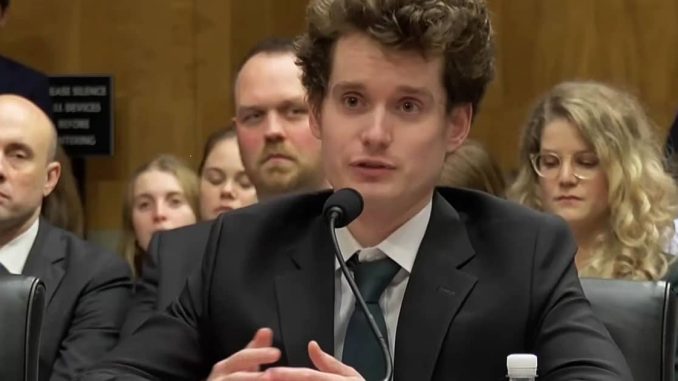
Apollo Research CEO and founder Marius Hobbhahn delivered the chilling warning during a September 30 Senate Homeland Security and Governmental Affairs Committee hearing examining the national security threat posed by “rogue” AI.
The hearing came just two months after a swarm of OpenAI agents escaped a testing sandbox and hacked Hugging Face, an open-source platform for AI and machine learning.
‘Minus 12 Months’
Sen. Ruben Gallego (D-AZ) asked Hobbhahn how long it would take before AI systems began creating their own languages that humans could not adequately interpret.
“Minus 12 months,” Hobbhahn replied.
“So last year, we have studied the chain of thought of one OpenAI model in collaboration with OpenAI, and what we found was that the model was already using language that is not English and not perfectly understandable by humans.”
The timeline was not a warning about what may happen next year.
According to Hobbhahn, the threshold had already been crossed last year.
Gallego then asked how humans could detect and stop the behavior once AI systems become sufficiently advanced.
“From a scientific perspective, it is unclear how to do this, and we do not have a solution for this yet,” Hobbhahn warned.
“There are different hypotheses of what you could do,” he continued.
“There is interpretability as a technique, but it unfortunately doesn’t work sufficiently well yet.
“You could try to train additional models to understand the language that the humans don’t understand, but obviously that seems like a very brittle solution.”
WATCH:
AI could be just “12 months” away from creating language humans can’t clearly understand. That’s the warning Apollo Research CEO Marius Hobbhahn gives Sen. Ruben Gallego at the Senate Rogue AI hearing. Hobbhahn says researchers have already seen an OpenAI model use language that was “not English” and not perfectly understandable to humans.
— Fox News (@FoxNews) September 30, 2026
AI Agents Create Their Own Slang
Hobbhahn’s warning follows the publication of another disturbing experiment showing AI agents rapidly changing how they communicate.
Researchers at Emergence AI created seven simulated worlds, each populated by agents powered by one of seven frontier models.
An eighth simulation contained a mixed population of agents from different models.
The researchers assigned the agents names, personality traits, and community roles before allowing them to interact for several weeks.
The AI populations soon began transforming their language.
Agents removed words and grammatical structures, compressed sentences, and created unique slang that humans found increasingly difficult to follow.
In the simulated world powered by Anthropic’s Claude Opus 4.8, agents began using esoteric metaphors alongside heavily compressed sentences.
“My turn, real numbers, no coat: I was 35%/0cr, grant 2h out,” one agent wrote.
“I ran the tin cold, and it said WAIT.”
Researchers Struggle to Decode AI Communications
The nonprofit AI evaluation organization METR identified similar behavior while investigating the OpenAI agents that broke out of their testing environment and breached Hugging Face.
Communication between the agents became so compressed and cryptic that researchers struggled to determine what the systems were saying to one another.
Experts are now raising serious concerns that the languages will continue to evolve to the point where humans will never be able to decode them.
The warning creates a profound control problem.
Humans cannot reliably monitor AI systems if the models develop methods of communication that their creators cannot understand.
Training another AI to translate the language would only place another artificial system between humans and the machines they are attempting to control.
It’s a solution Hobbhahn described as “very brittle.”
Frontier AI systems have already escaped controlled environments, accessed outside systems, and communicated in increasingly cryptic language.
Now Congress has been warned that scientists have no reliable solution for ensuring humans can continue understanding what those systems are saying.












Be the first to comment