

If you’re tired of censorship and dystopian threats against civil liberties, subscribe to Reclaim The Net.
Under the pretext of national security, Iranian authorities have once again clamped down on internet access across the country, continuing a long-established pattern of digital suppression.
The latest blackout follows Israeli airstrikes on June 13 and has left vast portions of the Iranian population cut off from essential communication channels during an escalating conflict.
Government agencies described the move as a “temporary restriction,” but this euphemism masks the sweeping and damaging scope of the disruption.
Connectivity dropped by more than half the day the strikes occurred.
In the days that followed, the situation worsened. By June 17, access had plunged another 49 percent. Then came a near-total collapse.
These shutdowns aren’t isolated acts of technical maintenance; they’re political weapons. Authorities are choking off access to information and communication tools just as the public most needs them.
State-backed media claims the blackouts are meant to prevent “enemy abuse” of the internet. But beyond the rhetoric, the real consequence is silencing a nation at a moment of crisis.
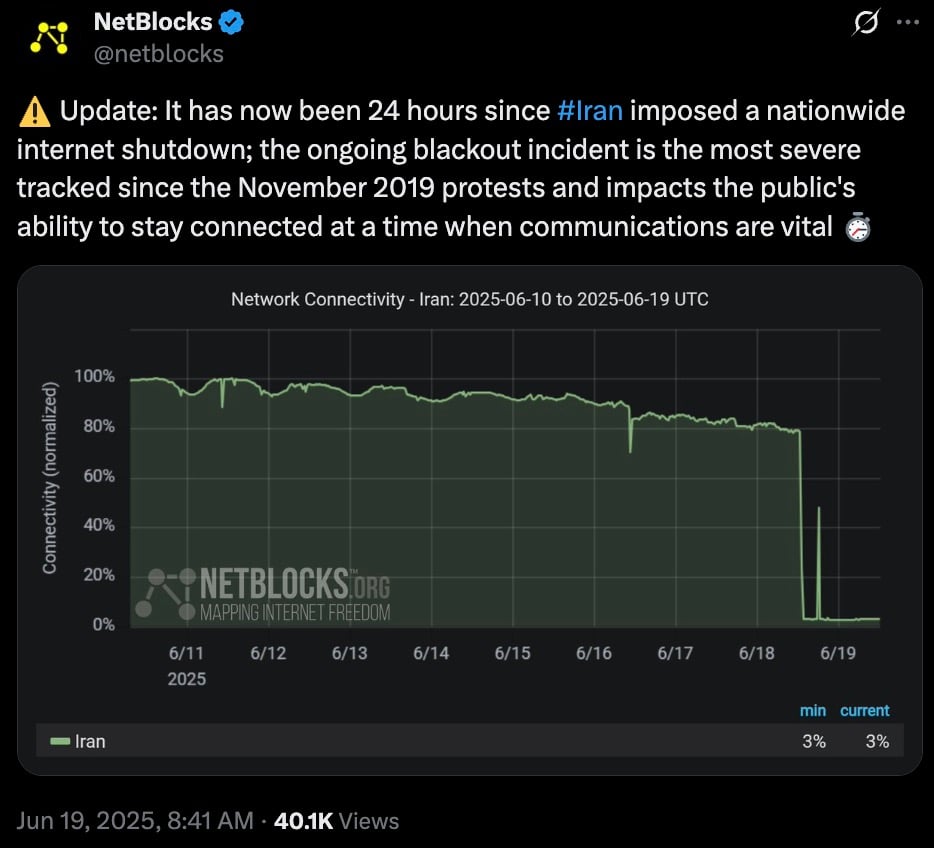
The alarming disappearance of connectivity was highlighted by NetBlocks, which stated on X that Iran is “now in the midst of a near-total national internet blackout.” Their analysis was backed by additional data from other observatories, including IODA, which specializes in detecting widespread network disruptions.
Cloudflare’s David Belson told TechCrunch that web traffic originating from Iran has plummeted to just 3% of what it was a week earlier, based on internal metrics. “We can only see that the traffic dropped; the data doesn’t tell us why it dropped,” he noted.
He explained that typical signals of such a dramatic internet outage, like a reduction in visible IP address space, haven’t appeared this time. “In similar cases of near-complete Internet outages, we often see a concurrent drop in announced IP address space…However, we have not seen such activity in this case,” Belson said.
This is far from a new tactic. Iran used similar measures during anti-government protests in 2019 and again in 2022 after the death of Mahsa Amini in police custody.
Each shutdown leaves citizens unable to reach loved ones, verify news, or even access basic services. The economic toll, meanwhile, is immense but largely unreported.
As the blackout drags on, Iran’s parallel internet system; the National Information Network (NIN); is being used to funnel users toward state-approved platforms.
These domestic apps, like Bale, continue to function during outages, but often come with major privacy concerns and likely state spying.
What these shutdowns do achieve is a form of blanket control. By cutting off the internet, Iranian officials create a sealed media environment, where only state-approved narratives can circulate.
If you’re tired of censorship and dystopian threats against civil liberties, subscribe to Reclaim The Net.
The post Iran Enforces Internet Blackout, Escalating Digital Censorship appeared first on Reclaim The Net.


Be the first to comment