
Article By Jon Brown
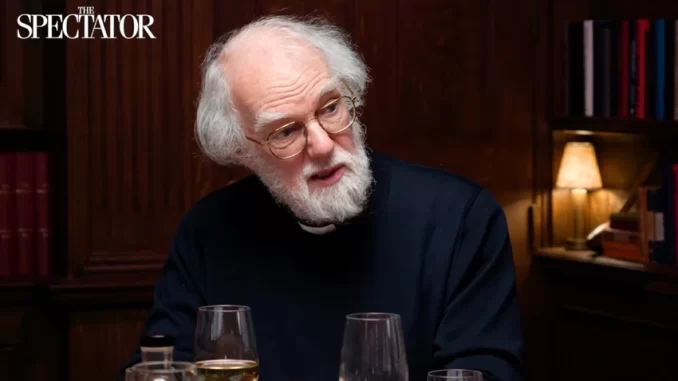
Former Archbishop of Canterbury Rowan Williams said during a recent interview that he believes a demonic element is manifesting in the political culture of the United States, pinpointing the rhetoric of Secretary of War Pete Hegseth as a prime example.
Williams, who served as the ceremonial head of the Church of England from 2002 to 2012, suggested to The Spectator in an April 17 podcast that the recurring political applications of the word “demonic” by figures such as former Rep. Marjorie Taylor Greene, R-Ga., or Tucker Carlson, are potentially misguided, though not necessarily entirely false.
'Pete Hegseth's rhetoric about the violent obliteration of enemies, period – that strikes me as diabolical in the broad sense of something which is working against the Gospel'.
— The Spectator (@spectator) April 17, 2026
Former Archbishop of Canterbury Rowan Williams tells the Spectator's Edition podcast about his fears… pic.twitter.com/km7AgUOyvV
“On the surface level, it’s another example of the incredibly overheated picture of political argument in the States at the moment,” he said of such terminology. “And for nearly 2,000 years, people have been identifying the Antichrist with people they don’t like very much; not exactly new.”
Carlson and Greene, both of whom were once key supporters of President Donald Trump and his political agenda, have since broken with him over the Iran war while accusing him of exhibiting characteristics typically associated with the Antichrist.
After Trump’s profane Truth Social threatening to annihilate Iranian civilization on Easter, followed by a meme portraying him as a Christ-like figure a week later, Greene said his behavior is “more than blasphemy” and “an Antichrist spirit.”
During his weekly monologue last Wednesday, Carlson accused Trump of an increasingly sacrilegious attitude toward Christianity, citing his public feud with Pope Leo XIV and social media posts that he said were “a mockery of God.”
Reading from the description of “the man of lawlessness” in 2 Thessalonians 2:3-12 and the prophecy of a boastful king in Daniel 11:36, Carlson claimed Trump has shown the traits described in such passages, though he said it remains “unclear” if Trump is the Antichrist.
Williams observed that accusations of being the Antichrist have been leveled at various figures throughout Christian history, including by many Anglicans against individual popes and the papacy generally, which he dismissed as “nonsense.” He noted the Apostle John described “antichrist” as a spirit, which Williams said has manifested in different ways throughout history.
“Already, in the New Testament, you have the qualification in the letters of John that Antichrist is all over the place,” he said. “It’s not going to be one enormous figure with horns on his head taking over the world so you can say, ‘Oh yes, that’s Antichrist, I’d know him anywhere.'”
Williams instead identified the spirit of Antichrist as the “deeply subversive, anti-life, anti-God elements which are creeping around all the time, and there are those in power who enable them.”
“In that sense, I’ll put my neck on the block and say, I think there is something demonic, in the wider sense, in the political culture of the United States at the moment: the permission being given to articulate, in the name of God, views which are, I’ve thought, completely antithetical to the Gospel,” he said.
Williams singled out the religious overtones from Hegseth, who has invoked imprecatory psalms against foreign adversaries and used biblical rhetoric to suggest God’s favor rests on U.S. military action in Iran and elsewhere.
“Pete Hegseth’s rhetoric about the violent obliteration of enemies, period. That strikes me as diabolical, in that broad sense, of something which is working against the Gospel,” he said.
Williams’ comments come amid an ongoing fracture among Christians over the war in Iran. Evangelical leaders such as Franklin Graham have stood behind the president and the war effort, while some Anglican and Roman Catholic leaders have raised concerns about its moral justification.
Archbishop Timothy Broglio, who leads the Roman Catholic Archdiocese for the Military Services, claimed earlier this month that the preemptive nature of the U.S.-Israeli strike against Iran rendered it unjust. He urged Catholic service members in a moral dilemma to “do as little harm as you can.”
Pope Leo XIV has condemned the violence in strong terms, claiming earlier this month that “God does not bless any conflict” and that “anyone who is a disciple of Christ, the Prince of Peace, is never on the side of those who once wielded the sword and today drop bombs.”
In a homily during his tour in Cameroon last week, the pope claimed the world is being “ravaged by a handful of tyrants.”
Williams’ successor, present Archbishop of Canterbury Sarah Mullally, expressed solidarity with the pope in a statement she issued last week.
“I stand with my brother in Christ, his holiness Pope Leo XIV, in his courageous call for a kingdom of peace. As innocent people are killed and displaced, families torn apart and futures destroyed, the human cost of war is incalculable,” she said.
Williams, who has been giving interviews after publishing a new book last month, recently made headlines for warning that the global Anglican Communion might cease to exist amid tensions over gender and sexuality.












Be the first to comment