
Article By Ian M. Giatti
Study finds ‘robotoid humanness’ fueling ‘quasi-social’ AI exchanges
Researchers from universities in the U.K., Denmark and Sweden have proposed a new framework for understanding how repeated interactions with increasingly human-like artificial intelligence could influence people’s behavior and self-perception.
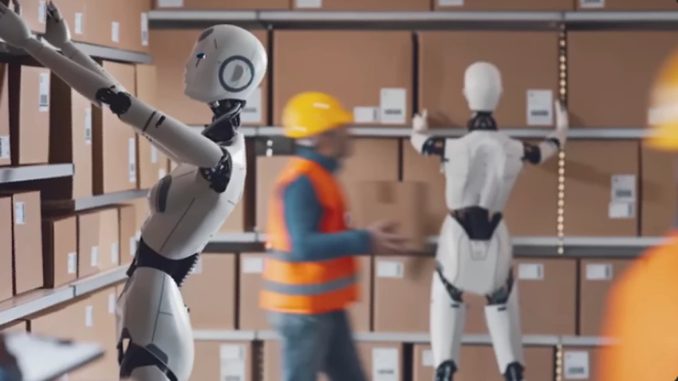
Dubbed “robotoid humanness,” the proposed phenomenon describes a two-way process in which AI systems become more human-like while people might adapt their behavior to become more compatible with machines.
The research, published Aug. 19 in the open-access journal AI & Society, focuses particularly on AI-powered social robots and other systems used in customer-service settings, including retail, hospitality, tourism and healthcare.
Titled “Robotoid humanness: when selfhood becomes machine-legible,” the paper argues that human-AI interactions can go beyond simple exchanges between a person and a technological tool.
“As generative systems and socially responsive service agents enter everyday consumption, human-AI interaction increasingly resembles a quasi-social encounter rather than a utilitarian interface,” the study found, according to Springer Nature.
Inci Toral-Manson, an associate professor of marketing at the University of Birmingham and one of the researchers, said the interaction can work in both directions.
“Our research explores how dealing with these anthropomorphized robots can create a bidirectional influence, where robots become more like people, and people become more like robots, which we call ‘robotoid humanness,’” Toral-Manson said in a statement provided by the University of Birmingham.
Designed to imitate aspects of human communication, including gestures, speech and emotional cues, social robots, much like AI and machine-learning systems, can also adjust their behavior in response to individual users, according to the study.
The researchers argue that people can respond to those cues through a process known as mirroring, in which individuals unconsciously imitate the behaviors, expressions or communication styles of others.
Selcen Ozturkcan, an associate professor of business administration at Linnaeus University, described the proposed process as a continuing exchange between the user and the machine.
“The consumer acts, the robot responds, and with repeated exposure, in time the consumer internalizes the exchange,” she said, adding that the process can be considerably amplified by machine learning and AI.
“For people, the innate instinct to mirror can lead to people returning the robot’s communicative behaviors, making them more robot-like,” Ozturkcan added.
The researchers argue that repeated exposure could potentially influence how consumers perceive themselves, particularly as AI systems become better at personalizing their responses.
These concerns could become even more relevant as AI becomes increasingly common in customer-service environments, according to Jean-Paul Jde Cros Peronard, an associate professor at Aarhus University.
“Robots and AI are now commonplace in customer service, and so it is important that we understand how people interact with them for businesses to use the technology at their disposal to best effect, whilst remaining ethical,” said Peronard.












Be the first to comment