
Article By David Lindfield
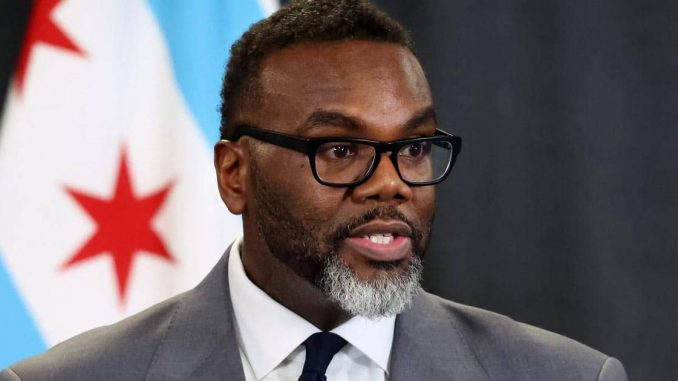
Chicago’s radical Democrat Mayor Brandon Johnson is running for reelection despite catastrophic approval numbers, betting that the same progressive and socialist political machine that put him in office can overcome widespread dissatisfaction with his leadership.
Johnson formally kicked off his 2027 campaign this month.
However, a new poll shows his job approval rating at just 23%, down from 25% in December.
Even more damaging, only 13.6% of Chicagoans surveyed said they want Johnson to run for another term, while 58% said they are not excited about another Johnson campaign.
Faced with those numbers, Johnson is not moving toward the center.
He is doubling down on the Left.
Johnson Vows to Separate ‘Real Progressives’ from ‘Posers’
Johnson used his campaign launch to frame the coming election as a battle between his progressive movement and wealthy interests he says are attempting to undermine his administration.
After months of deliberation, Johnson said his campaign would force Chicago voters to “identify the difference between real progressives and posers” in the crowded mayoral contest.
“The ultra-rich and elected officials who protect the ultra-rich have gone through great lengths to distort our record,” Johnson said.
“But to get to the people, to convince the people, they’re going to have to come through me and our movement.”
That “movement” will have plenty to defend.
Johnson has faced fierce criticism over crime, his handling of Chicago’s finances, his close relationship with the Chicago Teachers Union, and his administration’s approach to Israel and the war against Islamic terrorism.
Yet rather than treating his dismal approval numbers as a warning that Chicago voters want a change in direction, Johnson appears prepared to argue that the answer is an even more aggressive progressive campaign.
Socialist Organizers See an Opening
Johnson’s strategy depends heavily on rebuilding the progressive coalition that elected him in 2023.
Chicago Democratic Socialists of America Co-chair Sean Duffy pointed to recent victories by progressive and socialist candidates as evidence that the Left’s political infrastructure has become stronger.
“People are tired of politicians who don’t deliver and who side with corporations over working-class people,” Duffy said.
“There’s a palpable energy around candidates and organizations that are offering a real alternative.”
Johnson’s poll numbers suggest that “palpable energy” has not spread particularly far beyond the activist Left.
Just 13.6% of Chicagoans want another Johnson campaign.
But low enthusiasm across the broader electorate does not necessarily mean Johnson’s strategy cannot work.
Low-Turnout Strategy Could Keep Johnson Alive
Johnson’s path bears similarities to the political model that has helped socialist and far-left candidates win elections despite lacking overwhelming support among the broader population.
The strategy does not require persuading most voters that Johnson’s first term has been a success.
It requires organizing a committed ideological base and getting those voters to the polls in an election where large numbers of dissatisfied residents may stay home.
New York City Mayor Zohran Mamdani demonstrated the power of that model, riding an energized socialist coalition to victory while benefiting from a disciplined activist network.
Johnson is now making a similar bet in Chicago.
His approval rating may be 23%.
Only 13.6% may want him to run again.
But if progressive activists dominate a fragmented, low-turnout election, those numbers do not necessarily make him politically irrelevant.
That helps explain why Johnson’s response to political weakness is not moderation.
It is ideological consolidation.
Chicago’s Left Bets Its Machine Can Beat the Polls
Johnson entered office in 2023 with strong backing from organized labor and progressive activists, particularly the Chicago Teachers Union.
His first term has since produced repeated clashes over spending, public safety, taxation, and city priorities, leaving him deeply unpopular with the broader electorate.
Yet the mayor’s campaign is signaling that it believes the progressive coalition remains powerful enough to overcome that record.
Johnson is effectively asking Chicago’s activist Left to turn the 2027 election into a test of organizational strength rather than public approval.
For his opponents, the numbers provide an obvious opening.
A sitting mayor with 23% approval and only 13.6% of residents wanting him to seek another term would ordinarily look extraordinarily vulnerable.
But Johnson is betting that Chicago’s socialist and progressive political infrastructure can succeed where his popularity cannot.
If enough disillusioned Chicagoans stay home while the activist Left turns out, Johnson may not need anything resembling majority enthusiasm to remain a serious contender.
That is the gamble behind his reelection campaign: when the public has largely soured on the mayor, mobilize the ideological base and hope everyone else is too disgusted to stop it.












Be the first to comment