
Article By Frank Bergman
A Canadian federal minister has drawn fierce backlash after an internal government memo revealed plans to monitor citizens’ social media posts and file lawsuits against those who share content deemed “misinformation.”
The strategy comes from Industry Minister Mélanie Joly’s department.
The plan was exposed in a 35-page internal memo titled “Misinformation and Disinformation Strategy,” which was obtained through an Access to Information request and first reported by Blacklock’s Reporter.
The memo outlines a government framework to “prevent, detect and respond to false or misleading information.”
Conservative MPs are now sounding the alarm, warning that the Liberal government appears to be moving toward policing online speech and deciding what Canadians are allowed to say.
“This strategy seeks to uphold the integrity of and public trust in government information,” the March 31 memo states.
The memo does not specify penalties.
However, it lays out a structure for identifying, tracking, and responding to online content the government considers false, misleading, or out of context.
Government Already Monitoring Social Media
According to Canada’s Industry Department, staff are already monitoring social media platforms and Canadian media for public comments.
The new strategy would expand that work.
The department wants to move from a “reactive stance to one that is focused on prevention and early detection.”
Officials said the goal is to “proactively address false and misleading information” on social media platforms such as X and Facebook before it builds momentum.
The memo states that the department would decide whether online content is “factually incorrect, misleading or out of context.”
Any response to supposedly “factually incorrect” content would require senior approval.
The memo says the response would be “proportionate.”
But critics warn that the real danger is not merely what punishment is listed in the document.
The danger is the government creating a system to monitor citizens, judge their speech, and decide when to intervene.
Conservatives Warn of ‘Arbiter of Truth’
Conservative MP Leslyn Lewis blasted the plan and warned that the federal government appears to be positioning itself as the ultimate judge of truth.
“Who defines what is ‘misinformation’?” Lewis said in a post on X.
“Will government become the arbiter of truth?” she continued.
“That is a dangerous path for a free society.”
Conservative MP Roman Baber also warned that citizens should not be placed in a position of fearing the government over their speech.
He said the government “should fear citizens at the free press and the ballot box.”
“But the reverse, citizens fearing government gives rise to authoritarianism!” Baber wrote.
“Conservatives will not tolerate any Liberal assault to Canadians’ Civil Liberties,” he added.
Their warnings reflect a growing concern across Canada.
The government is not merely disagreeing with speech.
It is building systems to monitor it.
Memo Warns Crackdown Could Backfire
Even the government’s own memo acknowledges serious risks.
The document warns that going after social media users could trigger online backlash and end up “lending legitimacy to fringe sources.”
That warning exposes the central flaw in the plan.
When governments try to suppress speech, they often make the targeted information more visible.
They also erode public trust by making citizens believe officials are hiding something.
The memo frames the strategy as a way to protect trust in government information.
But trust is not built by monitoring citizens and threatening responses to online posts.
It is built through transparency, accountability, and respect for civil liberties.
The Liberal government’s plan moves in the opposite direction.
Carney Government Continues Trudeau’s Censorship Legacy
Prime Minister Mark Carney’s government is continuing the legacy of former Prime Minister Justin Trudeau by pushing deeper into online regulation and speech control.
The Liberal government’s “dystopian” internet censorship Bill C-22 was rammed through the House of Commons with unvetted amendments.
The bill would require people’s data to be retained for potential police review.
Bill C-9 was also recently passed by the Senate.
The legislation repeals religious protections and could effectively criminalize quoting parts of the Bible.
It was amended at the last minute to ban images of a noose after a senator described it as a symbol of “white supremacy.”
Another measure, Bill C-34, seeks to ban social media use for minors.
However, constitutional groups have warned that the social media ban could force Canadians to surrender basic freedoms.
Taken together, the measures show a government increasingly willing to regulate what Canadians say, see, post, quote, and share online.
Canada Moves Toward Speech Policing
Carney has long faced scrutiny over his globalist ties.
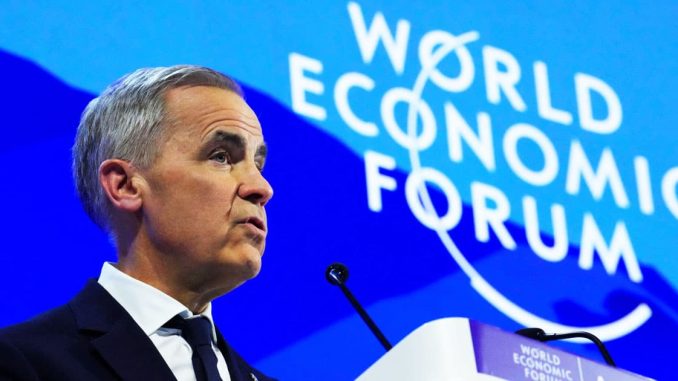
Conservative leader Pierre Poilievre has called him the World Economic Forum’s “golden boy.”
Carney has also admitted he is an “elitist” and a “globalist.”
Now his government is facing accusations that it is moving toward a centralized speech-control regime.
The new misinformation strategy gives bureaucrats a role in judging citizens’ online posts.
It allows officials to decide what is “misleading” or “out of context.”
It pushes the government toward early detection and prevention of speech it dislikes.
That is not how a free society operates.
Free nations do not need government ministries monitoring citizens’ opinions.
They do not need bureaucrats deciding what is true.
They do not need officials preparing “responses” to social media posts.
Canada’s latest plan is being sold as a defense of public trust.
But to many Canadians, it looks like something far more dangerous.
A government that monitors speech in the name of “misinformation” is still monitoring speech.
And once politicians claim the power to define truth, dissent becomes the next target.












Be the first to comment