
Article By David Lindfield
A liberal California-based bishop is drawing sharp criticism after demanding the creation of a “third testament” of the Bible and suggesting that portions of Scripture should be removed because they are “problematic.”
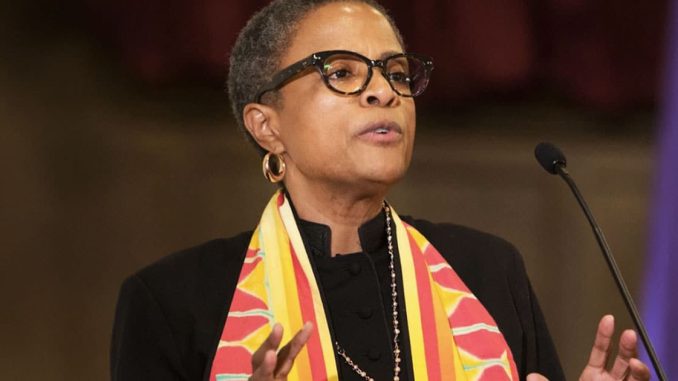
Yvette Flunder, leader of the City of Refuge United Church of Christ in Oakland and presiding prelate of The Fellowship of Affirming Ministries, made the remarks during a recent conference appearance.
The comments are igniting backlash from Christian leaders and commentators.
Bishop Calls Bible ‘Problematic,’ Suggests Removing Passages
Speaking at the 2026 Samuel DeWitt Proctor Conference, Flunder acknowledged her comments would be controversial.
“This is a very dangerous thing that I’m about to say now, … a bit dangerous,” she said.
“I’m of the opinion that we need a third testament because the Bible has become problematic.”
Flunder cited passages from the New Testament, including Ephesians 6:5 and 1 Corinthians 14:34–35, as examples of verses she finds troubling.
“‘Slaves obey your masters as you do the Lord.’ It’s a text,” she said.
“‘Let the women keep silent in the churches and if they have any questions let them ask their husbands at home.’”
While affirming her personal faith, Flunder said she is “completely frustrated” with what she described as the way certain texts portray God.
“But I am completely frustrated with the ways in which the text speaks to the kind of vitriolic God that makes those kinds of things,” she said.
She went further, arguing that problematic passages should be removed entirely, saying:
“And people will say, ‘Well, it’s in the book.’
“And I said, then we need to pull that page out.”
Rejecting the idea that Scripture is divinely authoritative, she added:
“No. It is not the Word of God.”
Critics Condemn Remarks as ‘Heresy’
The comments quickly gained traction online, with a clip circulating widely and drawing responses from Christian leaders and commentators.
Christian speaker April Chapman criticized Flunder’s remarks in a post on X.
“You don’t need a Third Testament.
“You need first-rate repentance,” Chapman wrote.
In a video response, Chapman added:
“You don’t get to stand in a pulpit, insult the word of the living God and say, ‘You know, I’m about to say something that’s a little dangerous,’ and then pretend that you are speaking for Christ.”
She continued: “You just knew what you were about to say was heresy.
“You are not being bold, you are just rebellious.”
You don’t need a Third Testament. You need first-rate repentance. Today I we deal with the lie that Scripture is just “words about God.” New episode: Yvette Flunder’s blasphemy, exposed biblically. https://t.co/N1Xtdq1GMz pic.twitter.com/0sCsD41ptt
— April Chapman (@Unshakablewapr) April 21, 2026
Pastors Warn of Broader Implications
Other church leaders warned that Flunder’s statements go beyond theological disagreement and strike at the foundation of Christian doctrine.
Pastor Rich Bitterman of Cedar Ridge Baptist Church said the remarks “should make every Christian shudder.”
“Bishop Yvette Flunder did not merely question a passage,” Bitterman wrote.
“She told the church, in plain words, that parts of God’s Word should be torn out.”
He added, “That sound is more than rebellion against ink and paper.
“It is rebellion against the God who speaks.”
Bitterman also pointed to 1 Timothy 4:1, warning that such views reflect a broader departure from traditional Christian teaching.
“Flunder’s statements are not simply offensive,” he wrote.
“They are spiritually murderous.”
Debate Highlights Ongoing Tensions in Churches
Flunder, who is married to her same-sex partner, has been a prominent figure in progressive Christian circles, often advocating for reinterpretations of traditional doctrine.
Her call for a “third testament” underscores ongoing divisions within churches over biblical authority, interpretation, and modern cultural issues.
For critics, however, the fundamental issue is whether Scripture itself remains the final authority for Christian faith and practice.
The controversy is likely to continue as religious leaders and believers grapple with competing visions for the future of the church.












Be the first to comment