
Article By David Lindfiel
Director of National Intelligence Tulsi Gabbard is stepping down from her post in the Trump administration to support her husband after he was diagnosed with what she described as an “extremely rare form of bone cancer.”
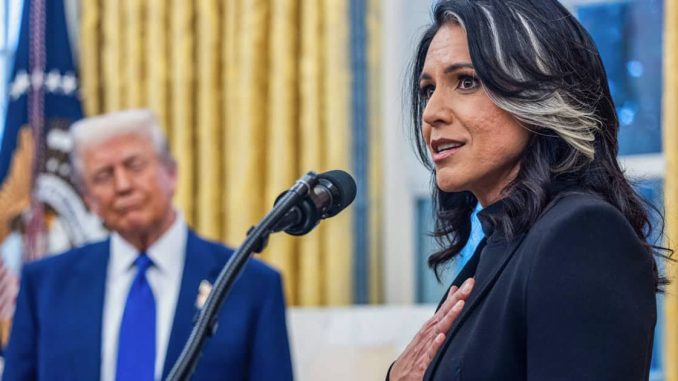
Gabbard informed President Donald Trump of her decision during a meeting in the Oval Office on Friday.
Her resignation will take effect on June 30, ending a tenure that saw sweeping reforms across the intelligence community and the release of hundreds of thousands of previously classified government documents.
Gabbard Says Family Must Come First
In a resignation letter submitted to President Trump, Gabbard expressed gratitude for the opportunity to serve while explaining the difficult personal circumstances behind her departure.
“I am deeply grateful for the trust you placed in me and for the opportunity to lead the Office of the Director of National Intelligence for the last year and a half,” Gabbard wrote.
“Unfortunately, I must submit my resignation, effective June 30, 2026.
“My husband, Abraham, has recently been diagnosed with an extremely rare form of bone cancer.”
Gabbard said her husband faces significant medical challenges in the months ahead and that she could not continue in such a demanding role while he undergoes treatment.
“At this time, I must step away from public service to be by his side and fully support him through this battle,” she wrote.
She added:
“Abraham has been my rock throughout our eleven years of marriage — standing steadfast through my deployment to East Africa on a Joint Special Operations mission, multiple political campaigns and now my service in this role.
“His strength and love have sustained me through every challenge.”
Major Reforms During Her Tenure
Gabbard’s departure comes after a year and a half marked by significant changes within the intelligence community.
As DNI, she led efforts to reduce the size of the Office of the Director of National Intelligence, with administration officials saying the reforms are projected to save taxpayers more than $700 million annually.
Her tenure also included the elimination of far-left “diversity, equity, and inclusion” (DEI) programs across elements of the intelligence community and a broader restructuring initiative aimed at increasing accountability and efficiency.
Gabbard repeatedly argued that intelligence agencies should focus on national security priorities rather than political agendas.
Declassification Efforts Drew National Attention
One of the most notable aspects of Gabbard’s leadership was an aggressive declassification campaign that resulted in the release of more than 500,000 pages of government records.
Among the documents made public were records related to the assassinations of President John F. Kennedy and Sen. Robert F. Kennedy, as well as files connected to the origins of the Trump-Russia investigation.
Gabbard argued that newly released materials showed intelligence assessments related to Russia’s involvement in the 2016 election had been politicized by Obama administration officials and used to undermine President Trump’s first election victory.
Those disclosures became a central part of the administration’s broader effort to examine alleged abuses of government power during and after the 2016 election.
Focus on Government Accountability
Gabbard also established the first federal “Weaponization Working Group,” an interagency initiative designed to investigate allegations that government agencies had been used for political purposes under the Biden administration.
The initiative became a cornerstone of the administration’s efforts to identify and expose what officials described as politically motivated actions taken against Trump supporters and political opponents.
Supporters praised the effort as a long-overdue review of government conduct, while critics argued it risked politicizing federal agencies.
National Security Accomplishments
The National Counterterrorism Center, operating under Gabbard’s leadership, reported significant enforcement actions related to border security and transnational criminal organizations.
According to administration figures, the agency prevented more than 10,000 individuals with ties to narco-terrorism from entering the United States during 2025 and placed more than 85,000 individuals with similar connections on federal terrorist watchlists.
Administration officials cited those efforts as evidence of a renewed focus on national security threats originating from criminal cartels and international trafficking networks.
Promises Smooth Transition
Despite stepping aside, Gabbard said she remains committed to ensuring an orderly transition for the administration.
“I am fully committed to ensuring a smooth and thorough transition over the coming weeks so that you and your team experience no disruption in leadership or momentum,” she wrote.
“Thank you for your understanding during this deeply personal and difficult time for our family.”
Gabbard concluded her letter by expressing gratitude for the opportunity to serve.
“I will remain forever grateful to you and to the American people for the profound honor of serving our nation as DNI.”
Her departure creates one of the most significant vacancies in President Trump’s second administration and comes as the intelligence community continues implementing reforms initiated under her leadership.















Be the first to comment