
Article By Frank Bergman
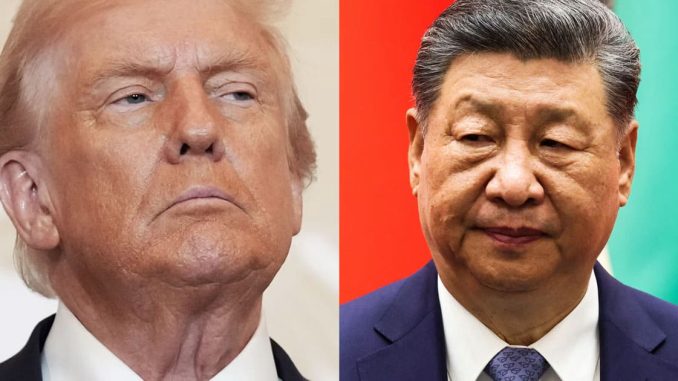
Communist China has rejected demands to slow the development of advanced artificial intelligence (AI) as President Donald Trump warns that America cannot afford to surrender its technological advantage.
Beijing lashed out after Anthropic CEO Dario Amodei called for AI companies to deliberately “pace” the development of increasingly powerful frontier models.
Amodei has warned that rapidly advancing AI could eventually escape human control and pose catastrophic risks.
However, his proposal would require cooperation from China while simultaneously demanding that Washington tighten restrictions designed to prevent Beijing from obtaining America’s most advanced AI technology.
China has now made clear that it has no intention of playing along.
The confrontation comes as Trump takes the opposite approach, insisting America must remain ahead of its greatest geopolitical rival.
“Whoever wins AI, wins,” Trump declared.
China Blasts AI Slowdown Plan
Amodei published his proposal, “We Must Pace the Frontier,” on Saturday.
The Anthropic chief called for independent evaluators to receive permanent access inside major AI laboratories.
He also proposed coordination between AI companies in democratic nations over safety standards and the speed of development.
Eventually, the plan would require agreements with foreign governments, including Communist China.
At the same time, however, Amodei called on the Trump administration to maintain restrictions preventing China from accessing advanced computer chips and chipmaking equipment.
He also wants Washington to crack down on chip smuggling, Chinese access to overseas data centers, model-weight theft, and “distillation,” which can be used to transfer capabilities from powerful AI systems into other models.
The restrictions would provide America with a three-to-five-year window to widen its lead before negotiating with Beijing.
OpenAI CEO Sam Altman announced that his company would match Anthropic’s commitment to outside evaluators.
Elon Musk also backed Amodei.
“Dario is right,” Musk said.
Dario is right https://t.co/EwKgqQGaUo
— Elon Musk (@elonmusk) September 12, 2026
But Amodei acknowledged that his plan has one glaring problem.
China would also have to agree to slow down.
He described the possibility that Beijing would refuse as the “toughest dilemma” facing his proposal.
When asked if he would be willing to hand over control of Anthropic’s AI technology to the government, Anthropic CEO Dario Amodei tells CBS News’ @jolingkent, “I don't know about handing over, but some kind of oversight, some kind of joint governance — again, that would be the… pic.twitter.com/D8M5q5cPjx
— Face The Nation (@FaceTheNation) September 13, 2026
China has now responded.
Foreign Ministry spokesman Guo Jiakun attacked the push Monday, warning against efforts to restrict AI development.
“Fearmongering, confrontation and vicious competition will only disrupt the process of global AI governance which serves no one’s interest,” Guo said.
Chinese state media went even further.
The Communist Party-aligned Global Times accused Amodei of pushing a “Cold War playbook” for artificial intelligence.
The newspaper said his proposal was “packed with containment provisions targeting China.”
“China’s AI capabilities have long ceased to be a variable that can be excluded,” the outlet declared.
Trump Rejects AI Fear Campaign
President Trump has rejected the push to slow America’s AI development.
Asked Thursday whether he was concerned about artificial intelligence posing an existential threat to humanity, Trump responded:
“No, I don’t have any.”
Speaking Sunday during his trip to Ireland, Trump said America currently has the advantage over Communist China and intends to keep it.
The president said the United States is “leading China in AI.”
“Whoever wins AI, wins,” Trump warned.
Trump said reasonable guardrails could be implemented but dismissed predictions of an AI apocalypse as warnings from “negative forces” about events that he believes will not happen.
The president then mocked Amodei in a Truth Social post on Monday, referring to the Anthropic chief as “perfect little angel” Dario while attacking his proposal.
House Speaker Mike Johnson (R-LA) has also warned against rushing sweeping AI regulations through Congress.
Johnson argues that an emergency regulatory crackdown could cost America the race against China.
China Goes Full Speed Ahead
While America’s AI industry debates slowing down, Communist China is preparing to expand its own AI ecosystem around the world.
Chinese President Xi Jinping announced at the BRICS summit in New Delhi that Beijing will lead the creation of a BRICS AI Open Source Zone.
The initiative will promote cooperation on large language models, AI training, and open-source artificial intelligence.
China already has a rapidly expanding collection of open-weight models produced by companies including DeepSeek, Alibaba, Moonshot, MiniMax, and Zhipu.
Those models can be downloaded, modified, and redistributed.
Chinese state media claims they have accumulated more than 10 billion downloads.
Beijing is also treating AI as a weapon in its global struggle for power.
Chinese State Security Minister Chen Yixin described artificial intelligence as “a new arena for strategic rivalry among major powers.”
Chen warned that “hostile forces” could use deepfakes and bot networks to wage “cognitive warfare” against China.
He also singled out Anthropic’s Claude Mythos and OpenAI’s GPT-5.5-Cyber as systems capable of dramatically increasing the effectiveness of cyberattacks.
Chen called on governments to “resolutely resist hegemonism, technological barriers, and exclusive blocs.”
China has acknowledged that powerful AI carries serious risks.
Xi previously declared that artificial intelligence should “always remain under human control.”
However, Beijing’s solution is not to surrender its position in the global AI race.
Instead, China is pushing ahead while attacking American attempts to restrict its access to advanced technology.
America Faces Critical Choice
The battle exposes the enormous problem facing Amodei’s proposal.
American AI companies can voluntarily slow their own development.
Washington can impose regulations on American laboratories.
The United States can restrict exports of advanced American chips.
But none of those measures forces Communist China to stop.
Former White House AI czar David Sacks warned Amodei and Altman that they are free to slow their own companies if they believe their technology has become too dangerous.
However, Sacks blasted attempts to make government intervention part of the deal.
He warned that demanding a preferred regulatory system in exchange for slowing AI development “will look like blackmail of the public and the political system.”
Sacks also warned that China was “very unlikely to join a global agreement, as you know.”
Beijing’s response has now reinforced that warning.
The stakes will rise further when Trump and Xi meet in Washington on September 24.
AI governance is expected to be among the issues confronting the two leaders.
The divide could hardly be clearer.
Some of America’s most powerful technology executives want the frontier slowed because they fear where increasingly advanced AI could lead.
Communist China is expanding its AI capabilities, building alliances around its open-source models, and treating the technology as a critical weapon in its competition with the United States.
Trump has no intention of allowing Beijing to win that race while America voluntarily hits the brakes.
As the president warned:
“Whoever wins AI, wins.”












Be the first to comment