
Article By Frank Bergman
Newly obtained documents reveal that Dr. Anthony Fauci was scrambling to destroy evidence after he was warned that his dangerous research could have devastating consequences for humanity.
Fauci ordered an aide to permanently delete an official email exchange after a journalist warned that dangerous gain-of-function research could unleash an “engineered doomsday.”
The extraordinary exchange occurred in 2012, eight years before the COVID-19 pandemic emerged and reignited a global battle over risky laboratory experiments and the possibility of a lab-related origin.
The documents show Fauci privately fuming over New York Times science writer Phil Boffey’s scrutiny of experiments that created an airborne strain of bird flu.
After complaining about Boffey in an NIH email, Fauci gave his subordinate an explicit instruction.
“Please delete this e-mail and then delete from the deleted file,” Fauci wrote.
The revelation adds to growing evidence that Fauci sought to destroy government records despite later testifying under oath that he never did so.
Destroying federal government records is prohibited under federal law.
Journalist Warned of ‘Engineered Doomsday’
The controversy began during the first major public reckoning over gain-of-function research in 2011.
Dutch virologist Ron Fouchier had conducted experiments, funded by Fauci’s institute at the National Institutes of Health, that produced an airborne strain of bird flu.
The natural virus had an estimated 50% fatality rate.
Fouchier described the laboratory-created strain as “probably one of the most dangerous viruses you can make.”
The research immediately triggered fears over what could happen if such a virus escaped from a laboratory or the methods used to create it fell into the hands of terrorists.
Fauci publicly defended the research.
In a December 2011 Washington Post editorial co-authored with then-NIH Director Francis Collins and National Institute of Allergy and Infectious Diseases Vaccine Research Center official Gary Nabel, Fauci argued that research involving manmade pandemic viruses represented a “risk worth taking.”
The argument was that such experiments could allow drugmakers and public health authorities to prepare in advance if similar viruses emerged naturally.
Boffey was far less convinced.
In January 2012, The New York Times published an un-bylined op-ed warning that the NIH had helped create an “engineered doomsday” capable of killing “hundreds of millions of people.”
The newly released emails reveal Boffey as the author of that piece.
“The consequences, should the virus escape, are too devastating to risk,” Boffey warned.
Fauci Raged Behind the Scenes
Boffey returned to the controversy in March 2012 with another article titled “The Truth About the Doomsday Virus?”
By then, Fouchier had begun walking back some of his earlier descriptions of the virus’s lethality as scrutiny intensified.
Boffey remained skeptical.
Experts who had reviewed the original description of the experiment said it indicated that the airborne laboratory virus remained as lethal as the natural strain.
Fauci, meanwhile, was pushing for the details of Fouchier’s experiment to be published despite concerns from biosecurity experts that the information could be exploited by a bioterrorist.
One passage from Boffey particularly angered Fauci.
“Now, this country’s National Institutes of Health, which financed the research and has its own reputation on the line, is asking the [NSABB] to reconsider its call to redact details before publication,” Boffey wrote.
Fauci complained about the journalist to Collins on March 4, 2012.
“Phil Boffey is really off base here,” Fauci wrote.
“He is acting like a mischievous guy.”
The following morning, Fauci was even more candid in an email to a subordinate.
“Clearly, people are getting to Phil Boffey, and he is swallowing it,” Fauci wrote.
Fauci strongly opposed a recommendation from the NIH’s biosecurity advisers that sensitive details from Fouchier’s experiment should not be published.
He warned that if the advisers refused to reverse course, “the field of research on influenza … has a serious problem.”
Then came Fauci’s instruction to erase the correspondence.
“Please delete this e-mail and then delete from the deleted file,” he wrote from his NIH email account.
Rand Paul Uncovered Other Fauci Deletion Requests
The email adds another example to evidence uncovered by Sen. Rand Paul (R-KY) involving Fauci’s handling of official records.
Paul previously highlighted two instances from 2020 in which Fauci apparently sought to have government records deleted.
Those revelations stand in stark contrast to Fauci’s sworn testimony before a congressional committee in 2024 that he had never deleted official records.
Fauci ultimately succeeded in persuading the NIH’s biosecurity advisers to allow Fouchier’s controversial experiment to be published in full.
Years later, both men would become involved in another far more consequential debate over dangerous virus research.
Fouchier Reemerged in COVID Origins Battle
When COVID-19 emerged, Fouchier worked with Fauci and other virologists as the possibility that the virus originated in a laboratory came under intense scrutiny.
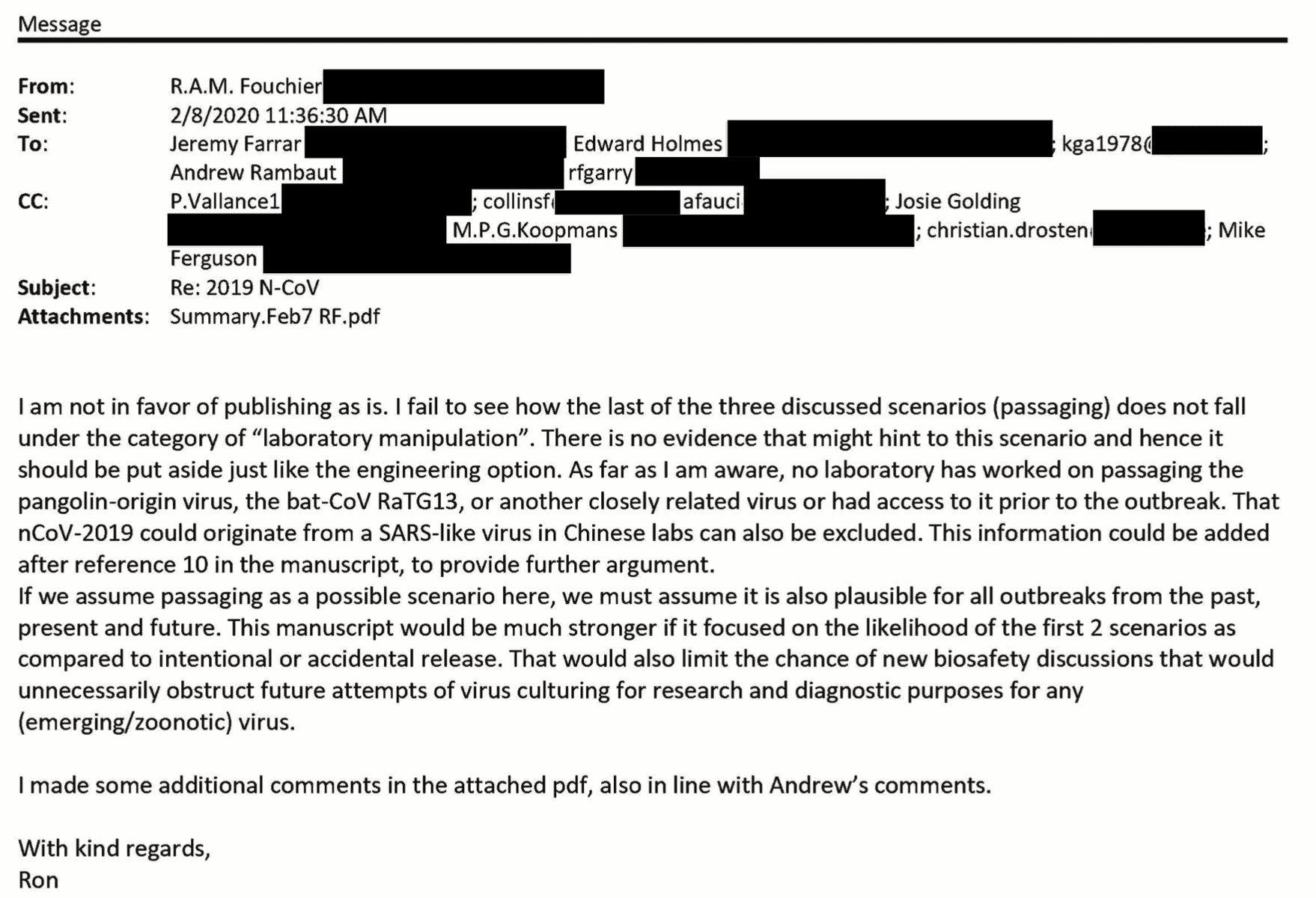
Fouchier ghostwrote a key argument incorporated into “The Proximal Origin of SARS-CoV-2,” the influential paper that dismissed a possible laboratory origin for the pandemic.
Fauci repeatedly cited the paper and its authors in subsequent years without revealing his behind-the-scenes collaboration with them.
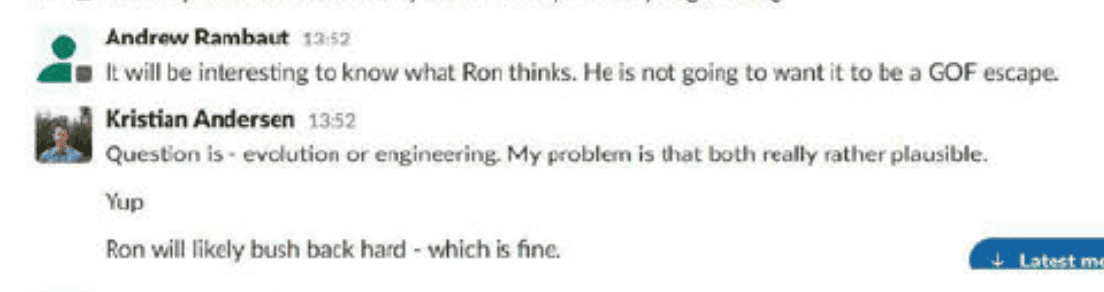
Privately, however, the paper’s own authors acknowledged Fouchier’s potential conflict.
They described him as “unbelievably conflicted.”
“Ron … is not going to want it to be a GOF [gain-of-function] escape,” one author said.
Fouchier himself opposed publicly addressing the lab-leak possibility in the “Proximal Origin” paper.
He warned that doing so could cause “harm to science” by reigniting scrutiny of laboratory biosafety and gain-of-function research.
“This manuscript would be much stronger if it focused on the likelihood of the first two scenarios as compared to intentional or accidental release,” Fouchier said.
“That would also limit the chance of new biosafety discussions that would unnecessarily obstruct future attempts of virus culturing for research and diagnostic purposes for any (emerging/zoonotic) virus.”
Eight years before COVID transformed the world, Boffey had already warned that the consequences of a dangerous laboratory virus escaping could be catastrophic.
The newly uncovered documents now show that Fauci’s private response to that scrutiny included an extraordinary instruction to an aide: delete the email, and then permanently erase it from the deleted folder.














Be the first to comment