
Article By Frank Bergman
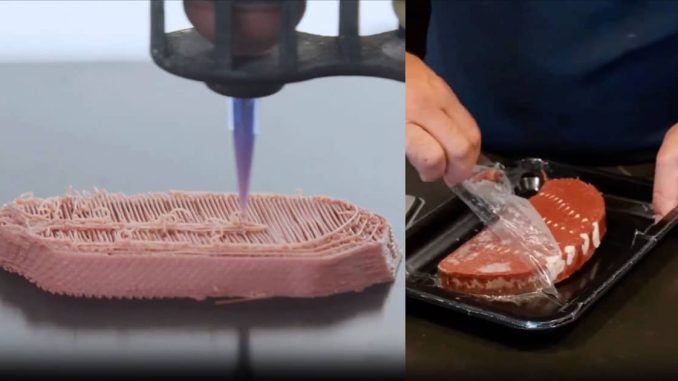
3D-printed fake “meat” and “fish” products are quietly flooding the U.S. food supply and arriving in American grocery stores without clear labeling.
The “foods” are sold in packaging that markets them as “premium plant-based meat” without disclosing the printing technology used to manufacture them.
Israeli food-technology company Steakholder Foods is launching its PERFECTA brand across the Northeastern United States, bringing engineered imitations of steak, chicken, and seafood to retail shelves.
The hyperprocessed products are “built” in Israel before being shipped to American stores in packaging that imitates real meat and fish.
The rollout raises a straightforward transparency question: will shoppers understand how these products are manufactured when the packaging does not identify them as 3D-printed?
Fake Steak Built From Oils, Starches, and Gums
The PERFECTA range includes products sold as marbled steak, filet mignon, chicken breast, salmon patties, and white fish patties.
The company uses industrial 3D printers to layer proteins and fats into textures designed to imitate conventional meat and fish.
Its plant-based “steak” formulation contains soy flour, rapeseed oil, modified starch, methylcellulose, xanthan gum, locust bean gum, and artificial meat coloring intended to reproduce beef’s appearance.
These are manufactured substitutes assembled to mimic the texture, taste, and appearance of animal products.
Yet the packaging promotes the range as “premium plant-based meat,” without identifying the 3D-printing process.
That distinction matters for consumers who want to know more than whether a product contains plant protein.
The manufacturing method is part of what separates these engineered substitutes from conventional food.
WATCH:
🇺🇸🇮🇱 Remember the story about 3D-PRINTED MEAT coming to American grocery stores? So apparently, it’s ISRAELI FOOD COMPANY Steakholder Foods that’s behind the technology… Look, I’m not saying they’re poisoning us, but WHY are we letting people PRINT SALMON before we’ve even figured out what’s in a hot dog?? I’m buying a cow. I’m done. Source: @Polymarket / Writer: Oliver https://t.co/5Mgl7B5Vge
— Mario Nawfal (@MarioNawfal) October 13, 2026
Company Plans Expansion Beyond Northeast
Steakholder Foods announced its American retail launch in September, describing the Northeast as the starting point for a broader commercial expansion.
“We believe the plant-based category is ready for a new generation of products that deliver on taste and eating experience without compromise,” CEO Arik Kaufman said.
“We are on track with our launch, and the Northeast is just the beginning of our commercial journey, and we intend to expand both our retail footprint and our distribution network as consumer demand grows,” Kaufman added.
The company joins an established market populated by brands such as Beyond Meat and Impossible Foods.
The Bill Gates-funded companies both sell plant-based alternatives to familiar animal products.
Steakholder Foods is pushing that category further with industrial printing designed to reproduce whole-cut textures.
Plans for Widespread Adoption
3D-printed fake “meat” currently costs more than conventional ground-meat substitutes because of lower production volumes and higher equipment costs.
However, companies are hoping that unit economics should improve as industrial printers scale up.
Early adoption will naturally target premium retail and foodservice segments.
To go mainstream, 3D-printed meat will need to be price competitive with high-end conventional cuts such as USDA Choice beef.
Contract manufacturers plan to boost the industry by installing industrial-scale printer arrays in standard food plants, so brands don’t have to build their own factories.
To address the price gap, Steakholder said it is launching Perfecta as a premium brand but plans to make the products more affordable as it grows.
The company confirmed that Perfecta is currently available in around 30–35 stores across the Northeast through KeHE.
Steakholder is pushing to expand into larger retail chains and new markets, including the West Coast, Virginia, the Carolinas, and Florida, as well as introduce more whole-cut products under the Perfecta brand.
Website Describes Engineered Meat-Like Experience
According to its website, the company combines plant proteins such as soy and pea with fats and flavor enhancers to produce a meat-like eating experience.
It describes advanced 3D-printing technology and precise culinary techniques engineered to mimic traditional meat.
The website also discusses cultivated products incorporating cultured cells.
That broader description does not establish that the five plant-based PERFECTA products contain those cells.
The immediate issue for American shoppers is disclosure: a new generation of printed substitutes is entering grocery stores, but the packaging does not clearly identify the technology used to make them.
As Steakholder Foods pursues wider distribution, consumers will encounter familiar meat and fish names on products created through a very different manufacturing process.












Be the first to comment