
Article By Ebere Inyama
Survivors say armed militants stormed a Catholic church in Enugu State, held them without food for days, and beat them while demanding ransom.
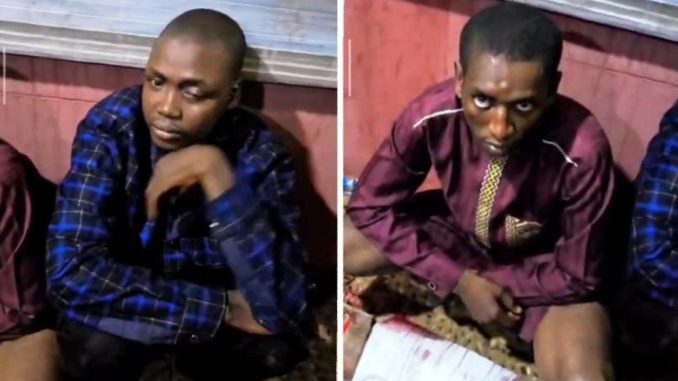
ENUGU, Nigeria — Two Christian worshipers abducted from a Catholic church in southeastern Nigeria say they endured beatings, starvation, and days of forced trekking under armed Fulani militant captors before security forces rescued them and arrested the suspects. The attackers stormed St. Joseph’s Church in Affa on August 2, dragging a seminarian and another worshiper into the forest, where they were held for seven days while their captors demanded ransom and threatened to kill them. A joint operation involving the Nigerian Army, DSS, police, and local guards later recovered multiple AK‑47 rifles and ammunition from the gang’s hideout.
The victims, Lawrence Igbo and Emmanuel Onwudi, were on Sunday, 2 August, 2026, abducted by heavily armed Fulani terrorists who invaded St. Joseph’s Church in Inoyi, Affa, in Udi County of Enugu State in southeastern Nigeria, according to a report by TruthNigeria.
Three days without food or water
Speaking during an interview with AIT shortly after they were rescued, one of the rescued victims who identified himself as a seminarian, Mr. Lawrence Igbo, said the attackers abducted him while he was preparing for mass inside the church and forced him and another worshiper into the bush.
“They ordered us out of the church premises, pointed their guns at us and forced us to trek inside the bush from 9am till we got to Enugu expressway by 6pm,” Igbo began during his interview with AIT.
“They kept us there until it became dark, then they forced us to cross to the other side of Enugu expressway from where we continued trekking, climbing hills on our way until about 3 or 4am the next day. Then we got to the hill where they kept us for seven days,” he continued to say.
“During those seven days, they were beating us with sticks, machetes and stones, threatening to kill us if our people failed to pay them ransom,” Igbo added.
The second victim, Mr. Emmanuel Onwudi, corroborated the statement made by Igbo but added that the kidnappers starved them of food and water for three days.
“They did not give any food or water for three days but on the fourth day, after our people negotiated to pay them 11 million ($7,900) naira as ransom, they gave us rice and beans to eat,” Onwudi said.
Lawrence Igbo hails from Amaozara – Affa while Emmanuel Onwudi hails from Inoyi – Affa, both in Udi county of Enugu state.
Attackers identified as Fulanis
The Nigerian army failed to disclose the ethnic identities of the arrested suspects but a former member of the Eastern Security Network (ESN), now working in collaboration with the Nigerian government, Mr. Ikenga Uruagu, revealed the tribe in Nigeria to which the suspects belong.
In a video posted online on 12 August, 2026, Uruagu said the arrested suspects were Fulanis.
“On 2nd of August, 2026, armed bandits with sophisticated weapons entered one catholic church in Affa community of Enugu state and kidnapped a seminarian, a catechist and a church member,” Uruagu said in the video.
“In search of community members that were kidnapped by Fulani bandits, Fulani people were also involved in the search and arrest of the bandits,” Uruagu added.
According to Uruagu, the “Enugu state government deployed a drone in the sky while the Police anti-kidnapping squad, the Enugu state Forest Guard, some genuine Fulani herders and a combined team of the Nigerian army and the Department of State Security (DSS) moved into the forest on foot in search of the kidnappers and the abducted worshippers.”
Uruagu said the search lasted for seven days after which the kidnapped worshipers were rescued while one of the suspects was arrested, adding the remaining two suspects were arrested on the eight day.”
Nigerian army confirms arrest of suspects
In a statement issued on Monday 10 August, 2026, the Acting Deputy Director, Army Public Relations, 82 Division, Lieutenant Colonel Olabisi Olalekan Ayeni, said an earlier operation had resulted in the neutralisation of one member of the kidnap gang and the arrest of a suspect, adding that information obtained from the arrested suspect enabled security operatives to track the fleeing commander of the gang.
“Acting on the intelligence, troops intensified their manhunt and eventually tracked, intercepted, and arrested the syndicate commander as he attempted to flee Enugu State,” Ayeni said in the statement.
“The arrested suspect subsequently led troops to the gang’s hidden armoury inside Umuchingu Ujenike Forest in Udi and during the follow-up operation, troops recovered four AK-47 rifles, seven AK-47 magazines, and 133 rounds of 7.62mm special ammunition from the forest hideout. Other items recovered from the suspects include US$1,000 and a cash of ₦785,900,” Ayeni added.
The Nigerian army gave the names of the arrested suspects as Usman Mohammad, Babugu Usman and Aliyu Mohammad.
Enugu state government confirms release of the victims
In a statement, the Secretary to the State Government, Prof. Chidiebere Onyia, said two of the three victims abducted during the August 2 attack, Lawrence Igbo and Emmanuel Onwudi had regained their freedom, adding that both victims had identified the arrested suspects as the men who abducted them.
“The kidnapped victims were all recovered and they have been returned safe. None of them lost their lives or were harmed,”Onyia said in the statement.
“Part of what was used was the ransom amount as bait, as part of our strategy,” he continued.
“We also want to very highly commend all the security agencies: the DSS, Nigerian Army, the Nigerian Police, the Enugu State Forest Guard, the military services, others for being very instrumental in some of the work that was done, and continue to do in Enugu State,”
Official and analytical Perspectives
Militant Fulani ethnic militias are increasingly expanding their traditional footprint from the northwest and Middle Belt regions into parts of southern Nigeria. Reports from organizations like the U.S. Commission on International Religious Freedom (USCIRF) note that an estimated 30,000 armed Fulani militants operate across the country.
Whereas the Nigerian government says the motivation behind the attacks by Fulani militia involve conflicts over land, resource limitations and cattle grazing routes, Premier Christian News. reports that their tactics have frequently escalated into the violent targeting of Christian infrastructure and leaders.












Be the first to comment