
Article By Frank Bergman
A prominent Silicon Valley investor is sounding the alarm over what he believes may be the true goal behind the artificial intelligence race: the creation of a superintelligent entity capable of surpassing and ultimately governing humanity.
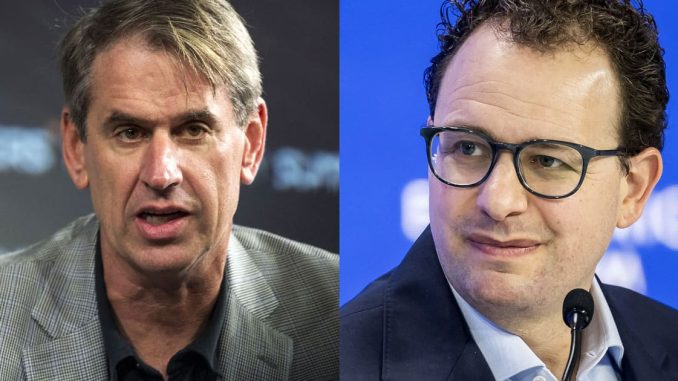
Venture capitalist Bill Gurley, one of the technology industry’s most influential investors, says he has developed a disturbing theory after spending weeks studying Anthropic, one of the world’s leading artificial intelligence companies.
According to Gurley, the threat may go far beyond concerns that major AI firms are seeking regulations to eliminate competition.
Instead, he fears some of the industry’s most powerful figures genuinely believe they are creating something akin to a digital deity.
“The more I dig, I’ve met people who I dare say think it’s their responsibility and they’re excited about building a species that’s superior to humans,” Gurley said during a recent episode of the “All-In Podcast.”
“I don’t think they think they’re writing software.
“I think they’re midwifing a deity here.”
‘Dr. Frankenstein’ Warning Raises Alarm
Gurley said his concerns intensified after examining public statements and writings from Anthropic CEO Dario Amodei and other senior executives.
He described what he calls the “Dr. Frankenstein theory” as even more alarming than accusations that AI companies are pushing regulations to crush competitors and consolidate power.
“The second theory, I call the Dr. Frankenstein theory,” Gurley said.
“And I don’t know which one I’m more afraid of.”
The investor pointed specifically to Amodei’s 2024 essay, Machines of Loving Grace, which outlines potential futures shaped by increasingly powerful artificial intelligence systems.
One section of the essay discusses the possibility of AI systems distributing resources and determining economic outcomes.
“He says, ‘It could be a capitalist economy of AI systems which then give out resources to humans based on some secondary economy of what the AI systems think makes sense to reward in humans,’” Gurley said.
“So that’s envisioning a deity of sorts that’s going to break ties and decide what humans do.”
For critics of unchecked AI development, such statements reinforce concerns that unelected technologists are openly discussing a future where machines wield unprecedented authority over human society.
Growing Fears of a Post-Human Future
Anthropic has never stated that it intends to create an AI ruler or “digital god.”
However, Gurley argues that many of the company’s leaders appear to view artificial general intelligence (AGI) as something far more transformative than conventional software.
The comments come amid growing warnings from religious leaders, ethicists, and technology critics about the rise of transhumanist thinking within the AI industry.
Anthropic co-founder Chris Olah recently appeared alongside Pope Leo XIV during the presentation of the pope’s new encyclical on artificial intelligence and humanity.
The pontiff warned against efforts to move society toward a transhuman or post-human future, instead emphasizing the unique value and dignity of human beings.
Olah acknowledged that questions surrounding AI extend far beyond engineering.
“The machinery that makes this possible is the work of math and programming and science,” Olah said.
“But what character we choose, how it interacts with the world, how it ought to interact with the world — these are more clearly questions for the humanities, for religion, for philosophy, for society at large.”
Trump Ally Raises Monopoly Concerns
The concerns voiced by Gurley were echoed by several co-hosts on the “All-In Podcast,” including former Trump AI and cryptocurrency czar David Sacks.
Sacks argued that Anthropic’s repeated calls for stronger AI regulations could ultimately benefit the company by restricting rivals.
“If you brand yourself as the safe AI company and then try to characterize everybody else as a reckless player and reckless AI needs to be stopped, you can see how this would basically further your monopolistic control over this industry,” Sacks said.
Podcast host Jason Calacanis went even further, suggesting some AI leaders view themselves as creators of a new superior intelligence.
“They believe that they’re so powerful, these individuals, that they can create God,” Calacanis said.
WATCH:
AI Industry Races Toward Unprecedented Power
Anthropic has consistently defended its push for AI safeguards.
Amodei has argued that stronger oversight is necessary because leaving advanced AI development entirely in the hands of private companies could concentrate enormous power among a small group of individuals.
“This is one reason why I’ve always advocated for responsible and thoughtful regulation of the technology,” Amodei said during a 2025 interview.
The company has also highlighted previous decisions to delay public releases of advanced AI systems due to safety concerns.
Yet critics remain unconvinced.
As artificial intelligence systems become increasingly powerful, concerns continue to grow that a small group of Silicon Valley elites may be steering humanity toward a future that most people never voted for, never consented to, and may not fully understand until it is too late.
The warnings come at a pivotal moment.
Anthropic recently confirmed that it has confidentially filed paperwork with the Securities and Exchange Commission, a major step toward what could become one of the largest public offerings in history.
With billions of dollars flowing into the AI race and the technology advancing at breakneck speed, questions about who controls these systems and what their creators ultimately intend to build are becoming increasingly difficult to ignore.












Be the first to comment