
Article By David Hawkins
California Gov. Gavin Newsom is pushing a controversial proposal to impose a 100% state tax on any California resident who receives money from President Donald Trump’s newly established Anti-Weaponization Fund, escalating the political battle over the program as Democrats move to block its implementation.
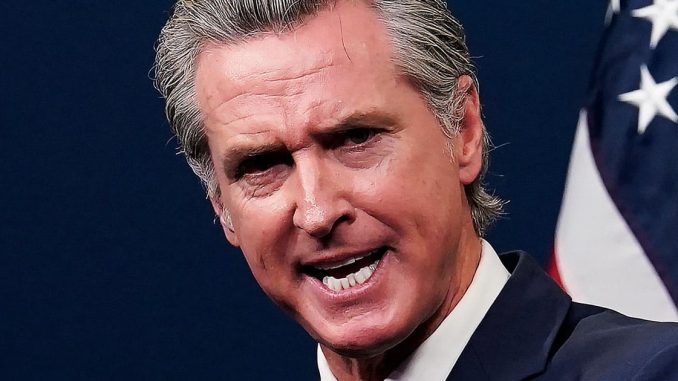
Newsom unveiled the proposal during a Wednesday press conference, arguing that California should prevent victims of Democrat lawfare from benefiting from payments distributed through the fund.
“Anyone from California that receives any of those funds,” Newsom said.
“We want to tax 100% of those proceeds, and that’s an action the state of California can take.
“It’s an action we look forward to taking.”
The proposal immediately drew criticism from conservatives, who accused the governor of using state tax policy to punish individuals based on political considerations.
Newsom Targets Trump-Backed Fund
The dispute centers on the Justice Department’s newly announced $1.776 billion Anti-Weaponization Fund, which was established as part of a settlement involving President Trump and the Internal Revenue Service.
Supporters of the fund argue it provides a pathway for Americans who believe they were unfairly targeted by the federal government to seek compensation.
Critics, including Newsom and other Democrats, have attacked the program, claiming it could benefit individuals who were charged or convicted in connection with the January 6 protest at the U.S. Capitol.
Newsom amplified those concerns in a post on X.
“He pardoned all of those folks that were beating up cops and absolved them, providing them 1.776 billion dollars,” Newsom wrote.
“So not only do you get a pardon, you get rewarded.
“That’s why this is needed.”
The governor’s proposal would effectively confiscate any payments distributed to California residents through the fund.
Republicans Accuse Newsom of Double Standards
Conservatives quickly pointed to the double standard, noting that Newsom has defended the use of taxpayer funds for politically charged initiatives in California.
Among those efforts was a $25 million legal fund backed by Newsom to fight actions taken by the Trump administration.
California Senate Minority Leader Brian Jones previously criticized that program as a political “slush fund.”
Newsom has also faced scrutiny over California’s handling of billions of dollars in pandemic-era spending.
Investigations into the state’s COVID-19 contracting practices found that large emergency contracts were awarded to politically connected firms, donors, and well-connected insiders, raising concerns about transparency and oversight.
California Faces Growing Fiscal Pressures
The proposal comes as California faces mounting financial challenges.
State officials are projecting a $2.9 billion budget shortfall for fiscal year 2027, while several major state projects continue to face cost overruns.
Among the most prominent examples is California’s long-delayed high-speed rail project, which has seen costs soar far beyond original estimates.
The state has also faced criticism over other expensive infrastructure projects, including a wildlife crossing project that Transportation Secretary Sean Duffy recently mocked as a “bridge to nowhere” after costs reportedly exceeded budget projections by $21 million.
Critics argue Newsom’s latest proposal is designed as much for national political positioning as state policy, particularly as speculation continues regarding a potential 2028 presidential campaign.
Democrats Expand Effort to Block Fund
California is not the only place where Democrats are seeking to challenge the Anti-Weaponization Fund.
Following the Justice Department’s announcement, Democrat lawmakers in New York introduced legislation aimed at blocking the program, while a Connecticut state legislator proposed imposing a similar 100% tax on any proceeds distributed through the fund.
The growing push highlights how the program is rapidly becoming another flashpoint in the broader political battle between the Trump administration and Democrat officials across the country.
Neither the White House nor Newsom’s office provided additional comment on the dispute following the governor’s remarks.












Be the first to comment