
Article By Frank Bergman
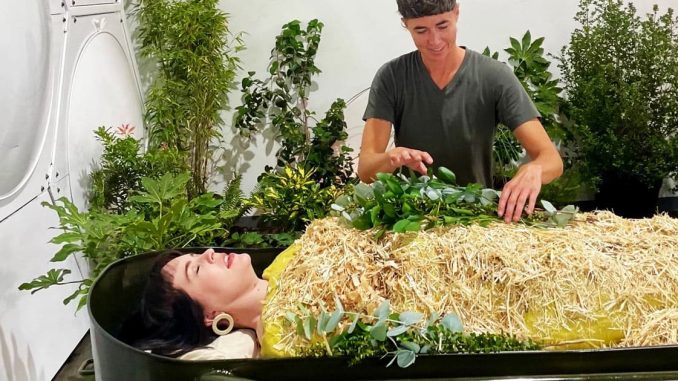
Oklahoma lawmakers are advancing a chilling plan to begin using decomposed human remains as soil fertilizer to grow food for public consumption.
Despite a widespread backlash, the state is pushing forward with controversial legislation to legalize “human composting.”
The move is igniting outrage from conservatives who warn that the state is adopting policies long associated with radical blue-state agendas.
The Oklahoma State House passed HB 3660 in a 59–37 vote, advancing a measure that would classify “natural organic reduction” (NOR), commonly referred to as human composting, as a form of cremation under state law.
Conservatives Warn of ‘Disturbing’ Shift
State Rep. Jim Shaw (R-OK) blasted the bill, warning it represents a fundamental departure from conservative principles.
“Today, the House advanced HB3660, a bill to legalize the use of composted human bodies as fertilizer,” Shaw said.
“If this bill is put into law, Oklahoma joins 14 BLUE states that have legalized this process.
“So, instead of outlawing this type of practice outright, we’re on track to take the use of humanure as fertilizer another disgusting step forward.”
Republican Lawmakers Lead the Push
The bill is sponsored by State Rep. Eddy Dempsey (R-OK) and State Sen. Casey Murdock (R-OK), both representing rural districts.
Despite Oklahoma’s Republican supermajority, the legislation passed with support from 43 GOP lawmakers.
Thirty-six Republicans and one Democrat voted against it.
Oklahoma House Speaker Kyle Hilbert (R-OK) also backed the measure.
Heated Exchange on House Floor
Shaw confronted Dempsey directly before the vote, pressing him on whether human remains should be used as fertilizer.
“I just gotta ask, do you really believe that human remains, or even my favorite subject, human poop, are okay as compost or fertilizer?” Shaw asked.
“Do you really believe that?”
“In this situation, yes,” Dempsey replied.
So, this was my day today…
— Jim Shaw (@ShawForOK) March 24, 2026
Today the House advanced HB3660, a bill to legalize the use of composted human bodies as fertilizer. If this bill is put into law, Oklahoma joins 14 BLUE states that have legalized this process. So, instead of outlawing this type of practice… pic.twitter.com/CSo47cYw4D
Shaw later warned that the vote exposes a deeper ideological shift inside the state legislature.
“This is not a conservative policy at all, but it is being passed by a supposed conservative legislature in Oklahoma that’s really not nearly as conservative as what they claim to be,” he said.
Following the Blue-State Playbook
If signed into law, Oklahoma would join a list of states, including California, New York, Oregon, and Washington, that have already legalized human composting.
Notably, those states are overwhelmingly Democrat-controlled or left-leaning.
The measure now heads to the Oklahoma State Senate, where conservatives hope it will be blocked.
“On the Senate side, we have a stronger conservative group of senators, and so it is possible, and hopefully likely… that the Senate will kill it,” Shaw said.
Expanding ‘Humanure’ Practices
Shaw also warned that the bill builds on existing practices involving biosolids, often referred to as “humanure,” already used as fertilizer in parts of Oklahoma.
“They’ve been spreading ‘humanure’ aka biosolids on Oklahoma farmland for decades,” he said.
“This bill is throwing in composted human remains to be used as fertilizer.
“This bill would take that practice to another level. It’s disturbing to say the least.”
They mean BODIES, not just 💩
— Brandy (@_mind_your_biz) March 25, 2026
Just so everyone is clear 😭 pic.twitter.com/5XfAIer9th
What the Bill Allows
Under NOR, human remains are placed in controlled containers with organic materials like wood chips and straw, where they decompose over several weeks into soil.
Families can then use the resulting material for gardens, trees, or other purposes.
What Comes Next
The bill now faces a critical test in the State Senate, and potentially the desk of Republican Gov. Kevin Stitt, whose position on the legislation remains unclear.
For critics like Shaw, the stakes go beyond one bill.
“We are absolutely moving in the wrong direction on both of those issues,” he said.
As the debate continues, the legislation has become a flashpoint in a broader fight over whether conservative states will hold the line or begin adopting policies once confined to the political Left.














Be the first to comment