
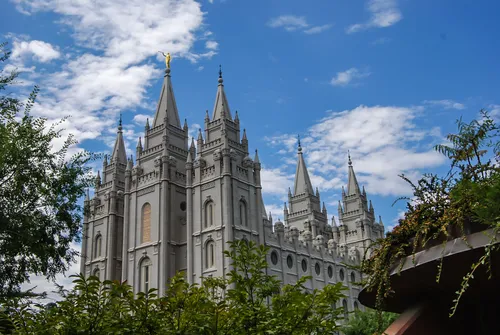
Original Article By John Stonestreet and Timothy D Padgett
The hours and days following the horrifying murder and arson at a Latter-day Saints church service in Michigan was not the time to parse theological identities. However, many used the tragedy as an opportunity to offer their answer to a question that has grown in importance and controversy in recent years: “Are Mormons truly Christian?”
Pew Research lists Latter-day Saints among “All Christians,” along with Protestants, Roman Catholics, Orthodox, and Jehovah’s Witnesses. Mormons not only call themselves Christian, it’s in their name, “The Church of Jesus Christ of Latter-day Saints.”
However, to borrow from Shakespeare, naming a flower a rose doesn’t make it smell just as sweet. Though Mormonism uses similar concepts and terms as Christianity, what is meant is often very different from what Christianity teaches. As Lukus Counterman put it at The Gospel Coalition, “While both Mormons and historic Christians believe in ‘Jesus Christ,’ they’re referring to different people.”
Mormonism began in the early nineteenth century on what was then the American frontier. So many new religious groups were sparked in that part of New York state, the region became known as the “burned-over district.” Many of these new movements claimed to know what everyone else in church history had missed.
While many of these groups added or subtracted from biblical teaching, Joseph Smith claimed to have received a series of expansive visions that completely rewrote the script on Christianity. While Marcion in the second century and Thomas Jefferson in the nineteenth subtracted what they didn’t like from the Bible, Smith crafted Mormon doctrines by adding three books, each with concepts unlike anything in the Bible. This led to a reimagined understanding of God from anything that Christians have preached since the Apostles. In fact, the Mormon view of God is even more extraordinary than the more notorious aspects of Mormon doctrine and practice, including special undergarments, polygamy, and that the Garden of Eden was in Missouri.
Mormon theology is simply incompatible with the Christian understanding of God. Christians see God as eternally existing from before all time and creation. Mormons claim God has not always been as He is. As Joseph Smith put it in a sermon in 1844,
God himself was once as we are now, and is an exalted man, and sits enthroned in yonder heavens! That is the great secret. … I say, if you were to see him today, you would see him like a man in form. … I am going to tell you how God came to be God. We have imagined and supposed that God was God from all eternity. I will refute that idea, and take away the veil, so that you may see.
Further, in Mormonism, the Godhead is made of three distinct beings, or three gods. Their unity is “one of purpose,” but not, as the Christian doctrine of the Trinity clarifies, of one nature.
Another key difference is who and what Jesus is. Christianity has always taught that Jesus is the eternal Son of God, a full member of the Trinity, “begotten not made.” He has always existed, but at the Incarnation He took on flesh and came to Earth, remaining then and now as fully God and fully man. In Mormonism, Jesus is God’s natural son, the offspring of the Father and a “Heavenly Mother.” All human beings are also God’s children in this way, according to Mormon doctrine, having lived in heaven before our conception and birth.
In other words, Mormons and Christians hold different and incompatible views about God, Jesus, humans, sin, salvation and the church.
As many people can attest, Mormons are often wonderful people. Despite some oddities, like not being able to drink coffee, they are often moral allies in an increasingly immoral society. However, Mormonism is not Christian, because Mormons and Christians do not worship the same God. As a friend often says, this is a case in which sharing vocabulary does not mean sharing a dictionary. Sharing certain convictions of morality does not imply sharing a theology, Christology, anthropology, soteriology, ecclesiology, or eschatology. Watering down the truth is not only unhelpful, it is an insult to both groups.



Be the first to comment