
Article By David Hawkins
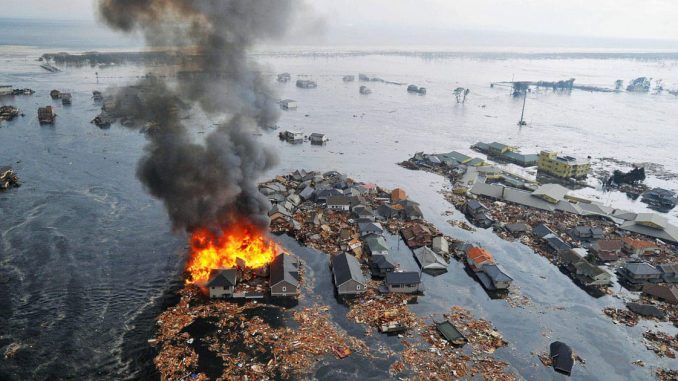
Scientists continue to monitor a massive unstable section of Spain’s Cumbre Vieja volcano over concerns that a future collapse into the Atlantic Ocean could generate a tsunami capable of reaching the United States.
The scenario centers on the western flank of La Palma in the Canary Islands, where a steep rock mass estimated in some studies at hundreds of cubic kilometers showed signs of partial detachment during a 1949 eruption.
Researchers in the 1990s documented the material moving slowly toward the sea at roughly 0.4 to 0.8 inches per year.
In a recent BBC Science Focus article, volcanologist Bill McGuire wrote:
“Based on extensive studies, I expect this part of the flank will eventually crash into the North Atlantic, launching a megatsunami in the process.
“I have no doubt this will be a cataclysmic event, but have no idea when it will happen — it could easily be centuries or even millennia down the line,” McGuire added.
Worst-Case Models Project Waves Reaching Florida Within Nine Hours
Early computer models examining a single, massive flank collapse projected that water near La Palma could be displaced by nearly 0.6 miles.
Some projections estimated that waves around 65 feet high could reach Florida roughly nine hours later.
Other estimates put potential wave heights along broader sections of the U.S. East Coast at about half that height.
Tsunami waves can travel across open ocean at speeds approaching those of commercial jet aircraft.
Research by Steven Ward and Simon Day in 2001 modeled collapse volumes between 150 and 500 cubic kilometers moving at speeds near 224 mph.
Their work suggested waves of roughly 33 to 82 feet could reach the Americas.
Some geologists have pointed to huge boulders along Bahamian shorelines as potential evidence of ancient Canary Islands tsunamis.
That interpretation remains disputed.
‘Megatsunami’ could reach US East Coast in just hours after catastrophic volcano collapse in Spain, scientist claims https://t.co/JhyW7MmBwg https://t.co/UmooKeKiNo
— Daily Mail US (@Daily_MailUS) November 6, 2026
USGS Says Earlier High-End Predictions Overstate Threat
The U.S. Geological Survey and other researchers have concluded that the original high-end projections overstated the threat to the United States.
Ocean-floor mapping indicates that historic collapses in the Canary Islands occurred through multiple smaller events rather than one massive, coherent slab entering the Atlantic at once.
Later modeling that accounts for energy loss, ocean-floor topography, and wave interactions estimates worst-case wave heights along the U.S. East Coast at roughly 3 to 7 feet.
Researchers have also found no distinctive tsunami sediment deposits on the eastern coasts of North or South America that would establish a pattern of repeated Atlantic-crossing megatsunamis from the Canary Islands.
Slope-stability studies conclude that Cumbre Vieja is currently stable.
They argue that it would require substantial additional growth before a major collapse becomes more likely.
The greatest danger from any significant collapse would fall on La Palma and nearby islands.
McGuire said any large failure would likely be preceded by measurable increases in seismic activity and ground deformation.












Be the first to comment