
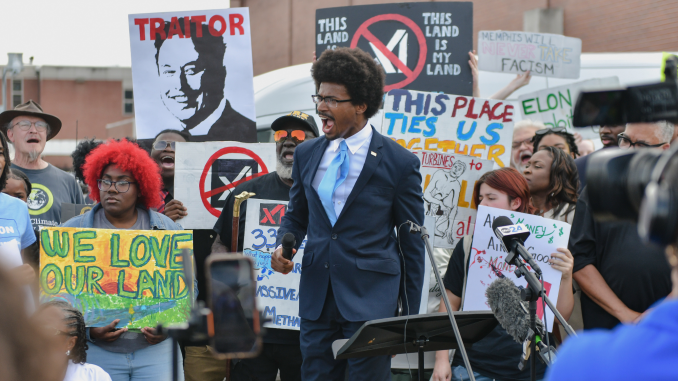
Article By Sophie Hurwitz
Tennessee Rep. Justin Pearson—running to flip a key midterm seat—will be locked out of a meeting that could pause new xAI data centers in Memphis.
Tennessee state Rep. Justin J. Pearson, a congressional candidate and high-profile opponent of local data center sprawl, filed suit Thursday against his hometown’s City Council after the council threw him, his brother, his mother, and other locals out of a meeting earlier this month for protesting delays to a vote on a data center moratorium—and then banned them from future city council meetings.
Pearson will now be locked out of a particularly important meeting on October 20, when the council will finally hold that data center moratorium vote. He and his five co-plaintiffs, including a high school senior involved in the protest, argue that the two-month ban from city council violates their first amendment rights to free expression.
“Every person, whether you disagree with them or not, is entitled to speak their opinion and give their ideas in public forms,” Pearson wrote in a press release October 15. “There is no right that gives a City Council chairwoman or anyone else the ability to go beyond the bounds of Tennessee law and the United States Constitution to discriminate or retaliate against those who do not agree with their actions.”
Pearson, elected in 2023 to the Tennessee House of Representatives, became known nationally in 2023 as one of the “Tennessee Three,” when he was removed from office for violating “decorum rules” after co-leading a personal protest for gun reform on the statehouse floor. He later won back his seat in a special election. Now Pearson is running for Congress in a freshly gerrymandered congressional district, seeking to woo a district where Republicans now have an estimated nine-point advantage, according to the Cook Political Report.
Pearson has made opposition to Elon Musk’s Memphis-area xAI data centers and their polluting onsite gas plants a cornerstone of his campaign. xAI has installed 59 gas turbines in Memphis to power its data centers, as Reuters recently found. People living near the site say they’re plagued with poor air quality and constant noise.
On October 6, Pearson attended the city council meeting where the data center moratorium vote was pushed back for the second time this year, and where the scheduled public comment period was canceled, leading chants of protest as police officers tried to remove people from the chamber, Memphis’ Fox News affiliate reported.
About 200 other people attended the protest.
To Pearson, the city council’s actions constitute an “ongoing pattern of intimidation.” With the moratorium vote approaching next week, he told Mother Jones he’s urging them to resolve the issue. “Our right to attend Council meetings should be restored and these bans rescinded,” he said. “I welcome an opportunity to meet to discuss how we move forward with protecting the First Amendment rights of the people as a priority, especially as we stand up against these hyperscale data centers.”
The city council policy under which Pearson was banned says that “members of the audience and persons addressing the council will not be permitted to engage in gossip, make defamatory, personal, slanderous, or profane comments or use abusive or vulgar language.” That, the plaintiffs’ lawyers argue, is a vague attempt to “suppress disfavored viewpoints, particularly criticism directed at City Council and its officials.”
“While they’re working to keep us out of city council meetings, neighbors in Westwood and Boxtown are still dealing with the impacts of having xAI in their community,” said Amber Sherman, a local political organizer who was banned from the meeting alongside Pearson.
As I wrote in August, data center backlash isn’t strictly a left-of-center issue. And that matters for Pearson, who—having stayed in the race after a Trump-backed redistricting went into effect in May—is running as an unabashed progressive in a Trump-leaning district some analysts think is Tennessee Democrats’ best shot at a flip.
The backlash draws on a current of populism—and suspicion of big companies, and fear of AI-prompted job loss—that goes beyond party boundaries. Opposition to data center buildout is nearly as high among Republicans as it is among Democrats.
That fact could be good news for Pearson. His Memphis-based district had a Democratic-voting, majority Black population, but the district was splintered and redrawn by Republican officials this year following a Supreme Court ruling that gutted the federal Voting Rights Act.
Pearson’s anti-data-center positions could play well with the rural, white, Republican-leaning voters who now make up part of his district.
Musk began building data centers in Memphis—and gas turbines to power them—in 2024.
“Before data centers were all the news every single day, our community was fighting Elon Musk,” Pearson said at a press conference this summer. People like SpaceX’s billionaire owner, Pearson said, “view these communities as sacrifice zones.”












Be the first to comment