
Article By Malayna Bizier
Euthanasia is federally legal in Australia, Belgium, Canada, Colombia, Ecuador, Luxembourg, the Netherlands, New Zealand, Portugal and Spain, with several countries on the coattails. Belgium, Canada, and the US – among others – sanctioned record-high numbers in recent years. Even World Population Review asserts, “Euthanasia is trending toward increased legality worldwide.”
In the US, 13 states–California, Colorado, Delaware, Hawaii, Illinois, Maine, Montana, Maine, New Jersey, New Mexico, New York, Oregon, Vermont, Washington State–and Washington, DC, sanction medically assisted dying and lawmakers in over a dozen additional states are moving to follow.
Death at Our Disposal
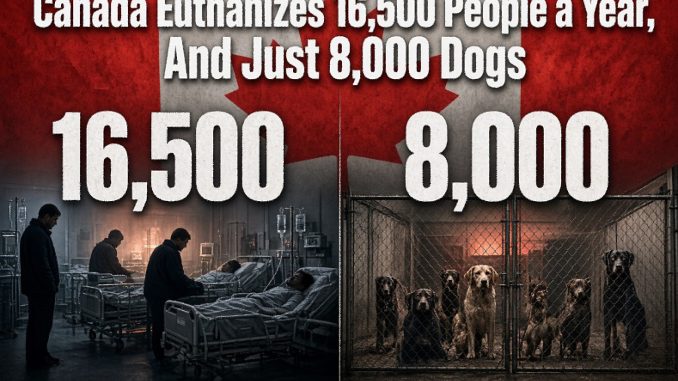
Canada euthanized 16,499 people in 2024. It euthanized less than 8,000 dogs.
Canada’s law, which is setting the curve for assisted suicide legislation around the world, makes citizens eligible for so-called “Medical Assistance in Dying” (MAID) if they meet the following criteria:
*Be a “mentally competent” and adult
*Have a “grievous and irremediable” condition
*Provide informed consent
But there is ample and grievous subjectivity in these words -– purposefully–so.
What classifies as “mental competence,” exactly? If a young man suffering from chronic depression and long-term homelessness decides he wants to take his own life, should society support him?
“Grievous and irremediable” is even more vague. Just because an illness cannot be cured does not make it terminal. Under Canada’s definition, an 18-year-old diabetic could opt for MAID in the same way as an 80-year-old in the end stages of Lou Gehrig’s Disease. But neither eliminates the ever-present value and potential of life.
Against the Odds
Take Morrie Schwartz, for example. Schwartz wrote his book “Morrie: In His Own Words” as he endured Lou Gehrig’s Disease, passing away at age 78 in 1995. His books have sold over 40 million copies and counting.
Similarly, Jane “Nightbirde” Marczewski won a Golden Buzzer on “America’s Got Talent” in 2022, boldly proclaiming the messages of positivity and presence amid a four-year cancer battle that took her life shortly after she took the stage. Her performance of the original song “It’s OK” has been viewed dozens of millions of times across streaming platforms.
And “Jeopardy!” host Alex Trebek inspired hearts across the globe with his composure and kindness on stage as he battled end stage pancreatic cancer in 2020.
Canada’s legislation and its wording only inspire despair, in a damning, slippery slAnd make no mistake, this wording is not accidental.
Ulterior Incentives
“The cost of euthanasia pales in comparison to how much money it saves the Canadian medical system, a fact that may be driving the movement to further liberalize euthanasia,” reported the Catholic Register in September 2026. “Thanks to a report published by the Parliamentary Budget Officer in 2020, Canadians already know that in 2021 alone, the country’s medical system saved an estimated $149 million because of MAID’s widespread availability” – publicly funded by the country’s taxpayers.
A 2024 report, cited by National Catholic Register, “also raised questions about the practice’s implementation, finding that more than half of MAID cases reviewed in the province involved errors requiring follow-up inquiries, including hundreds that raised compliance concerns.”
But these issues have begun to extend further into long-term healthcare.
The MAID program is framed by the Canadian establishment as part of end-of-life treatment, and roughly 75% of MAID recipients in 2024 received palliative care. But when culture combines care with convenience, the omnipresent value of life is too-easily forgotten.
Homing into Hospice
National Catholic Register wrote of ongoing, systemic fraud within for-profit hospice centers in July, including a $27-million scheme in Los Angeles, California. It reported,
“Hospice leaders and other experts say the flood of such hospice scandals is symptomatic of a profit-driven mindset that has taken hold in what is now a $31-billion-a-year industry, moving hospice farther and farther away from its roots as a Christian work of mercy predicated on the fundamental dignity of human life.”
When respect for life is not black and white, the grey gets muddy.
The outlet cited a Penn LDI study that found, “nonprofit hospice agencies generate yearly profit margins of roughly 5%-6%, compared with about 18%-22% among for-profit private-equity or publicly owned agencies.” One physician involved in the research, Dr. Ira Byock, said, “I am not against for-profit hospice care.” He added,
“I’m an American and a capitalist. I think there is a place for for-profit hospice care, but those programs must succeed by delivering consistently high-quality care and, unfortunately, that’s not what we’ve seen.”
The Register stated,
“The abuses uncovered within parts of the hospice industry have not only harmed patients and families; they have also damaged trust in providers that remain committed to hospice’s original mission of respect for human dignity.”
What’s more, the high-quality programs are under apparent attack. For example, in New York, which established its own MAID Act on August 5th, a group of hospice nuns had to take legal action to resist submitting to the state’s “Long‑Term Care Facility Residents’ Bill of Rights.” This has nothing to do with true quality of care, yet it threatened the 125-year-old organization with both fines and imprisonment.
But, as nurse and Sister Maria of the Trinity asserted, “You can’t throw the baby out with the bathwater.”
A Slope, Not a Line
Many assisted suicide proponents in the US have assured lawmakers that their proposed legislation is “not a slippery slope.” But if not a slope, where is the line?
Where was the line when Spain euthanized 25-year-old Noelia Castillo Ramos despite her lack of terminal illness and father’s pleading claims that she was not mentally capable of providing informed consent?
Where was the line when Canada euthanized hospice patient Brigitte “GG” Stegemann despite her alleged lack of consent and Christian faith?
We’ve entered a time in which, quietly, death has become part of end-of-life “care.”
And then there’s assisted suicide doctors such as Ellen Wiebe, who laughed in the face of her hundreds of victims and their families.
Canada’s 2024 report states that of the 22,535 MAID requests 692 were withdrawals. This begs the question: How many of the deceased may have withdrawn their requests under different circumstances – if they understood their options, had affordable access to proper hospice care, and better-yet knew how valued their lives truly are? At any age, at any stage.
Final Appeals
America’s hospice system needs help, but that help will never come from assisted suicide.
The solution to suffering can never be suicide.
Research cited by Behavioral Health News says, “every suicide affects an average of five family members and up to 135 community members.” It found that suicide-loss survivors have an increased risk of nausea, insomnia, headaches and heart disease; and one polling study concluded, “nearly one-quarter endorsed symptoms of depression, 18% endorsed anxiety, and 27% posttraumatic stress.”
There’s a famous quote that explains this: “Death doesn’t ‘happen’ to you, but to everyone around you.”
If we ever want to turn these tides, we must support the organizations doing things right. We must actively oppose any idea, movement, or legislation that threatens the well-being of our most vulnerable, to and through the conversion of their natural, honorable passing.
We must usurp this virus before it further spreads and establish a culture of life – never of death.












Be the first to comment