
Article By David Lindfield
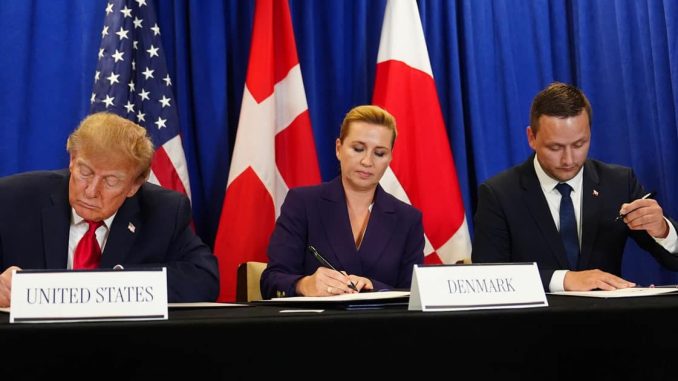
President Donald Trump signed a sweeping agreement with Denmark and Greenland that will expand America’s military presence across the strategically vital island, block non-NATO adversaries from establishing bases there, and remain in force even if Greenland becomes independent.
The agreement was signed Tuesday on the sidelines of the United Nations General Assembly in New York following months of negotiations between officials from the United States, Denmark, and Greenland.
“This is tremendous for Europe and for the United States and for everybody,” Trump said before the signing.
“And for Greenland, it’s going to be incredible.”
The deal eases tensions following Trump’s concerns about growing Russian and Chinese activity in the Arctic.
U.S. to Build Two ‘Very Major Military Bases’
Addressing the United Nations General Assembly before the signing, Trump said the United States would “immediately begin the process of developing a large military presence in the appropriate locations.”
That expansion will include “building two very major military bases,” Trump said.
The agreement allows Washington to “modernize and expand” its operations at Pituffik Space Base in northwestern Greenland, where approximately 200 U.S. troops currently support missile warning, missile defense, and space surveillance missions for America and NATO.
The United States can also establish “defense areas” at Narsarsuaq in southern Greenland and Mestersvig in the east.
The agreement further provides that Washington “may establish additional defense areas in Greenland and strengthen its military operations or facilities.”
American forces will receive broad mobility across Greenland’s territory, including “undersea access.”
Contracts for constructing, operating, maintaining, or dismantling bases will be awarded “to Greenlandic sources to the maximum extent possible.”
Non-NATO Powers Blocked From Establishing Bases
The accord prohibits any non-NATO country from establishing “its own manned or unmanned military installations in Greenland” without the consent of the three signatories.
Non-NATO powers will also be barred from maintaining a “persistent” military presence unless the United States, Denmark, and Greenland agree otherwise.
Trump previously argued that the United States needed to “take Greenland” to prevent Russia or China from doing so first.
Although he said he preferred to “make a deal” for the territory, Trump also warned that “one way or the other, we’re going to have Greenland.”
Approximately two-thirds of Greenland lies inside the Arctic Circle, where receding sea ice has opened additional shipping routes.
The island’s mineral resources and strategic position have made it increasingly important to American national security.
The United States once maintained thousands of troops across 17 Greenland bases and installations. That presence has steadily declined since 1945, leaving Pituffik as America’s principal remaining outpost.
Agreement Will Survive Greenlandic Independence
The accord “does not have an end date.”
If Greenland chooses independence from Denmark, it must agree to remain in NATO and assume Denmark’s rights and obligations under the agreement.
Danish Prime Minister Mette Frederiksen described the accord as a “deal that can last forever” and said it would benefit the United States, Greenland, Denmark, and the NATO alliance.
“Mr. President, you have been very clear: You don’t want adversaries to come too close,” Frederiksen told Trump. “I fully agree.”
Greenlandic Prime Minister Jens-Frederik Nielsen called it “a win-win-win agreement.”
“Your security is our security,” Nielsen said, “and our security is your security.”
NATO Secretary General Mark Rutte also praised the agreement.
“This agreement, along with NATO’s growing role in securing this vital region, enhances our collective security and supports a safer and more stable future for us all,” Rutte wrote on X.
Greenland Gains ‘Bigger Seat at the Table’
The months-long standoff over Greenland’s future strained relations within NATO and alarmed some of the island’s approximately 56,000 residents.
“A lot of trust has been tested, I would say,” Naaja Nathanielsen, one of Greenland’s two lawmakers in the Danish parliament and a former government minister, told The Associated Press.
“It’s been really difficult in Greenland, and people have been generally afraid and worried about everything, from losing our country to our livelihoods and so on.”
Nevertheless, Nathanielsen praised the agreement as “a huge step in the right direction” and the first binding international accord Greenland has signed as a country.
“For us, that is a huge step forward in our quest for more self-autonomy and a bigger seat at the table,” Nathanielsen said.












Be the first to comment