
Article By Iranintl
ran is preparing to issue a new compulsory hijab directive for universities, a senior official said Tuesday, as hardliners intensify pressure on women over mandatory veiling ahead of the anniversary of Mahsa Amini’s death in morality police custody.
Saeed Karami, deputy for cultural and political affairs at the Office of the Supreme Leader’s Representative in Universities, said the directive had been drafted and would soon be issued by the ministries of Science and Health, which oversee most universities and medical schools.
Karami told the semi-official Mehr news agency that existing regulations on hijab were “very good” and only needed renewed attention.
Asked whether universities would receive a “hijab charter,” Karami said “directive” was a more appropriate term. He did not give details of the measures it would contain or specify when they would take effect.
“We will certainly not witness the bitter incidents that we sometimes see on the streets at universities,” he said, without elaborating.
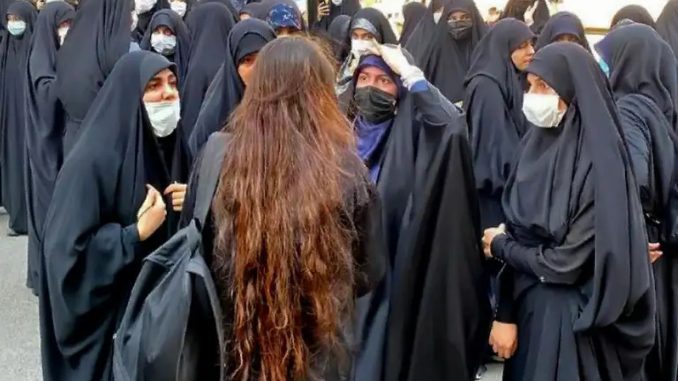
The planned directive comes amid a renewed push by hardline officials, clerics and government supporters to strengthen enforcement of compulsory hijab, four years after the death of Mahsa Jina Amini in morality police custody triggered the Woman, Life, Freedom uprising.
Women appearing in public without headscarves have since become commonplace in Tehran and other major cities, making rejection of compulsory hijab one of the most visible social changes to survive the 2022 protests.
Pressure has increased in recent weeks as hardliners demand implementation of the stalled Hijab and Chastity Law and criticize President Masoud Pezeshkian’s government for what they describe as a retreat on the issue.
Hardline lawmaker Mohammad-Taghi Naghd-Ali said Tuesday the government had backed down over hijab and accused it of failing to implement the legislation, describing compulsory veiling as one of the “foundations of the revolution.”
The more sweeping Hijab and Chastity Law remains suspended after the Supreme National Security Council instructed parliament not to promulgate it, Parliament Speaker Mohammad-Bagher Ghalibaf disclosed last year. The decision was widely seen as reflecting fears that aggressive enforcement could trigger renewed unrest.
Other signs of renewed pressure have appeared across Iran. The commander of the Revolutionary Guards in North Khorasan said this week that groups tasked with verbally warning women over their clothing were being revived, while pro-government gatherings demanding stricter hijab enforcement have been held in Qom, Birjand and Isfahan.
Iran International found last month that authorities had sealed at least 42 cafés, restaurants, shops, sports clubs and other businesses in 17 cities within three weeks over alleged violations of hijab rules and other Islamic norms.
Authorities have increasingly used business closures, judicial warnings and economic pressure rather than relying solely on the large-scale morality police patrols associated with enforcement before the 2022 uprising. Reports from inside Iran have nevertheless also pointed to renewed street warnings and patrol activity in several cities.
Universities have long been a particular focus of hijab enforcement and political control. Campuses became major centers of protest during the Woman, Life, Freedom uprising, and female students were among those who openly removed their headscarves in defiance of the state.
In April 2023, the Science Ministry said universities would not be required to provide educational, welfare and other services to students who refused to comply with hijab regulations. Female students were subsequently barred from campuses, summoned to disciplinary committees and in some cases suspended or expelled from dormitories.
At the University of Tehran, authorities later deployed women with seminary backgrounds to monitor students’ clothing, while students at several other institutions reported being photographed, having their student IDs recorded or being denied entry over their clothing.
At Tehran’s Amir Kabir University of Technology, students boycotted classes in 2024 after reports that more than 200 students had been barred from campus amid stricter dress-code enforcement. Similar pressure was subsequently reported at Tehran North Islamic Azad University.
Signs of renewed tension have emerged again this year. The Student Basij at Iran University of Science and Technology recently protested the presence of unveiled female students at an event attended by senior officials from the Science Ministry.
Despite successive enforcement campaigns, many Iranian women continue to appear without mandatory hijab in streets, cafés, shopping centers and other public spaces, maintaining a form of civil disobedience that has persisted since the Woman, Life, Freedom protests.












Be the first to comment